 Add to Chrome
 Add to Firefox
 Add to Edge
ActiveUltraFeedback: Efficient Preference Data Generation using Active Learning
Mar 10, 2026
Reinforcement Learning from Human Feedback (RLHF) has become the standard for aligning Large Language Models (LLMs), yet its efficacy is bottlenecked by the high cost of acquiring preference data, especially in low-resource and expert domains. To address this, we introduce ACTIVEULTRAFEEDBACK, a modular active learning pipeline that leverages uncertainty estimates to dynamically identify the most informative responses for annotation. Our pipeline facilitates the systematic evaluation of standard response selection methods alongside DOUBLE REVERSE THOMPSON SAMPLING (DRTS) and DELTAUCB, two novel methods prioritizing response pairs with large predicted quality gaps, leveraging recent results showing that such pairs provide good signals for fine-tuning. Our experiments demonstrate that ACTIVEULTRAFEEDBACK yields high-quality datasets that lead to significant improvements in downstream performance, notably achieving comparable or superior results with as little as one-sixth of the annotated data relative to static baselines. Our pipeline is available at https://github.com/lasgroup/ActiveUltraFeedback and our preference datasets at https://huggingface.co/ActiveUltraFeedback.

SimAB: Simulating A/B Tests with Persona-Conditioned AI Agents for Rapid Design Evaluation
Mar 01, 2026A/B testing is a standard method for validating design decisions, yet its reliance on real user traffic limits iteration speed and makes certain experiments impractical. We present SimAB, a system that reframes A/B testing as a fast, privacy-preserving simulation using persona-conditioned AI agents. Given design screenshots and a conversion goal, SimAB generates user personas, deploys them as agents that state their preference, aggregates results, and synthesizes rationales. Through a formative study with experimentation practitioners, we identified scenarios where traffic constraints hinder testing, including low-traffic pages, multi-variant comparisons, micro-optimizations, and privacy-sensitive contexts. Our design emphasizes speed, early feedback, actionable rationales, and audience specification. We evaluate SimAB against 47 historical A/B tests with known outcomes, achieving 67% overall accuracy, increasing to 83% for high-confidence cases. Additional experiments show robustness to naming and positional bias and demonstrate accuracy gains from personas. Practitioner feedback suggests that SimAB supports faster evaluation cycles and rapid screening of designs difficult to assess with traditional A/B tests.
Apertus: Democratizing Open and Compliant LLMs for Global Language Environments
Sep 17, 2025
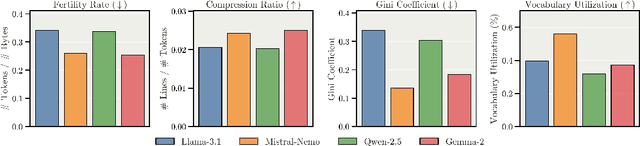

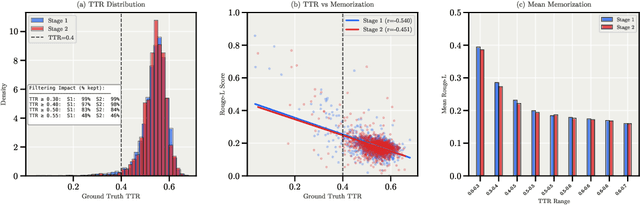
We present Apertus, a fully open suite of large language models (LLMs) designed to address two systemic shortcomings in today's open model ecosystem: data compliance and multilingual representation. Unlike many prior models that release weights without reproducible data pipelines or regard for content-owner rights, Apertus models are pretrained exclusively on openly available data, retroactively respecting robots.txt exclusions and filtering for non-permissive, toxic, and personally identifiable content. To mitigate risks of memorization, we adopt the Goldfish objective during pretraining, strongly suppressing verbatim recall of data while retaining downstream task performance. The Apertus models also expand multilingual coverage, training on 15T tokens from over 1800 languages, with ~40% of pretraining data allocated to non-English content. Released at 8B and 70B scales, Apertus approaches state-of-the-art results among fully open models on multilingual benchmarks, rivalling or surpassing open-weight counterparts. Beyond model weights, we release all scientific artifacts from our development cycle with a permissive license, including data preparation scripts, checkpoints, evaluation suites, and training code, enabling transparent audit and extension.