 Add to Chrome
 Add to Firefox
 Add to Edge
AIFL: A Global Daily Streamflow Forecasting Model Using Deterministic LSTM Pre-trained on ERA5-Land and Fine-tuned on IFS
Feb 18, 2026
Reliable global streamflow forecasting is essential for flood preparedness and water resource management, yet data-driven models often suffer from a performance gap when transitioning from historical reanalysis to operational forecast products. This paper introduces AIFL (Artificial Intelligence for Floods), a deterministic LSTM-based model designed for global daily streamflow forecasting. Trained on 18,588 basins curated from the CARAVAN dataset, AIFL utilises a novel two-stage training strategy to bridge the reanalysis-to-forecast domain shift. The model is first pre-trained on 40 years of ERA5-Land reanalysis (1980-2019) to capture robust hydrological processes, then fine-tuned on operational Integrated Forecasting System (IFS) control forecasts (2016-2019) to adapt to the specific error structures and biases of operational numerical weather prediction. To our knowledge, this is the first global model trained end-to-end within the CARAVAN ecosystem. On an independent temporal test set (2021-2024), AIFL achieves high predictive skill with a median modified Kling-Gupta Efficiency (KGE') of 0.66 and a median Nash-Sutcliffe Efficiency (NSE) of 0.53. Benchmarking results show that AIFL is highly competitive with current state-of-the-art global systems, achieving comparable accuracy while maintaining a transparent and reproducible forcing pipeline. The model demonstrates exceptional reliability in extreme-event detection, providing a streamlined and operationally robust baseline for the global hydrological community.

Understanding the Efficacy of U-Net & Vision Transformer for Groundwater Numerical Modelling
Jul 08, 2023
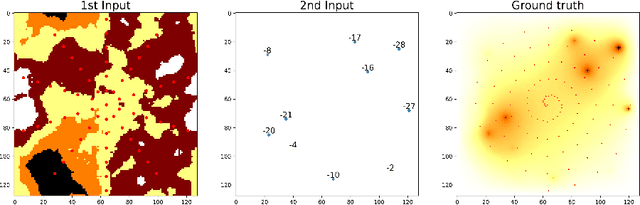
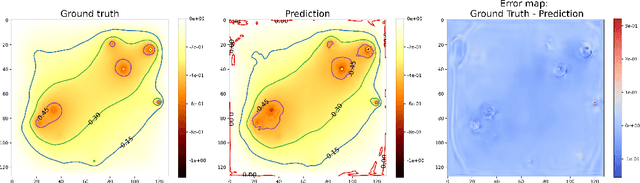
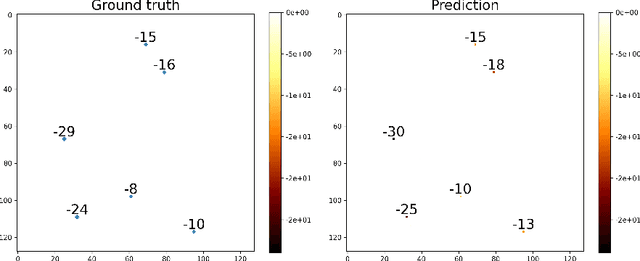
This paper presents a comprehensive comparison of various machine learning models, namely U-Net, U-Net integrated with Vision Transformers (ViT), and Fourier Neural Operator (FNO), for time-dependent forward modelling in groundwater systems. Through testing on synthetic datasets, it is demonstrated that U-Net and U-Net + ViT models outperform FNO in accuracy and efficiency, especially in sparse data scenarios. These findings underscore the potential of U-Net-based models for groundwater modelling in real-world applications where data scarcity is prevalent.
Attention U-Net as a surrogate model for groundwater prediction
Apr 09, 2022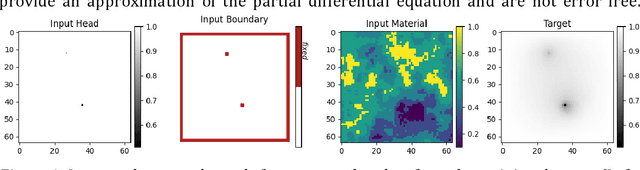
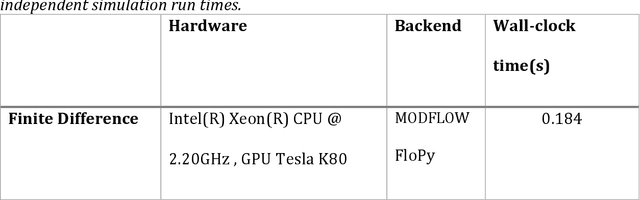
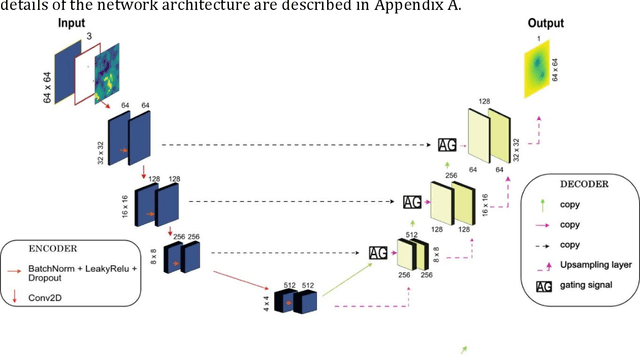
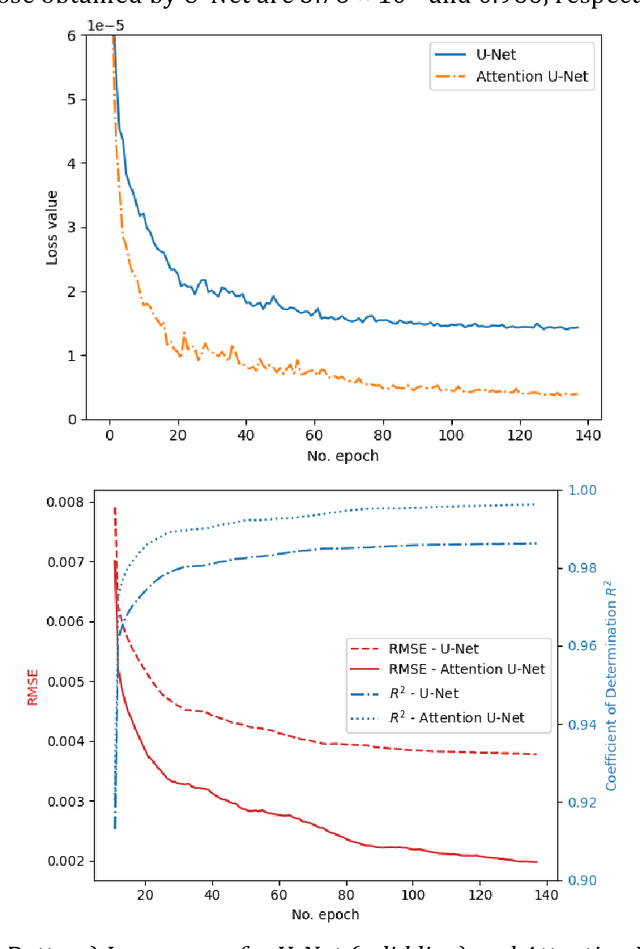
Numerical simulations of groundwater flow are used to analyze and predict the response of an aquifer system to its change in state by approximating the solution of the fundamental groundwater physical equations. The most used and classical methodologies, such as Finite Difference (FD) and Finite Element (FE) Methods, use iterative solvers which are associated with high computational cost. This study proposes a physics-based convolutional encoder-decoder neural network as a surrogate model to quickly calculate the response of the groundwater system. Holding strong promise in cross-domain mappings, encoder-decoder networks are applicable for learning complex input-output mappings of physical systems. This manuscript presents an Attention U-Net model that attempts to capture the fundamental input-output relations of the groundwater system and generates solutions of hydraulic head in the whole domain given a set of physical parameters and boundary conditions. The model accurately predicts the steady state response of a highly heterogeneous groundwater system given the locations and piezometric head of up to 3 wells as input. The network learns to pay attention only in the relevant parts of the domain and the generated hydraulic head field corresponds to the target samples in great detail. Even relative to coarse finite difference approximations the proposed model is shown to be significantly faster than a comparative state-of-the-art numerical solver, thus providing a base for further development of the presented networks as surrogate models for groundwater prediction.