 Add to Chrome
 Add to Firefox
 Add to Edge
AIFL: A Global Daily Streamflow Forecasting Model Using Deterministic LSTM Pre-trained on ERA5-Land and Fine-tuned on IFS
Feb 18, 2026
Reliable global streamflow forecasting is essential for flood preparedness and water resource management, yet data-driven models often suffer from a performance gap when transitioning from historical reanalysis to operational forecast products. This paper introduces AIFL (Artificial Intelligence for Floods), a deterministic LSTM-based model designed for global daily streamflow forecasting. Trained on 18,588 basins curated from the CARAVAN dataset, AIFL utilises a novel two-stage training strategy to bridge the reanalysis-to-forecast domain shift. The model is first pre-trained on 40 years of ERA5-Land reanalysis (1980-2019) to capture robust hydrological processes, then fine-tuned on operational Integrated Forecasting System (IFS) control forecasts (2016-2019) to adapt to the specific error structures and biases of operational numerical weather prediction. To our knowledge, this is the first global model trained end-to-end within the CARAVAN ecosystem. On an independent temporal test set (2021-2024), AIFL achieves high predictive skill with a median modified Kling-Gupta Efficiency (KGE') of 0.66 and a median Nash-Sutcliffe Efficiency (NSE) of 0.53. Benchmarking results show that AIFL is highly competitive with current state-of-the-art global systems, achieving comparable accuracy while maintaining a transparent and reproducible forcing pipeline. The model demonstrates exceptional reliability in extreme-event detection, providing a streamlined and operationally robust baseline for the global hydrological community.

GFN: A graph feedforward network for resolution-invariant reduced operator learning in multifidelity applications
Jun 05, 2024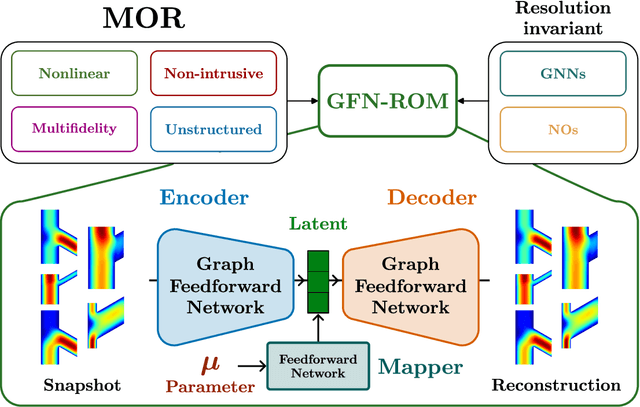
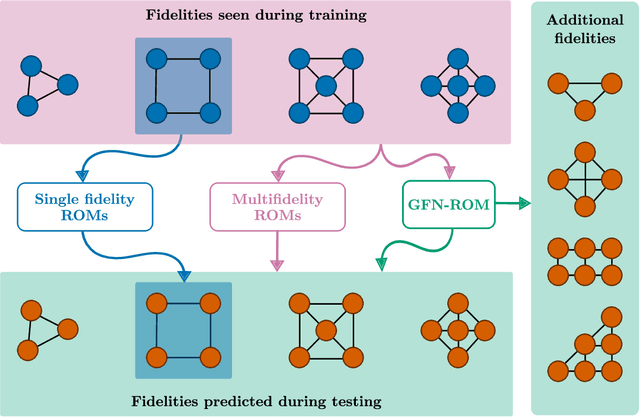

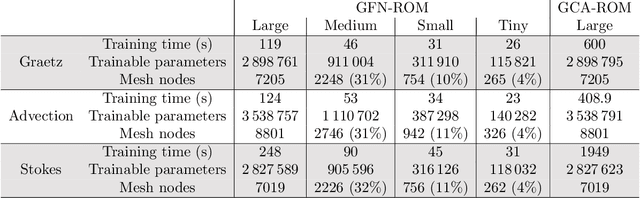
This work presents a novel resolution-invariant model order reduction strategy for multifidelity applications. We base our architecture on a novel neural network layer developed in this work, the graph feedforward network, which extends the concept of feedforward networks to graph-structured data by creating a direct link between the weights of a neural network and the nodes of a mesh, enhancing the interpretability of the network. We exploit the method's capability of training and testing on different mesh sizes in an autoencoder-based reduction strategy for parametrised partial differential equations. We show that this extension comes with provable guarantees on the performance via error bounds. The capabilities of the proposed methodology are tested on three challenging benchmarks, including advection-dominated phenomena and problems with a high-dimensional parameter space. The method results in a more lightweight and highly flexible strategy when compared to state-of-the-art models, while showing excellent generalisation performance in both single fidelity and multifidelity scenarios.