 Add to Chrome
 Add to Firefox
 Add to Edge
Long-Context Encoder Models for Polish Language Understanding
Mar 12, 2026
While decoder-only Large Language Models (LLMs) have recently dominated the NLP landscape, encoder-only architectures remain a cost-effective and parameter-efficient standard for discriminative tasks. However, classic encoders like BERT are limited by a short context window, which is insufficient for processing long documents. In this paper, we address this limitation for the Polish by introducing a high-quality Polish model capable of processing sequences of up to 8192 tokens. The model was developed by employing a two-stage training procedure that involves positional embedding adaptation and full parameter continuous pre-training. Furthermore, we propose compressed model variants trained via knowledge distillation. The models were evaluated on 25 tasks, including the KLEJ benchmark, a newly introduced financial task suite (FinBench), and other classification and regression tasks, specifically those requiring long-document understanding. The results demonstrate that our model achieves the best average performance among Polish and multilingual models, significantly outperforming competitive solutions in long-context tasks while maintaining comparable quality on short texts.

PLLuM: A Family of Polish Large Language Models
Nov 05, 2025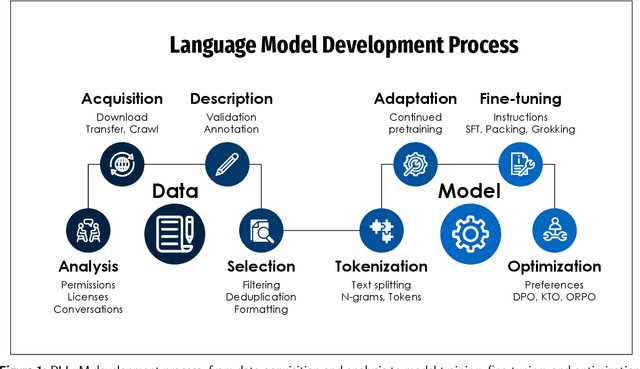
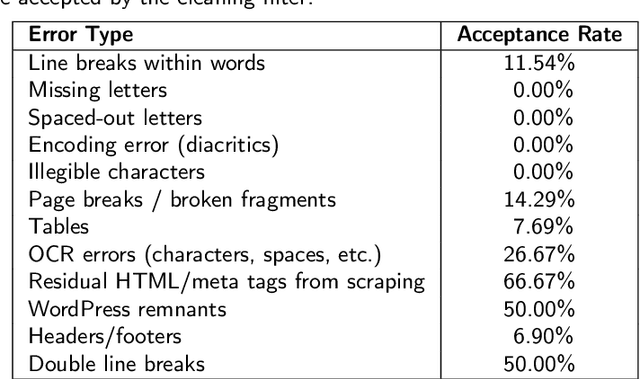
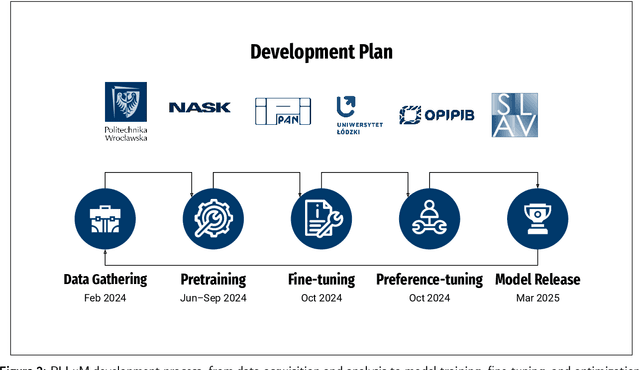

Large Language Models (LLMs) play a central role in modern artificial intelligence, yet their development has been primarily focused on English, resulting in limited support for other languages. We present PLLuM (Polish Large Language Model), the largest open-source family of foundation models tailored specifically for the Polish language. Developed by a consortium of major Polish research institutions, PLLuM addresses the need for high-quality, transparent, and culturally relevant language models beyond the English-centric commercial landscape. We describe the development process, including the construction of a new 140-billion-token Polish text corpus for pre-training, a 77k custom instructions dataset, and a 100k preference optimization dataset. A key component is a Responsible AI framework that incorporates strict data governance and a hybrid module for output correction and safety filtering. We detail the models' architecture, training procedures, and alignment techniques for both base and instruction-tuned variants, and demonstrate their utility in a downstream task within public administration. By releasing these models publicly, PLLuM aims to foster open research and strengthen sovereign AI technologies in Poland.