 Add to Chrome
 Add to Firefox
 Add to Edge
Do What I Say: A Spoken Prompt Dataset for Instruction-Following
Mar 10, 2026
Speech Large Language Models (SLLMs) have rapidly expanded, supporting a wide range of tasks. These models are typically evaluated using text prompts, which may not reflect real-world scenarios where users interact with speech. To address this gap, we introduce DoWhatISay (DOWIS), a multilingual dataset of human-recorded spoken and written prompts designed to pair with any existing benchmark for realistic evaluation of SLLMs under spoken instruction conditions. Spanning 9 tasks and 11 languages, it provides 10 prompt variants per task-language pair, across five styles. Using DOWIS, we benchmark state-of-the-art SLLMs, analyzing the interplay between prompt modality, style, language, and task type. Results show that text prompts consistently outperform spoken prompts, particularly for low-resource and cross-lingual settings. Only for tasks with speech output, spoken prompts do close the gap, highlighting the need for speech-based prompting in SLLM evaluation.

How to Connect Speech Foundation Models and Large Language Models? What Matters and What Does Not
Sep 25, 2024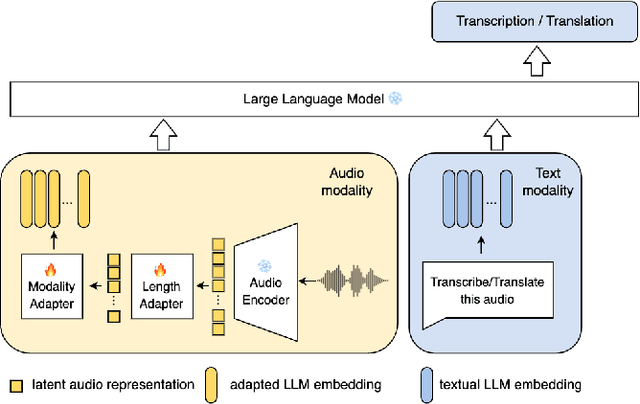
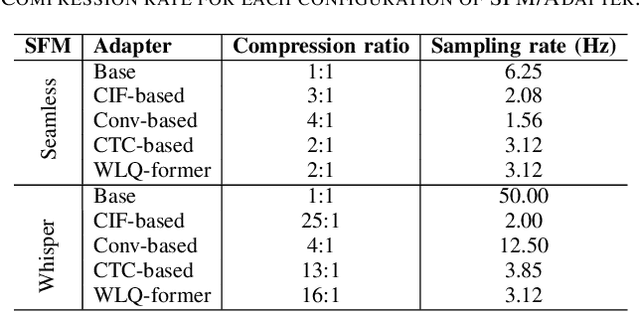

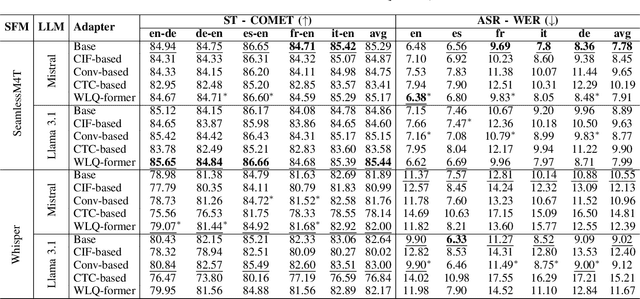
The remarkable performance achieved by Large Language Models (LLM) has driven research efforts to leverage them for a wide range of tasks and input modalities. In speech-to-text (S2T) tasks, the emerging solution consists of projecting the output of the encoder of a Speech Foundational Model (SFM) into the LLM embedding space through an adapter module. However, no work has yet investigated how much the downstream-task performance depends on each component (SFM, adapter, LLM) nor whether the best design of the adapter depends on the chosen SFM and LLM. To fill this gap, we evaluate the combination of 5 adapter modules, 2 LLMs (Mistral and Llama), and 2 SFMs (Whisper and SeamlessM4T) on two widespread S2T tasks, namely Automatic Speech Recognition and Speech Translation. Our results demonstrate that the SFM plays a pivotal role in downstream performance, while the adapter choice has moderate impact and depends on the SFM and LLM.