 Add to Chrome
 Add to Firefox
 Add to Edge
P-ARC: Exploiting Subproblem Independence for Parallel Multi-Robot Motion Planning
Jun 26, 2026
This paper presents Parallel ARC (P-ARC), a parallel variant of the Adaptive Robot Coordination (ARC) approach to multi-robot motion planning (MRMP). P-ARC proposes a parallel variant for each of the three main stages in ARC: initial individual solutions, conflict detection, and conflict resolution, exploiting the independence created by ARC's decomposition of the MRMP problem. Additionally, we employ an OR-parallel multi-start strategy to both ARC and P-ARC, creating a hybrid parallel strategy OR-P-ARC. We evaluate the impact of the different parallel strategies for ARC using a set of scaling 2D mobile and planar manipulator scenarios with up to 128 robots to control for conflicts and work distribution across the stages of ARC. Additionally, we demonstrate planning time speedups approaching 4X over the sequential version for large Panda multi-manipulator teams in real-world inspired scenarios when deploying 16 CPU cores.

AO-ARC: Almost-Surely Asymptotically Optimal Multi-Robot Motion Planning with ARC
Jun 25, 2026We present AO-ARC, an anytime multi-robot motion planning (MRMP) method that achieves initial solution times on par with state-of-the-art MRMP feasibility solvers while converging faster and more reliably than existing anytime MRMP methods as the number of robots increases. AO-ARC adapts the AO-x meta-algorithm for converting feasibility solvers into anytime algorithms by iteratively calling the original ARC method on bounded MRMP instances under a makespan cost metric. This exploits the adaptive (de)coupling of ARC while maintaining the consistent cost bound across robot (de)compositions needed for AO-x. We provide theoretical analysis proving the asymptotic optimality properties of AO- ARC and conduct empirical evaluation on a set of 2D scenarios with different levels of coordination complexity and a 3D manipulator scenario representative of real-world applications.
Scalable Multi-robot Motion Planning via Hierarchical Subproblem Expansion and Workspace Decomposition Refinement
May 19, 2026A fundamental challenge in multi-robot motion planning is achieving sufficient coordination to avoid inter-robot conflicts without incurring the large computational expense of searching the joint configuration space of the robot group. In this work, we present a method for multiple mobile robot motion planning that achieves an improvement in planning time up to an order of magnitude by leveraging the insight that we can use discrete search over a workspace decomposition to provide coordination between robots during planning. While prior work uses workspace topology to inform when coordination between robots is needed and then composes robots into their joint configuration space, we take a step further by iteratively refining our workspace representation to allow our planner to search smaller, decoupled configuration spaces.
Multi-Robot Motions in Milliseconds: Vector-Accelerated Primitives for Sampling-Based Planning
Apr 27, 2026In this paper, we extend the recent Vector-Accelerated Motion Planning (VAMP) framework to multi-robot motion planning (MRMP). We develop two vector-accelerated primitives, multi-robot MotionValidation (MotVal) and FindFirstConflict (FFC), which exploit SIMD parallelism within the multi-robot domain. On pure multi-robot motion validation tests, this achieves over 1100X speedup in validation time. Additionally, we modify a representative set of MRMP algorithms to use these new primitives. The relative speedup for each algorithm is studied on scenarios with manipulator, rigid body, and heterogeneous teams with some instances producing multi-robot solutions in the order of milliseconds and, in many cases, shows planning time speedups of over 850X.
Serialized Red-Green-Gray: Quicker Heuristic Validation of Edges in Dynamic Roadmap Graphs
Mar 30, 2026Motion planning in dynamic environments, such as robotic warehouses, requires fast adaptation to frequent changes in obstacle poses. Traditional roadmap-based methods struggle in such settings, relying on inefficient reconstruction of a roadmap or expensive collision detection to update the existing roadmap. To address these challenges we introduce the Red-Green-Gray (RGG) framework, a method that builds on SPITE to quickly classify roadmap edges as invalid (red), valid (green), or uncertain (gray) using conservative geometric approximations. Serial RGG provides a high-performance variant leveraging batch serialization and vectorization to enable efficient GPU acceleration. Empirical results demonstrate that while RGG effectively reduces the number of unknown edges requiring full validation, SerRGG achieves a 2-9x speedup compared to the sequential implementation. This combination of geometric precision and computational speed makes SerRGG highly effective for time-critical robotic applications.
PRISM: Complete Online Decentralized Multi-Agent Pathfinding with Rapid Information Sharing using Motion Constraints
May 12, 2025We introduce PRISM (Pathfinding with Rapid Information Sharing using Motion Constraints), a decentralized algorithm designed to address the multi-task multi-agent pathfinding (MT-MAPF) problem. PRISM enables large teams of agents to concurrently plan safe and efficient paths for multiple tasks while avoiding collisions. It employs a rapid communication strategy that uses information packets to exchange motion constraint information, enhancing cooperative pathfinding and situational awareness, even in scenarios without direct communication. We prove that PRISM resolves and avoids all deadlock scenarios when possible, a critical challenge in decentralized pathfinding. Empirically, we evaluate PRISM across five environments and 25 random scenarios, benchmarking it against the centralized Conflict-Based Search (CBS) and the decentralized Token Passing with Task Swaps (TPTS) algorithms. PRISM demonstrates scalability and solution quality, supporting 3.4 times more agents than CBS and handling up to 2.5 times more tasks in narrow passage environments than TPTS. Additionally, PRISM matches CBS in solution quality while achieving faster computation times, even under low-connectivity conditions. Its decentralized design reduces the computational burden on individual agents, making it scalable for large environments. These results confirm PRISM's robustness, scalability, and effectiveness in complex and dynamic pathfinding scenarios.
Path Database Guidance for Motion Planning
Apr 07, 2025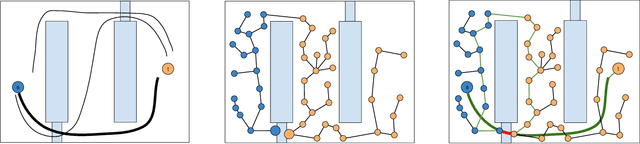

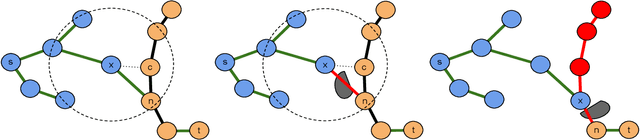
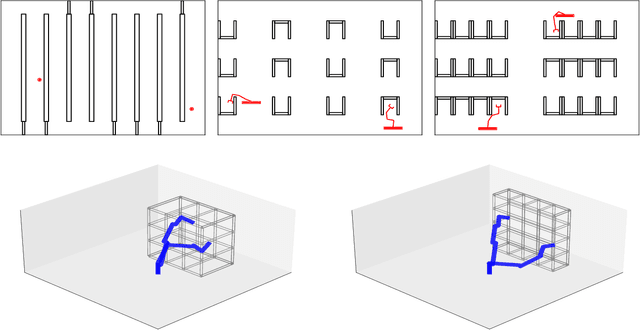
One approach to using prior experience in robot motion planning is to store solutions to previously seen problems in a database of paths. Methods that use such databases are characterized by how they query for a path and how they use queries given a new problem. In this work we present a new method, Path Database Guidance (PDG), which innovates on existing work in two ways. First, we use the database to compute a heuristic for determining which nodes of a search tree to expand, in contrast to prior work which generally pastes the (possibly transformed) queried path or uses it to bias a sampling distribution. We demonstrate that this makes our method more easily composable with other search methods by dynamically interleaving exploration according to a baseline algorithm with exploitation of the database guidance. Second, in contrast to other methods that treat the database as a single fixed prior, our database (and thus our queried heuristic) updates as we search the implicitly defined robot configuration space. We experimentally demonstrate the effectiveness of PDG in a variety of explicitly defined environment distributions in simulation.
Lazy-DaSH: Lazy Approach for Hypergraph-based Multi-robot Task and Motion Planning
Apr 07, 2025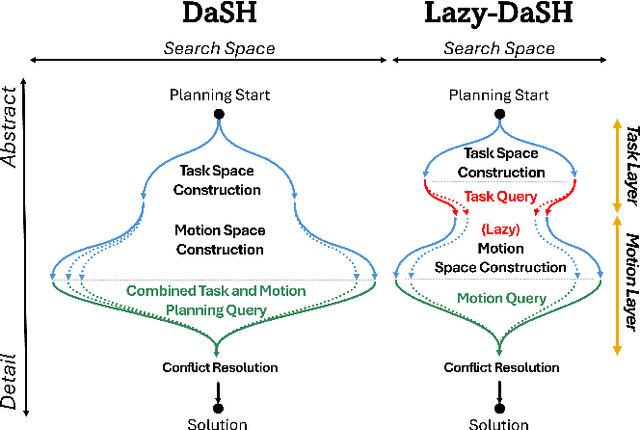
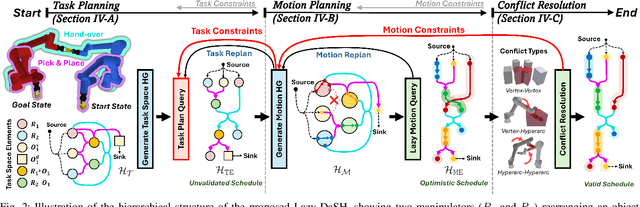
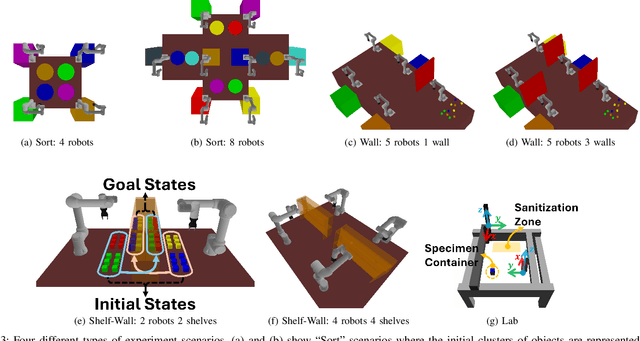
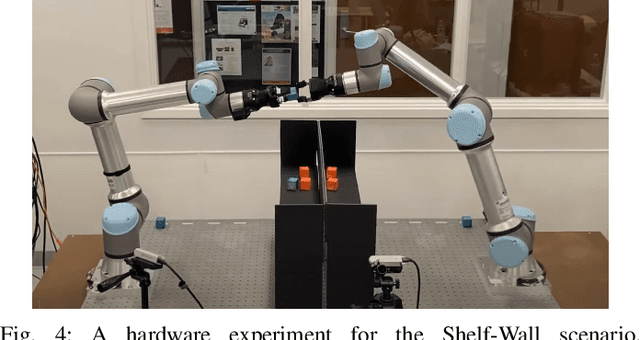
We introduce Lazy-DaSH, an improvement over the recent state of the art multi-robot task and motion planning method DaSH, which scales to more than double the number of robots and objects compared to the original method and achieves an order of magnitude faster planning time when applied to a multi-manipulator object rearrangement problem. We achieve this improvement through a hierarchical approach, where a high-level task planning layer identifies planning spaces required for task completion, and motion feasibility is validated lazily only within these spaces. In contrast, DaSH precomputes the motion feasibility of all possible actions, resulting in higher costs for constructing state space representations. Lazy-DaSH maintains efficient query performance by utilizing a constraint feedback mechanism within its hierarchical structure, ensuring that motion feasibility is effectively conveyed to the query process. By maintaining smaller state space representations, our method significantly reduces both representation construction time and query time. We evaluate Lazy-DaSH in four distinct scenarios, demonstrating its scalability to increasing numbers of robots and objects, as well as its adaptability in resolving conflicts through the constraint feedback mechanism.
K-ARC: Adaptive Robot Coordination for Multi-Robot Kinodynamic Planning
Jan 02, 2025
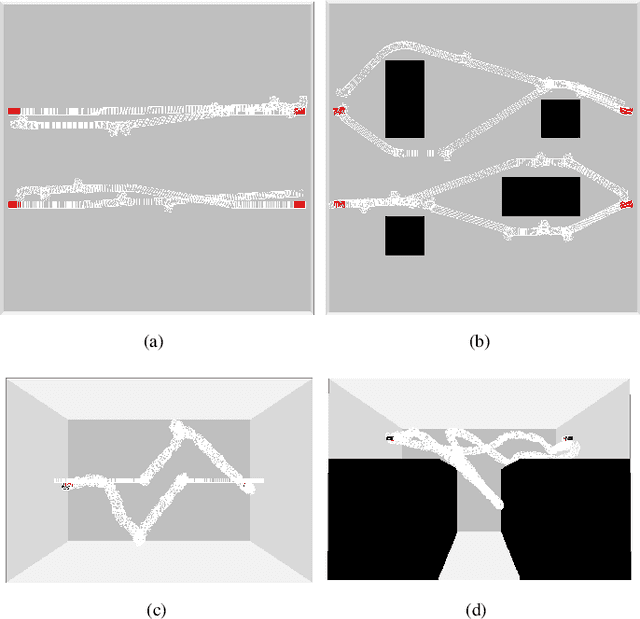

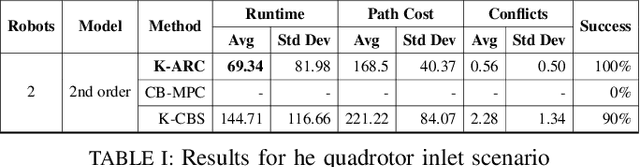
This work presents Kinodynamic Adaptive Robot Coordination (K-ARC), a novel algorithm for multi-robot kinodynamic planning. Our experimental results show the capability of K-ARC to plan for up to 32 planar mobile robots, while achieving up to an order of magnitude of speed-up compared to previous methods in various scenarios. K-ARC is able to achieve this due to its two main properties. First, K-ARC constructs its solution iteratively by planning in segments, where initial kinodynamic paths are found through optimization-based approaches and the inter-robot conflicts are resolved through sampling-based approaches. The interleaving use of sampling-based and optimization-based approaches allows K-ARC to leverage the strengths of both approaches in different sections of the planning process where one is more suited than the other, while previous methods tend to emphasize on one over the other. Second, K-ARC builds on a previously proposed multi-robot motion planning framework, Adaptive Robot Coordination (ARC), and inherits its strength of focusing on coordination between robots only when needed, saving computation efforts. We show how the combination of these two properties allows K-ARC to achieve overall better performance in our simulated experiments with increasing numbers of robots, increasing degrees of problem difficulties, and increasing complexities of robot dynamics.
Experience-based Subproblem Planning for Multi-Robot Motion Planning
Nov 13, 2024


Multi-robot systems enhance efficiency and productivity across various applications, from manufacturing to surveillance. While single-robot motion planning has improved by using databases of prior solutions, extending this approach to multi-robot motion planning (MRMP) presents challenges due to the increased complexity and diversity of tasks and configurations. Recent discrete methods have attempted to address this by focusing on relevant lower-dimensional subproblems, but they are inadequate for complex scenarios like those involving manipulator robots. To overcome this, we propose a novel approach that %leverages experience-based planning by constructs and utilizes databases of solutions for smaller sub-problems. By focusing on interactions between fewer robots, our method reduces the need for exhaustive database growth, allowing for efficient handling of more complex MRMP scenarios. We validate our approach with experiments involving both mobile and manipulator robots, demonstrating significant improvements over existing methods in scalability and planning efficiency. Our contributions include a rapidly constructed database for low-dimensional MRMP problems, a framework for applying these solutions to larger problems, and experimental validation with up to 32 mobile and 16 manipulator robots.