 Add to Chrome
 Add to Firefox
 Add to Edge
Scalable Multi-robot Motion Planning via Hierarchical Subproblem Expansion and Workspace Decomposition Refinement
May 19, 2026
A fundamental challenge in multi-robot motion planning is achieving sufficient coordination to avoid inter-robot conflicts without incurring the large computational expense of searching the joint configuration space of the robot group. In this work, we present a method for multiple mobile robot motion planning that achieves an improvement in planning time up to an order of magnitude by leveraging the insight that we can use discrete search over a workspace decomposition to provide coordination between robots during planning. While prior work uses workspace topology to inform when coordination between robots is needed and then composes robots into their joint configuration space, we take a step further by iteratively refining our workspace representation to allow our planner to search smaller, decoupled configuration spaces.

Lazy-DaSH: Lazy Approach for Hypergraph-based Multi-robot Task and Motion Planning
Apr 07, 2025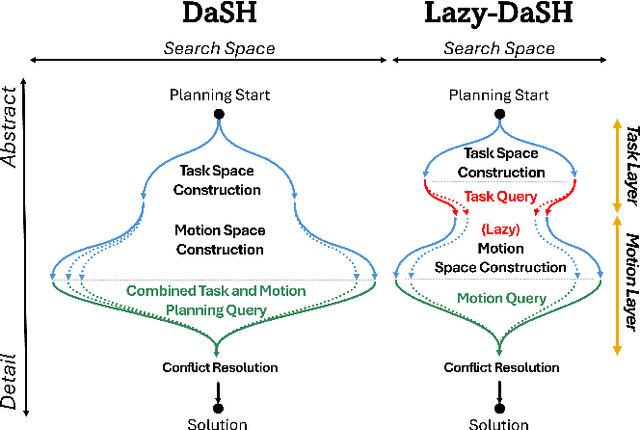
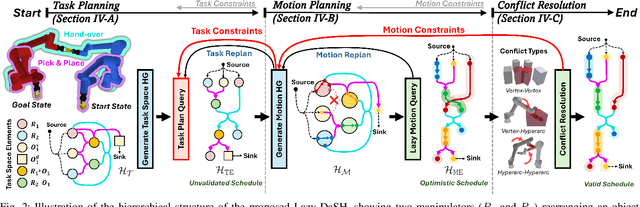
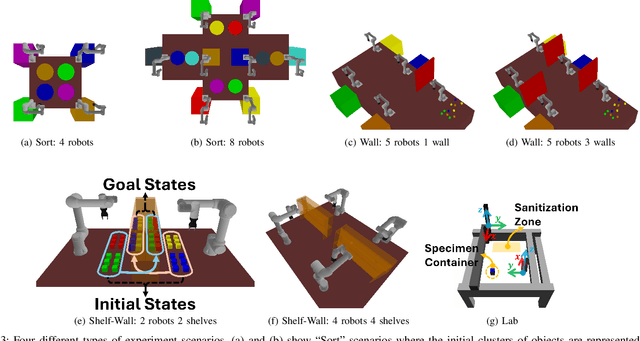
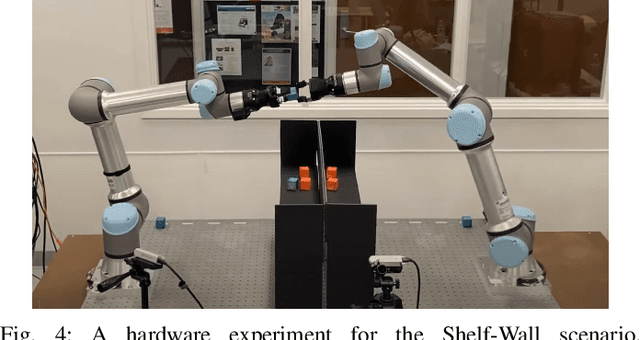
We introduce Lazy-DaSH, an improvement over the recent state of the art multi-robot task and motion planning method DaSH, which scales to more than double the number of robots and objects compared to the original method and achieves an order of magnitude faster planning time when applied to a multi-manipulator object rearrangement problem. We achieve this improvement through a hierarchical approach, where a high-level task planning layer identifies planning spaces required for task completion, and motion feasibility is validated lazily only within these spaces. In contrast, DaSH precomputes the motion feasibility of all possible actions, resulting in higher costs for constructing state space representations. Lazy-DaSH maintains efficient query performance by utilizing a constraint feedback mechanism within its hierarchical structure, ensuring that motion feasibility is effectively conveyed to the query process. By maintaining smaller state space representations, our method significantly reduces both representation construction time and query time. We evaluate Lazy-DaSH in four distinct scenarios, demonstrating its scalability to increasing numbers of robots and objects, as well as its adaptability in resolving conflicts through the constraint feedback mechanism.