 Add to Chrome
 Add to Firefox
 Add to Edge
Reinforcement learning for quantum processes with memory
Mar 26, 2026
In reinforcement learning, an agent interacts sequentially with an environment to maximize a reward, receiving only partial, probabilistic feedback. This creates a fundamental exploration-exploitation trade-off: the agent must explore to learn the hidden dynamics while exploiting this knowledge to maximize its target objective. While extensively studied classically, applying this framework to quantum systems requires dealing with hidden quantum states that evolve via unknown dynamics. We formalize this problem via a framework where the environment maintains a hidden quantum memory evolving via unknown quantum channels, and the agent intervenes sequentially using quantum instruments. For this setting, we adapt an optimistic maximum-likelihood estimation algorithm. We extend the analysis to continuous action spaces, allowing us to model general positive operator-valued measures (POVMs). By controlling the propagation of estimation errors through quantum channels and instruments, we prove that the cumulative regret of our strategy scales as $\widetilde{\mathcal{O}}(\sqrt{K})$ over $K$ episodes. Furthermore, via a reduction to the multi-armed quantum bandit problem, we establish information-theoretic lower bounds demonstrating that this sublinear scaling is strictly optimal up to polylogarithmic factors. As a physical application, we consider state-agnostic work extraction. When extracting free energy from a sequence of non-i.i.d. quantum states correlated by a hidden memory, any lack of knowledge about the source leads to thermodynamic dissipation. In our setting, the mathematical regret exactly quantifies this cumulative dissipation. Using our adaptive algorithm, the agent uses past energy outcomes to improve its extraction protocol on the fly, achieving sublinear cumulative dissipation, and, consequently, an asymptotically zero dissipation rate.

Towards sample-optimal learning of bosonic Gaussian quantum states
Mar 18, 2026Continuous-variable systems enable key quantum technologies in computation, communication, and sensing. Bosonic Gaussian states emerge naturally in various such applications, including gravitational-wave and dark-matter detection. A fundamental question is how to characterize an unknown bosonic Gaussian state from as few samples as possible. Despite decades-long exploration, the ultimate efficiency limit remains unclear. In this work, we study the necessary and sufficient number of copies to learn an $n$-mode Gaussian state, with energy less than $E$, to $\varepsilon$ trace distance with high probability. We prove a lower bound of $Ω(n^3/\varepsilon^2)$ for Gaussian measurements, matching the best known upper bound up to doubly-log energy dependence, and $Ω(n^2/\varepsilon^2)$ for arbitrary measurements. We further show an upper bound of $\widetilde{O}(n^2/\varepsilon^2)$ given that the Gaussian state is promised to be either pure or passive. Interestingly, while Gaussian measurements suffice for nearly optimal learning of pure Gaussian states, non-Gaussian measurements are provably required for optimal learning of passive Gaussian states. Finally, focusing on learning single-mode Gaussian states via non-entangling Gaussian measurements, we provide a nearly tight bound of $\widetildeΘ(E/\varepsilon^2)$ for any non-adaptive schemes, showing adaptivity is indispensable for nearly energy-independent scaling. As a byproduct, we establish sharp bounds on the trace distance between Gaussian states in terms of the total variation distance between their Wigner distributions, and obtain a nearly tight sample complexity bound for learning the Wigner distribution of any Gaussian state to $\varepsilon$ total variation distance. Our results greatly advance quantum learning theory in the bosonic regimes and have practical impact in quantum sensing and benchmarking applications.
Efficient Hamiltonian, structure and trace distance learning of Gaussian states
Nov 05, 2024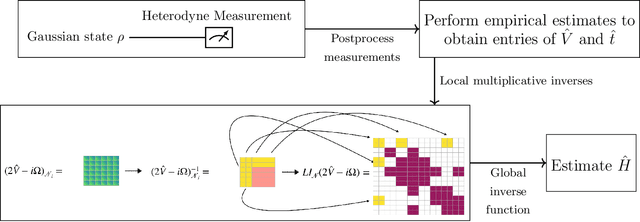
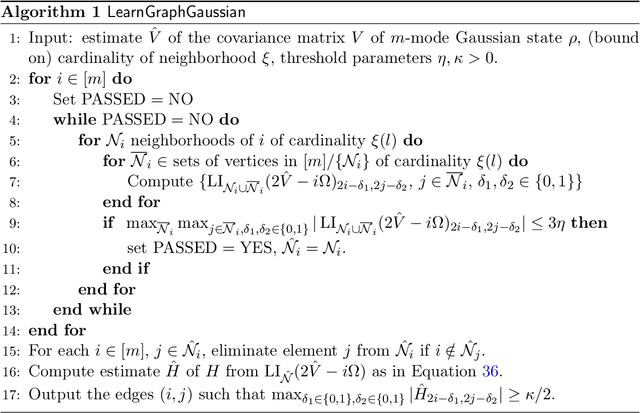
In this work, we initiate the study of Hamiltonian learning for positive temperature bosonic Gaussian states, the quantum generalization of the widely studied problem of learning Gaussian graphical models. We obtain efficient protocols, both in sample and computational complexity, for the task of inferring the parameters of their underlying quadratic Hamiltonian under the assumption of bounded temperature, squeezing, displacement and maximal degree of the interaction graph. Our protocol only requires heterodyne measurements, which are often experimentally feasible, and has a sample complexity that scales logarithmically with the number of modes. Furthermore, we show that it is possible to learn the underlying interaction graph in a similar setting and sample complexity. Taken together, our results put the status of the quantum Hamiltonian learning problem for continuous variable systems in a much more advanced state when compared to spins, where state-of-the-art results are either unavailable or quantitatively inferior to ours. In addition, we use our techniques to obtain the first results on learning Gaussian states in trace distance with a quadratic scaling in precision and polynomial in the number of modes, albeit imposing certain restrictions on the Gaussian states. Our main technical innovations are several continuity bounds for the covariance and Hamiltonian matrix of a Gaussian state, which are of independent interest, combined with what we call the local inversion technique. In essence, the local inversion technique allows us to reliably infer the Hamiltonian of a Gaussian state by only estimating in parallel submatrices of the covariance matrix whose size scales with the desired precision, but not the number of modes. This way we bypass the need to obtain precise global estimates of the covariance matrix, controlling the sample complexity.
Learning finitely correlated states: stability of the spectral reconstruction
Dec 12, 2023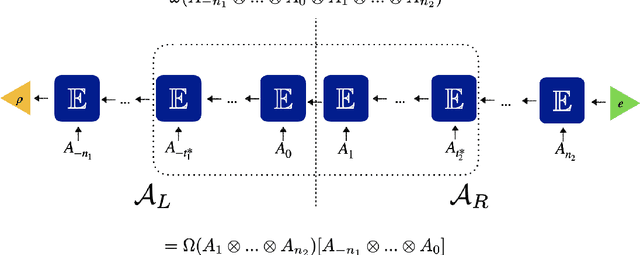
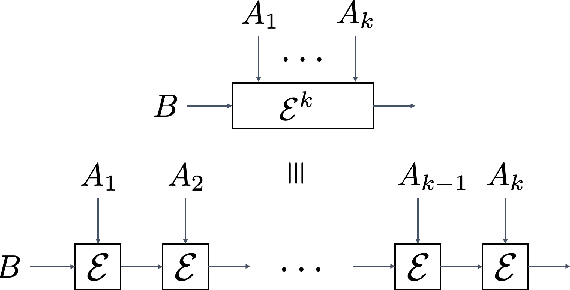
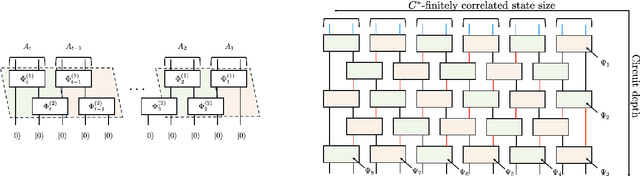
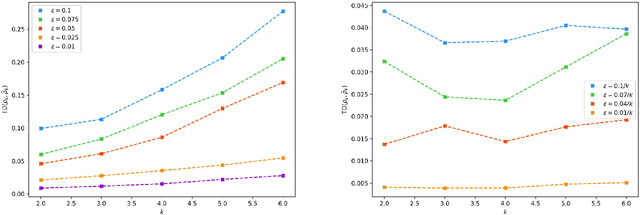
We show that marginals of subchains of length $t$ of any finitely correlated translation invariant state on a chain can be learned, in trace distance, with $O(t^2)$ copies -- with an explicit dependence on local dimension, memory dimension and spectral properties of a certain map constructed from the state -- and computational complexity polynomial in $t$. The algorithm requires only the estimation of a marginal of a controlled size, in the worst case bounded by a multiple of the minimum bond dimension, from which it reconstructs a translation invariant matrix product operator. In the analysis, a central role is played by the theory of operator systems. A refined error bound can be proven for $C^*$-finitely correlated states, which have an operational interpretation in terms of sequential quantum channels applied to the memory system. We can also obtain an analogous error bound for a class of matrix product density operators reconstructible by local marginals. In this case, a linear number of marginals must be estimated, obtaining a sample complexity of $\tilde{O}(t^3)$. The learning algorithm also works for states that are only close to a finitely correlated state, with the potential of providing competitive algorithms for other interesting families of states.