 Add to Chrome
 Add to Firefox
 Add to Edge
Reinforcement learning for quantum processes with memory
Mar 26, 2026
In reinforcement learning, an agent interacts sequentially with an environment to maximize a reward, receiving only partial, probabilistic feedback. This creates a fundamental exploration-exploitation trade-off: the agent must explore to learn the hidden dynamics while exploiting this knowledge to maximize its target objective. While extensively studied classically, applying this framework to quantum systems requires dealing with hidden quantum states that evolve via unknown dynamics. We formalize this problem via a framework where the environment maintains a hidden quantum memory evolving via unknown quantum channels, and the agent intervenes sequentially using quantum instruments. For this setting, we adapt an optimistic maximum-likelihood estimation algorithm. We extend the analysis to continuous action spaces, allowing us to model general positive operator-valued measures (POVMs). By controlling the propagation of estimation errors through quantum channels and instruments, we prove that the cumulative regret of our strategy scales as $\widetilde{\mathcal{O}}(\sqrt{K})$ over $K$ episodes. Furthermore, via a reduction to the multi-armed quantum bandit problem, we establish information-theoretic lower bounds demonstrating that this sublinear scaling is strictly optimal up to polylogarithmic factors. As a physical application, we consider state-agnostic work extraction. When extracting free energy from a sequence of non-i.i.d. quantum states correlated by a hidden memory, any lack of knowledge about the source leads to thermodynamic dissipation. In our setting, the mathematical regret exactly quantifies this cumulative dissipation. Using our adaptive algorithm, the agent uses past energy outcomes to improve its extraction protocol on the fly, achieving sublinear cumulative dissipation, and, consequently, an asymptotically zero dissipation rate.

Quantum state-agnostic work extraction (almost) without dissipation
May 14, 2025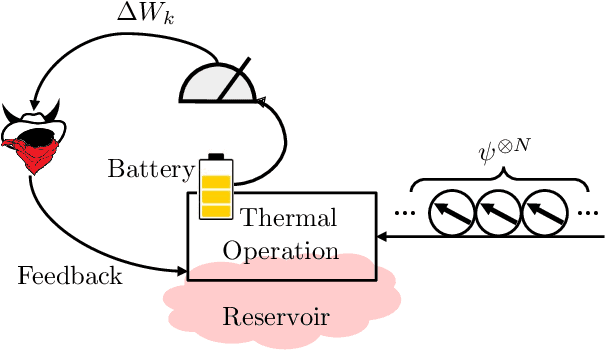
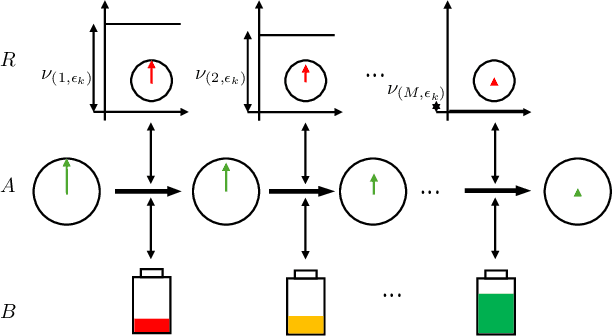
We investigate work extraction protocols designed to transfer the maximum possible energy to a battery using sequential access to $N$ copies of an unknown pure qubit state. The core challenge is designing interactions to optimally balance two competing goals: charging of the battery optimally using the qubit in hand, and acquiring more information by qubit to improve energy harvesting in subsequent rounds. Here, we leverage exploration-exploitation trade-off in reinforcement learning to develop adaptive strategies achieving energy dissipation that scales only poly-logarithmically in $N$. This represents an exponential improvement over current protocols based on full state tomography.