 Add to Chrome
 Add to Firefox
 Add to Edge
Collocation-based Robust Physics Informed Neural Networks for time-dependent simulations of pollution propagation under thermal inversion conditions on Spitsbergen
Apr 24, 2026
In this paper, we propose a Physics-Informed Neural Network framework for time-dependent simulations of pollution propagation originating from moving emission sources. We formulate a robust variational framework for the time-dependent advection-diffusion problem and establish the boundedness and inf-sup stability of the corresponding discrete weak formulation. Based on this mathematical foundation, we construct a robust loss function that is directly related to the true approximation error, defined as the difference between the neural network approximation and the (unknown) exact solution. Additionally, a collocation-based strategy is introduced to speed up neural network training. As a case study, we investigate pollution propagation caused by snowmobile traffic in Longyearbyen, Spitsbergen, supported by detailed in-field measurements collected using dedicated sensors. The proposed framework is applied to analyze the effects of thermal inversion on pollutant accumulation. Our results demonstrate that thermal inversion traps dense and humid air masses near the ground, significantly enhancing particulate matter (PM) concentration and worsening local air quality.

CO$_2$ sequestration hybrid solver using isogeometric alternating-directions and collocation-based robust variational physics informed neural networks (IGA-ADS-CRVPINN)
Apr 22, 2026This paper presents the hybrid solver for a $CO_2$ sequestration problem. The solver uses the IGA-ADS (IsoGeometric Analysis Alternating Directions solver) to compute the saturation scalar field update using the explicit method, and CRVPINN (Collocation-based Robust Variational Physics Informed Neural Networks solver) to compute the pressure scalar field. The study focuses on simulating the physical behavior of $CO_2$ in porous structures, excluding chemical reactions. The mathematical model is based on Darcy's Law. The CRVPINN is pretrained on the initial pressure configuration, and the time step pressure updates require only 100 iterations of the Adam method per time step. We compare our hybrid IGA-ADS solver, coupled with the CRVPINN method, with a baseline of the IGA-ADS solver coupled with the MUMPS direct solver. Our hybrid solver is over 3 times faster on a single computational node from the ARES cluster of ACK CYFRONET. Future work includes extensive testing, inverse problem solving, and potential application to $H_2$ storage problems.
Robust Physics Informed Neural Networks
Jan 12, 2024We introduce a Robust version of the Physics-Informed Neural Networks (RPINNs) to approximate the Partial Differential Equations (PDEs) solution. Standard Physics Informed Neural Networks (PINN) takes into account the governing physical laws described by PDE during the learning process. The network is trained on a data set that consists of randomly selected points in the physical domain and its boundary. PINNs have been successfully applied to solve various problems described by PDEs with boundary conditions. The loss function in traditional PINNs is based on the strong residuals of the PDEs. This loss function in PINNs is generally not robust with respect to the true error. The loss function in PINNs can be far from the true error, which makes the training process more difficult. In particular, we do not know if the training process has already converged to the solution with the required accuracy. This is especially true if we do not know the exact solution, so we cannot estimate the true error during the training. This paper introduces a different way of defining the loss function. It incorporates the residual and the inverse of the Gram matrix, computed using the energy norm. We test our RPINN algorithm on two Laplace problems and one advection-diffusion problem in two spatial dimensions. We conclude that RPINN is a robust method. The proposed loss coincides well with the true error of the solution, as measured in the energy norm. Thus, we know if our training process goes well, and we know when to stop the training to obtain the neural network approximation of the solution of the PDE with the true error of required accuracy.
Approximation of the objective insensitivity regions using Hierarchic Memetic Strategy coupled with Covariance Matrix Adaptation Evolutionary Strategy
May 17, 2019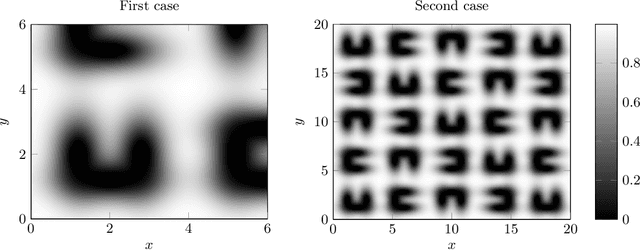
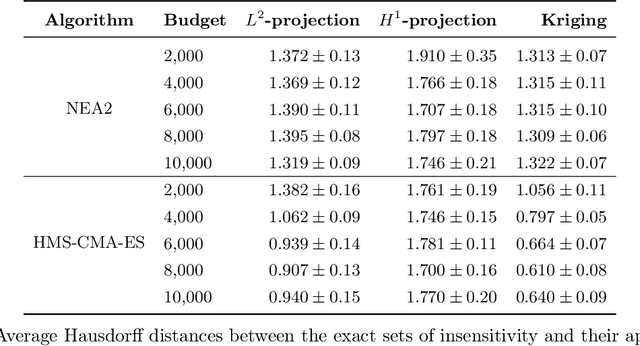
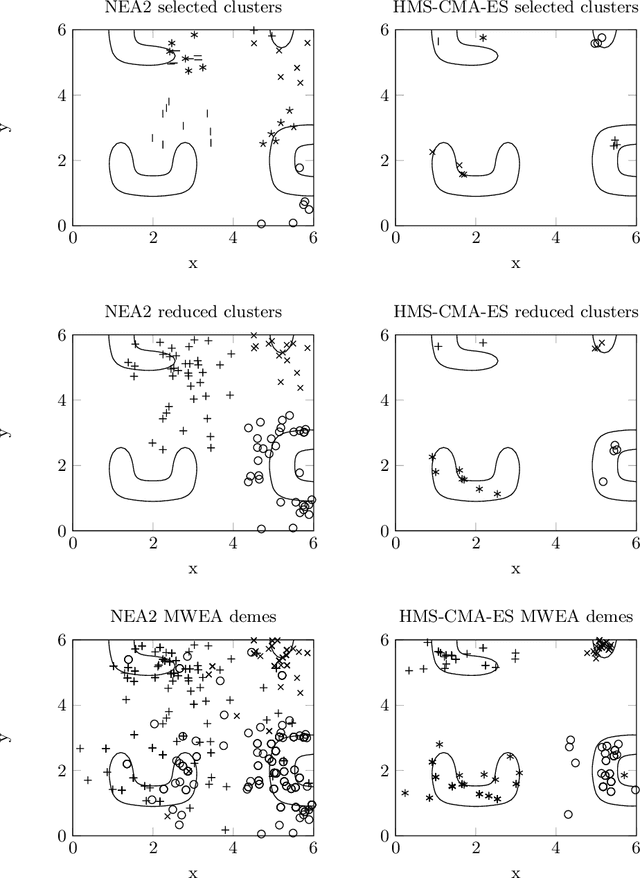

One of the most challenging types of ill-posedness in global optimization is the presence of insensitivity regions in design parameter space, so the identification of their shape will be crucial, if ill-posedness is irrecoverable. Such problems may be solved using global stochastic search followed by post-processing of a local sample and a local objective approximation. We propose a new approach of this type composed of Hierarchic Memetic Strategy (HMS) powered by the Covariance Matrix Adaptation Evolutionary Strategy (CMA-ES) well-known as an effective, self-adaptable stochastic optimization algorithm and we leverage the distribution density knowledge it accumulates to better identify and separate insensitivity regions. The results of benchmarks prove that the improved HMS-CMA-ES strategy is effective in both the total computational cost and the accuracy of insensitivity region approximation. The reference data for the tests was obtained by means of a well-known effective strategy of multimodal stochastic optimization called the Niching Evolutionary Algorithm 2 (NEA2), that also uses CMA-ES as a component.