 Add to Chrome
 Add to Firefox
 Add to Edge
Collocation-based Robust Physics Informed Neural Networks for time-dependent simulations of pollution propagation under thermal inversion conditions on Spitsbergen
Apr 24, 2026
In this paper, we propose a Physics-Informed Neural Network framework for time-dependent simulations of pollution propagation originating from moving emission sources. We formulate a robust variational framework for the time-dependent advection-diffusion problem and establish the boundedness and inf-sup stability of the corresponding discrete weak formulation. Based on this mathematical foundation, we construct a robust loss function that is directly related to the true approximation error, defined as the difference between the neural network approximation and the (unknown) exact solution. Additionally, a collocation-based strategy is introduced to speed up neural network training. As a case study, we investigate pollution propagation caused by snowmobile traffic in Longyearbyen, Spitsbergen, supported by detailed in-field measurements collected using dedicated sensors. The proposed framework is applied to analyze the effects of thermal inversion on pollutant accumulation. Our results demonstrate that thermal inversion traps dense and humid air masses near the ground, significantly enhancing particulate matter (PM) concentration and worsening local air quality.

Operator Learning for Surrogate Modeling of Wave-Induced Forces from Sea Surface Waves
Apr 07, 2026Wave setup plays a significant role in transferring wave-induced energy to currents and causing an increase in water elevation. This excess momentum flux, known as radiation stress, motivates the coupling of circulation models with wave models to improve the accuracy of storm surge prediction, however, traditional numerical wave models are complex and computationally expensive. As a result, in practical coupled simulations, wave models are often executed at much coarser temporal resolution than circulation models. In this work, we explore the use of Deep Operator Networks (DeepONets) as a surrogate for the Simulating WAves Nearshore (SWAN) numerical wave model. The proposed surrogate model was tested on three distinct 1-D and 2-D steady-state numerical examples with variable boundary wave conditions and wind fields. When applied to a realistic numerical example of steady state wave simulation in Duck, NC, the model achieved consistently high accuracy in predicting the components of the radiation stress gradient and the significant wave height across representative scenarios.
Learning Storm Surge with Gradient Boosting
Apr 27, 2022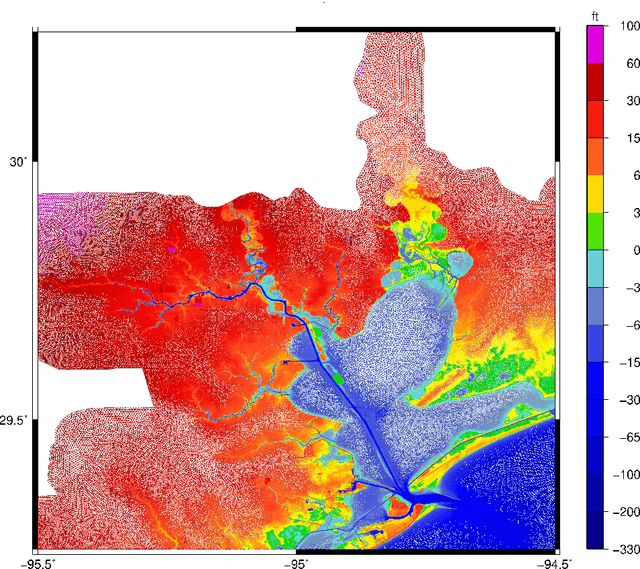
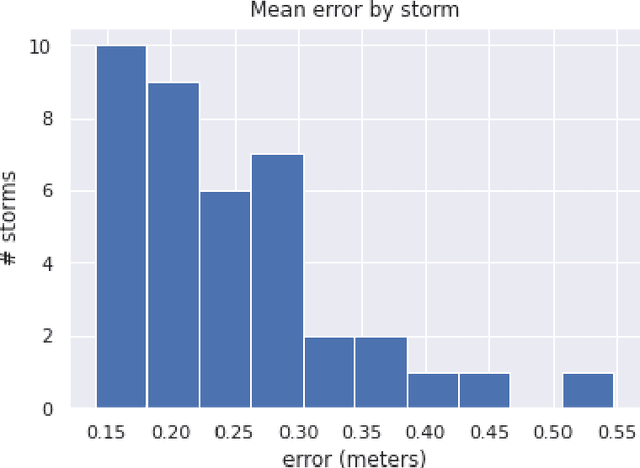
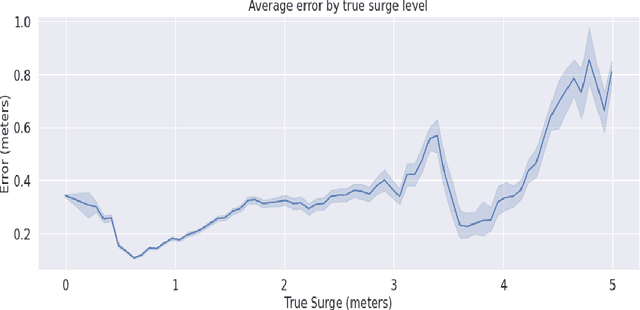
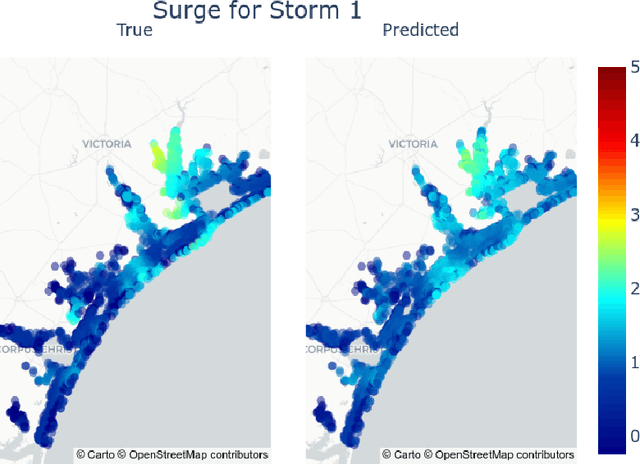
Storm surge is a major natural hazard for coastal regions, responsible both for significant property damage and loss of life. Accurate, efficient models of storm surge are needed both to assess long-term risk and to guide emergency management decisions. While high-fidelity ocean circulation models such as the ADvanced CIRCulation (ADCIRC) model can accurately predict storm surge, they are very computationally expensive. Consequently, there have been a number of efforts in recent years to develop data-driven surrogate models for storm surge. While these models can attain good accuracy and are highly efficient, they are often limited to a small geographical region and a fixed set of output locations. We develop a novel surrogate model for peak storm surge prediction based on gradient boosting. Unlike most surrogate approaches, our model is not explicitly constrained to a fixed set of output locations or specific geographical region. The model is trained with a database of 446 synthetic storms that make landfall on the Texas coast and obtains a mean absolute error of 0.25 meters. We additionally present a test of the model on Hurricanes Ike (2008) and Harvey (2017).