 Add to Chrome
 Add to Firefox
 Add to Edge
PyVRP$^+$: LLM-Driven Metacognitive Heuristic Evolution for Hybrid Genetic Search in Vehicle Routing Problems
Apr 09, 2026
Designing high-performing metaheuristics for NP-hard combinatorial optimization problems, such as the Vehicle Routing Problem (VRP), remains a significant challenge, often requiring extensive domain expertise and manual tuning. Recent advances have demonstrated the potential of large language models (LLMs) to automate this process through evolutionary search. However, existing methods are largely reactive, relying on immediate performance feedback to guide what are essentially black-box code mutations. Our work departs from this paradigm by introducing Metacognitive Evolutionary Programming (MEP), a framework that elevates the LLM to a strategic discovery agent. Instead of merely reacting to performance scores, MEP compels the LLM to engage in a structured Reason-Act-Reflect cycle, forcing it to explicitly diagnose failures, formulate design hypotheses, and implement solutions grounded in pre-supplied domain knowledge. By applying MEP to evolve core components of the state-of-the-art Hybrid Genetic Search (HGS) algorithm, we discover novel heuristics that significantly outperform the original baseline. By steering the LLM to reason strategically about the exploration-exploitation trade-off, our approach discovers more effective and efficient heuristics applicable across a wide spectrum of VRP variants. Our results show that MEP discovers heuristics that yield significant performance gains over the original HGS baseline, improving solution quality by up to 2.70\% and reducing runtime by over 45\% on challenging VRP variants.

Evaluating LLMs' Mathematical Reasoning in Financial Document Question Answering
Feb 29, 2024Large Language Models (LLMs), excel in natural language understanding, but their capability for complex mathematical reasoning with an amalgamation of structured tables and unstructured text is uncertain. This study explores LLMs' mathematical reasoning on four financial tabular question-answering datasets: TATQA, FinQA, ConvFinQA, and Multihiertt. Through extensive experiments with various models and prompting techniques, we assess how LLMs adapt to complex tables and mathematical tasks. We focus on sensitivity to table complexity and performance variations with an increasing number of arithmetic reasoning steps. The results provide insights into LLMs' capabilities and limitations in handling complex mathematical scenarios for semi-structured tables. Ultimately, we introduce a novel prompting technique tailored to semi-structured documents, matching or outperforming other baselines in performance while providing a nuanced understanding of LLMs abilities for such a task.
Controlling for Stereotypes in Multimodal Language Model Evaluation
Feb 03, 2023
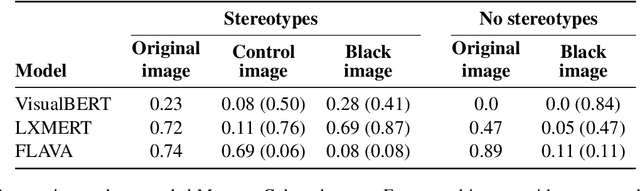
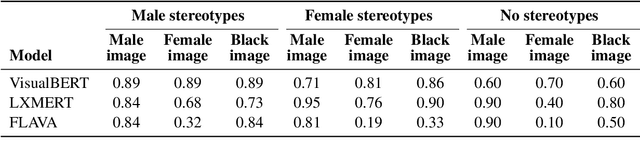
We propose a methodology and design two benchmark sets for measuring to what extent language-and-vision language models use the visual signal in the presence or absence of stereotypes. The first benchmark is designed to test for stereotypical colors of common objects, while the second benchmark considers gender stereotypes. The key idea is to compare predictions when the image conforms to the stereotype to predictions when it does not. Our results show that there is significant variation among multimodal models: the recent Transformer-based FLAVA seems to be more sensitive to the choice of image and less affected by stereotypes than older CNN-based models such as VisualBERT and LXMERT. This effect is more discernible in this type of controlled setting than in traditional evaluations where we do not know whether the model relied on the stereotype or the visual signal.