 Add to Chrome
 Add to Firefox
 Add to Edge
Probabilistic Low-Voltage Peak Load Forecasting with Time Series Foundation Models Evaluated on Application-Oriented Metrics
Jul 02, 2026
Low-voltage load forecasting is an important component in current and future energy systems with a high degree of electrification and decentralized generation. However, current forecasting methods require significant manual effort, often lack uncertainty estimation and proper peak prediction, and they are often not adequately evaluated in terms of grid requirements. In the present study, we provide an extensive evaluation of short-term net load forecasts of 200 real-world low-voltage feeders with a focus on the rapidly evolving time series foundation models. Our study compares Chronos-Bolt, Chronos-2 and TabPFN-TS to six baseline models and demonstrates superior performance, in particular for Chronos-2. An ablation study, in which weather covariates are omitted, shows that time series foundation models adapt to increased uncertainty, despite the importance of weather information. A novel application-oriented metric links the model's forecasting capabilities in peak prediction to the trade-off in grid asset planning and operation between cost reduction and minimizing the risk of failure.

Generating peak-aware pseudo-measurements for low-voltage feeders using metadata of distribution system operators
Sep 29, 2024
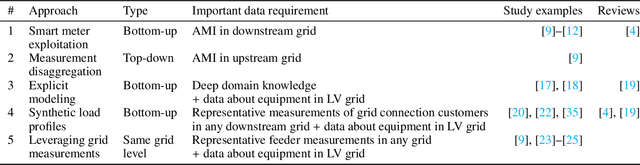
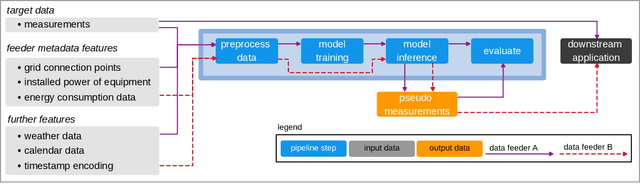
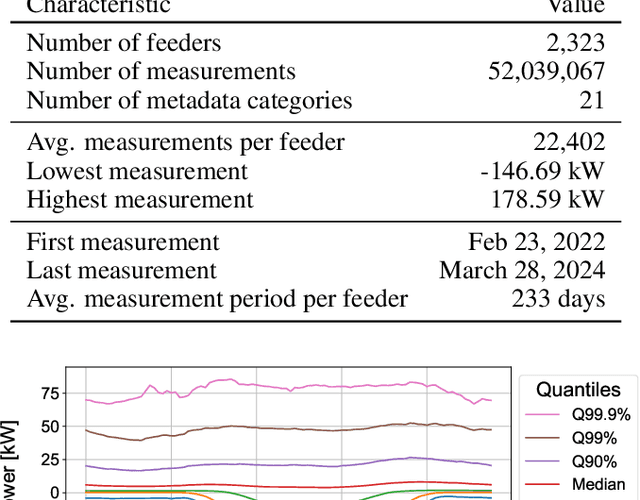
Distribution system operators (DSOs) must cope with new challenges such as the reconstruction of distribution grids along climate neutrality pathways or the ability to manage and control consumption and generation in the grid. In order to meet the challenges, measurements within the distribution grid often form the basis for DSOs. Hence, it is an urgent problem that measurement devices are not installed in many low-voltage (LV) grids. In order to overcome this problem, we present an approach to estimate pseudo-measurements for non-measured LV feeders based on the metadata of the respective feeder using regression models. The feeder metadata comprise information about the number of grid connection points, the installed power of consumers and producers, and billing data in the downstream LV grid. Additionally, we use weather data, calendar data and timestamp information as model features. The existing measurements are used as model target. We extensively evaluate the estimated pseudo-measurements on a large real-world dataset with 2,323 LV feeders characterized by both consumption and feed-in. For this purpose, we introduce peak metrics inspired by the BigDEAL challenge for the peak magnitude, timing and shape for both consumption and feed-in. As regression models, we use XGBoost, a multilayer perceptron (MLP) and a linear regression (LR). We observe that XGBoost and MLP outperform the LR. Furthermore, the results show that the approach adapts to different weather, calendar and timestamp conditions and produces realistic load curves based on the feeder metadata. In the future, the approach can be adapted to other grid levels like substation transformers and can supplement research fields like load modeling, state estimation and LV load forecasting.