 Add to Chrome
 Add to Firefox
 Add to Edge
Irregularly Sampled Time Series Interpolation for Binary Evolution Simulations Using Dynamic Time Warping
Apr 15, 2026
Binary stellar evolution simulations are computationally expensive. Stellar population synthesis relies on these detailed evolution models at a fundamental level. Producing thousands of such models requires hundreds of CPU hours, but stellar track interpolation provides one approach to significantly reduce this computational cost. Although single-star track interpolation is straightforward, stellar interactions in binary systems introduce significant complexity to binary evolution, making traditional single-track interpolation methods inapplicable. Binary tracks present fundamentally different challenges compared to single stars, which possess relatively straightforward evolutionary phases identifiable through distinct physical properties. Binary systems are complicated by mutual interactions that can dramatically alter evolutionary trajectories and introduce discontinuities difficult to capture through standard interpolation. In this work, we introduce a novel approach for track alignment and iterative track averaging based on Dynamic Time Warping to address misalignments between neighboring tracks. Our method computes a single shared warping path across all physical parameters simultaneously, placing them on a consistent temporal grid that preserves the causal relationships between parameters. We demonstrate that this joint-alignment strategy maintains key physical relationships such as the Stefan-Boltzmann law in the interpolated tracks. Our comprehensive evaluation across multiple binary configurations demonstrates that proper temporal alignment is crucial for track interpolation methods. The proposed method consistently outperforms existing approaches and enables the efficient generation of more accurate binary population samples for astrophysical studies.

Learning the Stellar Structure Equations via Self-supervised Physics-Informed Neural Networks
Apr 06, 2026Stellar astrophysics relies critically on accurate descriptions of the physical conditions inside stars. Traditional solvers such as \texttt{MESA} (Modules for Experiments in Stellar Astrophysics), which employ adaptive finite-difference methods, can become computationally expensive and challenging to scale for large stellar population synthesis ($>10^9$ stars). In this work, we present an self-supervised physics-informed neural network (PINN) framework that provides a mesh-free and fully differentiable approach to solving the stellar structure equations under hydrostatic and thermal equilibrium. The model takes as input the stellar boundary conditions (at the center and surface) together with the chemical composition, and learns continuous radial profiles for mass $M_r(r)$, pressure $P(r)$, density $ρ(r)$, temperature $T(r)$, and luminosity $L_r(r)$ by enforcing the governing structure equations through physics-based loss terms. To incorporate realistic microphysics, we introduce auxiliary neural networks that approximate the equation of state and opacity tables as smooth, differentiable functions of the local thermodynamic state. These surrogates replace traditional tabulated inputs and enable end-to-end training. Once trained for a given star, the model produces continuous solutions across the entire radial domain without requiring discretization or interpolation. Validation against benchmark \texttt{MESA} models across a range of stellar masses yields a Mean Relative Absolute Error of $3.06\%$ and an average $R^2$ score of $99.98\%$. To our knowledge, this is the first demonstration that the stellar structure equations can be solved in a fully self-supervised and data-free fashion employing PINNs. This work establishes a foundation for scalable, physics-informed emulation of stellar interiors and opens the door to future extensions toward time-dependent stellar evolution.
Modeling and Simulation of Charge-Induced Signals in Photon-Counting CZT Detectors for Medical Imaging Applications
May 21, 2024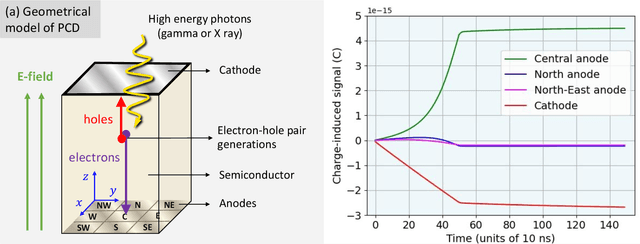
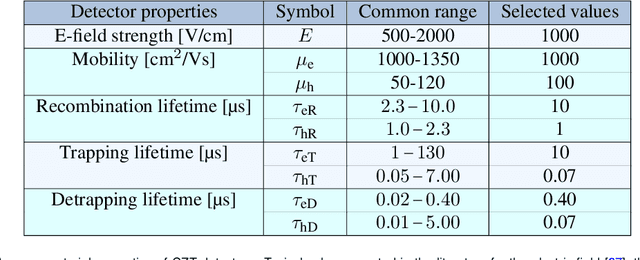
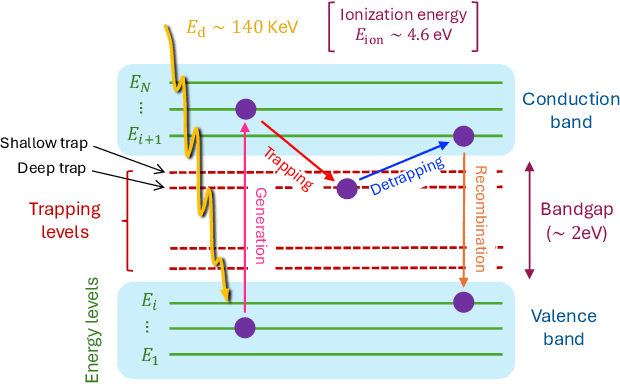
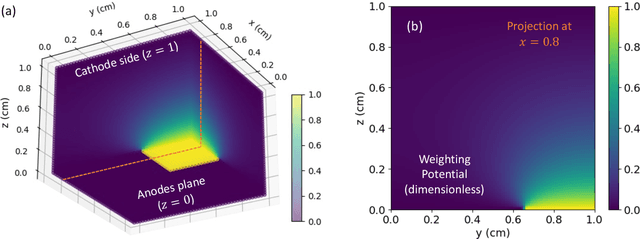
Photon-counting detectors based on CZT are essential in nuclear medical imaging, particularly for SPECT applications. Although CZT detectors are known for their precise energy resolution, defects within the CZT crystals significantly impact their performance. These defects result in inhomogeneous material properties throughout the bulk of the detector. The present work introduces an efficient computational model that simulates the operation of semiconductor detectors, accounting for the spatial variability of the crystal properties. Our simulator reproduces the charge-induced pulse signals generated after the X/gamma-rays interact with the detector. The performance evaluation of the model shows an RMSE in the signal below 0.70%. Our simulator can function as a digital twin to accurately replicate the operation of actual detectors. Thus, it can be used to mitigate and compensate for adverse effects arising from crystal impurities.
A Physics based Machine Learning Model to characterize Room Temperature Semiconductor Detectors in 3D
Nov 04, 2023Room temperature semiconductor radiation detectors (RTSD) for X-ray and gamma-ray detection are vital tools for medical imaging, astrophysics and other applications. CdZnTe (CZT) has been the main RTSD for more than three decades with desired detection properties. In a typical pixelated configuration, CZT have electrodes on opposite ends. For advanced event reconstruction algorithms at sub-pixel level, detailed characterization of the RTSD is required in three dimensional (3D) space. However, 3D characterization of the material defects and charge transport properties in the sub-pixel regime is a labor-intensive process with skilled manpower and novel experimental setups. Presently, state-of-art characterization is done over the bulk of the RTSD considering homogenous properties. In this paper, we propose a novel physics based machine learning (PBML) model to characterize the RTSD over a discretized sub-pixelated 3D volume which is assumed. Our novel approach is the first to characterize a full 3D charge transport model of the RTSD. In this work, we first discretize the RTSD between a pixelated electrodes spatially in 3D - x, y, and z. The resulting discretizations are termed as voxels in 3D space. In each voxel, the different physics based charge transport properties such as drift, trapping, detrapping and recombination of charges are modeled as trainable model weights. The drift of the charges considers second order non-linear motion which is observed in practice with the RTSDs. Based on the electron-hole pair injections as input to the PBML model, and signals at the electrodes, free and trapped charges (electrons and holes) as outputs of the model, the PBML model determines the trainable weights by backpropagating the loss function. The trained weights of the model represents one-to-one relation to that of the actual physical charge transport properties in a voxelized detector.
Single-shot ToF sensing with sub-mm precision using conventional CMOS sensors
Dec 02, 2022We present a novel single-shot interferometric ToF camera targeted for precise 3D measurements of dynamic objects. The camera concept is based on Synthetic Wavelength Interferometry, a technique that allows retrieval of depth maps of objects with optically rough surfaces at submillimeter depth precision. In contrast to conventional ToF cameras, our device uses only off-the-shelf CCD/CMOS detectors and works at their native chip resolution (as of today, theoretically up to 20 Mp and beyond). Moreover, we can obtain a full 3D model of the object in single-shot, meaning that no temporal sequence of exposures or temporal illumination modulation (such as amplitude or frequency modulation) is necessary, which makes our camera robust against object motion. In this paper, we introduce the novel camera concept and show first measurements that demonstrate the capabilities of our system. We present 3D measurements of small (cm-sized) objects with > 2 Mp point cloud resolution (the resolution of our used detector) and up to sub-mm depth precision. We also report a "single-shot 3D video" acquisition and a first single-shot "Non-Line-of-Sight" measurement. Our technique has great potential for high-precision applications with dynamic object movement, e.g., in AR/VR, industrial inspection, medical imaging, and imaging through scattering media like fog or human tissue.