 Add to Chrome
 Add to Firefox
 Add to Edge
Towards Effective Waste Segmentation for Automated Waste Recycling in Cluttered Background
Jun 11, 2026
Rapid expansion of urban areas and population growth is causing an immense increase in waste production, which demands the need for efficient and automated waste management. In this scenario, automated waste recycling (AWR) using deep learning methods can assist humans in optimal waste management. Recent deep learning approaches for AWR provide promising waste segmentation performance, however, these methods rely on large backbone networks that are inefficient for AWR systems and suffer from performance deterioration in cluttered scenes. To this end, an optimal waste segmentation network is introduced which effectively utilizes the spatial domain to capture localized structural dependencies and the spectral domain to efficiently extract global contextual relationships. This cascaded design allows the network to progressively leverage both local and global representations across complementary domains to highlight the semantic information necessary for effective segmentation of various waste objects. Furthermore, auxiliary feature enhancement module (AFEM) is introduced to enhance the target objects' boundaries and blob amplification for better segmentation in cluttered scenarios. Extensive experimentation on ZeroWaste-aug, ZeroWaste-f and SpectralWaste datasets reveals the merits of the proposed method.

COSNet: A Novel Semantic Segmentation Network using Enhanced Boundaries in Cluttered Scenes
Oct 31, 2024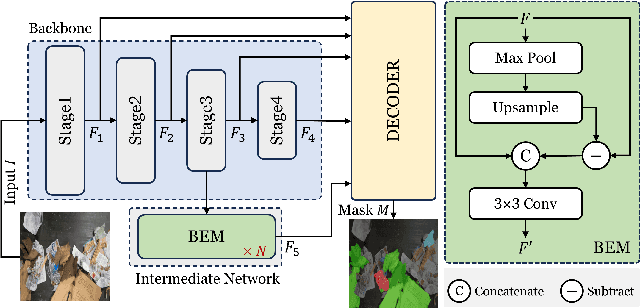


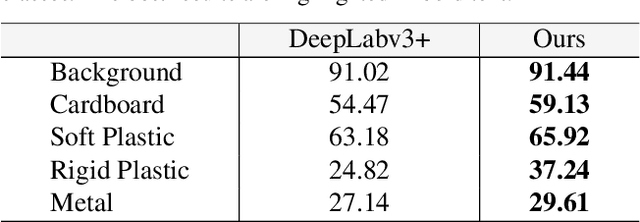
Automated waste recycling aims to efficiently separate the recyclable objects from the waste by employing vision-based systems. However, the presence of varying shaped objects having different material types makes it a challenging problem, especially in cluttered environments. Existing segmentation methods perform reasonably on many semantic segmentation datasets by employing multi-contextual representations, however, their performance is degraded when utilized for waste object segmentation in cluttered scenarios. In addition, plastic objects further increase the complexity of the problem due to their translucent nature. To address these limitations, we introduce an efficacious segmentation network, named COSNet, that uses boundary cues along with multi-contextual information to accurately segment the objects in cluttered scenes. COSNet introduces novel components including feature sharpening block (FSB) and boundary enhancement module (BEM) for enhancing the features and highlighting the boundary information of irregular waste objects in cluttered environment. Extensive experiments on three challenging datasets including ZeroWaste-f, SpectralWaste, and ADE20K demonstrate the effectiveness of the proposed method. Our COSNet achieves a significant gain of 1.8% on ZeroWaste-f and 2.1% on SpectralWaste datasets respectively in terms of mIoU metric.
FANet: Feature Amplification Network for Semantic Segmentation in Cluttered Background
Jul 12, 2024Existing deep learning approaches leave out the semantic cues that are crucial in semantic segmentation present in complex scenarios including cluttered backgrounds and translucent objects, etc. To handle these challenges, we propose a feature amplification network (FANet) as a backbone network that incorporates semantic information using a novel feature enhancement module at multi-stages. To achieve this, we propose an adaptive feature enhancement (AFE) block that benefits from both a spatial context module (SCM) and a feature refinement module (FRM) in a parallel fashion. SCM aims to exploit larger kernel leverages for the increased receptive field to handle scale variations in the scene. Whereas our novel FRM is responsible for generating semantic cues that can capture both low-frequency and high-frequency regions for better segmentation tasks. We perform experiments over challenging real-world ZeroWaste-f dataset which contains background-cluttered and translucent objects. Our experimental results demonstrate the state-of-the-art performance compared to existing methods.