 Add to Chrome
 Add to Firefox
 Add to Edge
SCRuB: Social Concept Reasoning under Rubric-Based Evaluation
May 07, 2026
While many studies of Large Language Model (LLM) reasoning capabilities emphasize mathematical or technical tasks, few address reasoning about social concepts: the abstract ideas shaping social norms, culture, and institutions. This understudied capability is essential for modern models acting as social agents, yet no systematic evaluation methodology targets it. We introduce SCRuB (Social Concept Reasoning under Rubric-Based Evaluation), a framework designed for this setting of task indeterminacy. Our goal is to measure the degree to which a model reasons about social concepts with the depth and critical rigor of a human expert. SCRuB proceeds in three phases: prompt construction from established sources, response generation by experts and models, and comparative evaluation using a five-dimensional critical thinking rubric. To enable generalization of the pipeline, we introduce a Panel of Disciplinary Perspectives ensemble validated against independent expert judges. We release SCRuBEval (n=4,711 evaluation prompts) and SCRuBAnnotations (300 expert-authored responses and 150 expert comparative judgments from 45 PhD-level scholars). Our results show that frontier models consistently outperform human experts across all five rubric dimensions. Across 1,170 pairwise comparisons, expert judges ranked a model response first in 80.8% of judgments and preferred model responses overall 74.4% of the time. Ultimately, this study provides the first expert-grounded demonstration of evaluation saturation for social concept reasoning: the single-turn exam-style format has reached its ceiling for models and humans alike.

The Llama 4 Herd: Architecture, Training, Evaluation, and Deployment Notes
Jan 15, 2026This document consolidates publicly reported technical details about Metas Llama 4 model family. It summarizes (i) released variants (Scout and Maverick) and the broader herd context including the previewed Behemoth teacher model, (ii) architectural characteristics beyond a high-level MoE description covering routed/shared-expert structure, early-fusion multimodality, and long-context design elements reported for Scout (iRoPE and length generalization strategies), (iii) training disclosures spanning pre-training, mid-training for long-context extension, and post-training methodology (lightweight SFT, online RL, and lightweight DPO) as described in release materials, (iv) developer-reported benchmark results for both base and instruction-tuned checkpoints, and (v) practical deployment constraints observed across major serving environments, including provider-specific context limits and quantization packaging. The manuscript also summarizes licensing obligations relevant to redistribution and derivative naming, and reviews publicly described safeguards and evaluation practices. The goal is to provide a compact technical reference for researchers and practitioners who need precise, source-backed facts about Llama 4.
Llama Guard 3-1B-INT4: Compact and Efficient Safeguard for Human-AI Conversations
Nov 18, 2024This paper presents Llama Guard 3-1B-INT4, a compact and efficient Llama Guard model, which has been open-sourced to the community during Meta Connect 2024. We demonstrate that Llama Guard 3-1B-INT4 can be deployed on resource-constrained devices, achieving a throughput of at least 30 tokens per second and a time-to-first-token of 2.5 seconds or less on a commodity Android mobile CPU. Notably, our experiments show that Llama Guard 3-1B-INT4 attains comparable or superior safety moderation scores to its larger counterpart, Llama Guard 3-1B, despite being approximately 7 times smaller in size (440MB).
Llama Guard 3 Vision: Safeguarding Human-AI Image Understanding Conversations
Nov 15, 2024
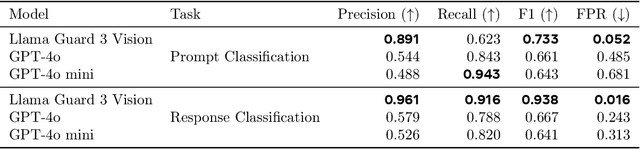


We introduce Llama Guard 3 Vision, a multimodal LLM-based safeguard for human-AI conversations that involves image understanding: it can be used to safeguard content for both multimodal LLM inputs (prompt classification) and outputs (response classification). Unlike the previous text-only Llama Guard versions (Inan et al., 2023; Llama Team, 2024b,a), it is specifically designed to support image reasoning use cases and is optimized to detect harmful multimodal (text and image) prompts and text responses to these prompts. Llama Guard 3 Vision is fine-tuned on Llama 3.2-Vision and demonstrates strong performance on the internal benchmarks using the MLCommons taxonomy. We also test its robustness against adversarial attacks. We believe that Llama Guard 3 Vision serves as a good starting point to build more capable and robust content moderation tools for human-AI conversation with multimodal capabilities.
The Llama 3 Herd of Models
Jul 31, 2024Modern artificial intelligence (AI) systems are powered by foundation models. This paper presents a new set of foundation models, called Llama 3. It is a herd of language models that natively support multilinguality, coding, reasoning, and tool usage. Our largest model is a dense Transformer with 405B parameters and a context window of up to 128K tokens. This paper presents an extensive empirical evaluation of Llama 3. We find that Llama 3 delivers comparable quality to leading language models such as GPT-4 on a plethora of tasks. We publicly release Llama 3, including pre-trained and post-trained versions of the 405B parameter language model and our Llama Guard 3 model for input and output safety. The paper also presents the results of experiments in which we integrate image, video, and speech capabilities into Llama 3 via a compositional approach. We observe this approach performs competitively with the state-of-the-art on image, video, and speech recognition tasks. The resulting models are not yet being broadly released as they are still under development.