 Add to Chrome
 Add to Firefox
 Add to Edge
Harnessing Magnitude-Only and Complex Measurements for Improved Dynamic MRI Reconstruction with Learned Priors
Aug 18, 2026
MRI reconstruction methods for undersampled k-space data naturally utilize complex-valued measurements. Parallel developments in sparse phase retrieval have shown that magnitude-only measurements may provide complementary information for signal recovery. However, their use in MRI reconstruction remains largely unexplored, due to lack of practical settings where informative magnitude measurements can be obtained without additional scan time. In this work, we investigate the use of auxiliary k-space magnitude information for accelerated steady-state dynamic MRI reconstruction, and demonstrate strong consistency of k-space magnitudes across time-frames. Building on this observation, we propose $\mathbb{C}+\text{Mag}$, a magnitude-informed physics-driven deep learning reconstruction method. The proposed method employs an ADMM-based unrolling framework with a novel magnitude-aware data-fidelity formulation, where quadratically smoothed optimization and momentum-based updates are introduced to address the non-differentiability and non-convexity of the magnitude constraints. Experiments on retrospectively undersampled cine MRI and phase-contrast flow MRI datasets, as well as prospectively undersampled real-time cine MRI acquisitions, demonstrate improved artifact suppression, sharper anatomical recovery, and better preservation of phase information compared to conventional PD-DL methods, which is further supported through blinded expert reader evaluations.

UMPIRE-Net: Unrolled Magnitude-Phase Regularization Network for Accelerated MRI
Aug 14, 2026MRI reconstruction from undersampled k-space measurements is an ill-posed inverse problem. Physics-driven deep learning (PD-DL) methods have shown strong performance for this task by combining the MRI forward model with learned image regularization within algorithm-unrolling frameworks. However, most existing PD-DL methods reconstruct complex-valued images directly, thereby implicitly coupling magnitude and phase within a single learned representation. This coupled regularization may be suboptimal in reconstruction settings where accurate phase modeling plays an important role, such as partial Fourier (PF) imaging, where recovery of the omitted asymmetric k-space measurements depends on the underlying image phase. In such scenarios, explicit modeling of magnitude and phase as separate components may reduce the reliance on externally estimated or predefined phase information. To this end, we propose UMPIRE-Net (Unrolled Magnitude-Phase In REgularization Network), a PD-DL method that introduces separate learned regularizers for magnitude and phase components, together with a novel data-fidelity formulation that enforces measurements consistency. We evaluate UMPIRE-Net for accelerated MRI with PF across different datasets and acceleration factors. Experimental results demonstrate that our proposed method improves reconstruction quality compared with a conventional complex-valued PD-DL baseline, yielding sharper images and reduced artifacts. Code available at: https://github.com/MahdiSaberii/UMPIRE-Net
Detecting and Mitigating Adversarial Attacks on Deep Learning-Based MRI Reconstruction Without Any Retraining
Jan 03, 2025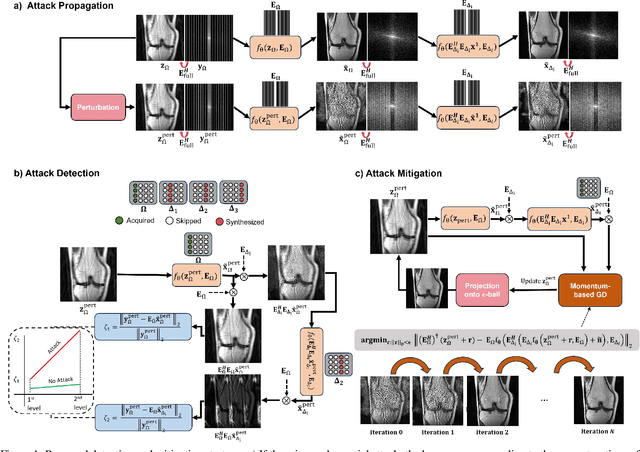
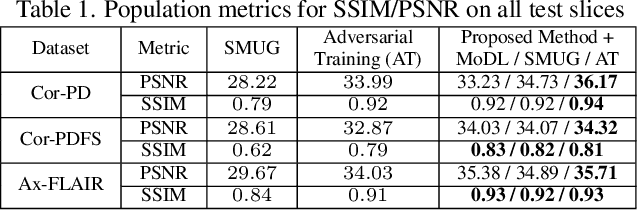
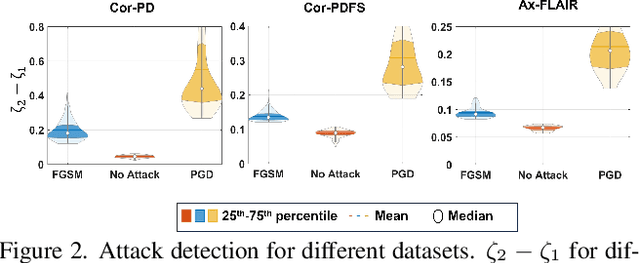
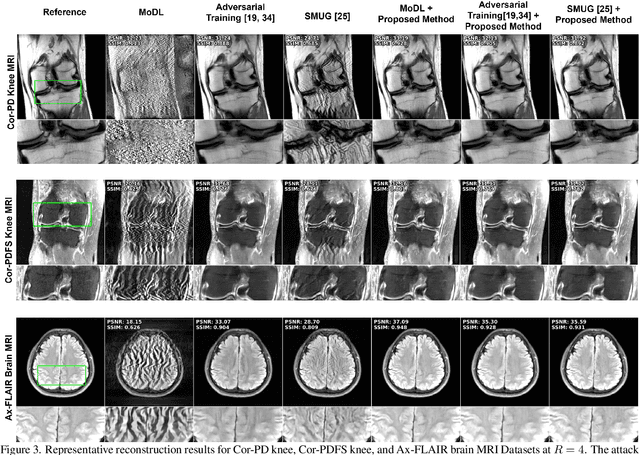
Deep learning (DL) methods, especially those based on physics-driven DL, have become the state-of-the-art for reconstructing sub-sampled magnetic resonance imaging (MRI) data. However, studies have shown that these methods are susceptible to small adversarial input perturbations, or attacks, resulting in major distortions in the output images. Various strategies have been proposed to reduce the effects of these attacks, but they require retraining and may lower reconstruction quality for non-perturbed/clean inputs. In this work, we propose a novel approach for detecting and mitigating adversarial attacks on MRI reconstruction models without any retraining. Our detection strategy is based on the idea of cyclic measurement consistency. The output of the model is mapped to another set of MRI measurements for a different sub-sampling pattern, and this synthesized data is reconstructed with the same model. Intuitively, without an attack, the second reconstruction is expected to be consistent with the first, while with an attack, disruptions are present. Subsequently, this idea is extended to devise a novel objective function, which is minimized within a small ball around the attack input for mitigation. Experimental results show that our method substantially reduces the impact of adversarial perturbations across different datasets, attack types/strengths and PD-DL networks, and qualitatively and quantitatively outperforms conventional mitigation methods that involve retraining.