 Add to Chrome
 Add to Firefox
 Add to Edge
Online Algorithms with Unreliable Guidance
Feb 24, 2026
This paper introduces a new model for ML-augmented online decision making, called online algorithms with unreliable guidance (OAG). This model completely separates between the predictive and algorithmic components, thus offering a single well-defined analysis framework that relies solely on the considered problem. Formulated through the lens of request-answer games, an OAG algorithm receives, with each incoming request, a piece of guidance which is taken from the problem's answer space; ideally, this guidance is the optimal answer for the current request, however with probability $β$, the guidance is adversarially corrupted. The goal is to develop OAG algorithms that admit good competitiveness when $β= 0$ (a.k.a. consistency) as well as when $β= 1$ (a.k.a. robustness); the appealing notion of smoothness, that in most prior work required a dedicated loss function, now arises naturally as $β$ shifts from $0$ to $1$. We then describe a systematic method, called the drop or trust blindly (DTB) compiler, which transforms any online algorithm into a learning-augmented online algorithm in the OAG model. Given a prediction-oblivious online algorithm, its learning-augmented counterpart produced by applying the DTB compiler either follows the incoming guidance blindly or ignores it altogether and proceeds as the initial algorithm would have; the choice between these two alternatives is based on the outcome of a (biased) coin toss. As our main technical contribution, we prove (rigorously) that although remarkably simple, the class of algorithms produced via the DTB compiler includes algorithms with attractive consistency-robustness guarantees for three classic online problems: for caching and uniform metrical task systems our algorithms are optimal, whereas for bipartite matching (with adversarial arrival order), our algorithm outperforms the state-of-the-art.

Credence: Augmenting Datacenter Switch Buffer Sharing with ML Predictions
Jan 05, 2024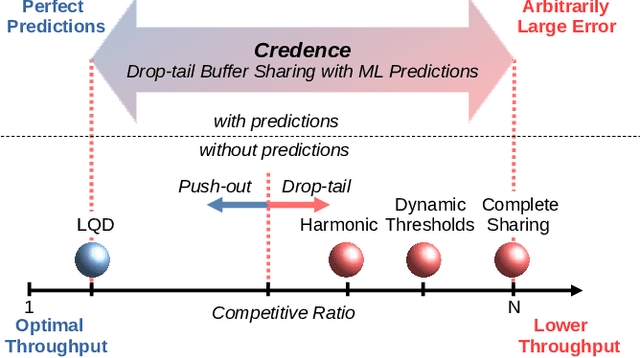
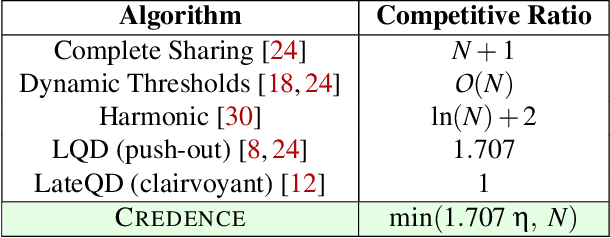
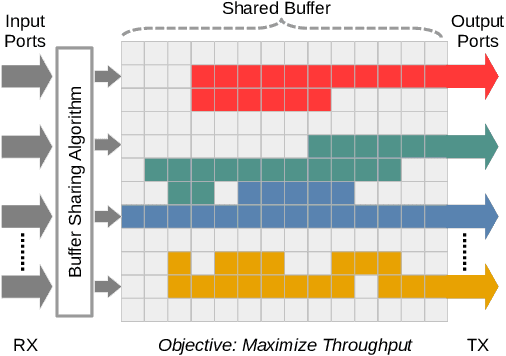
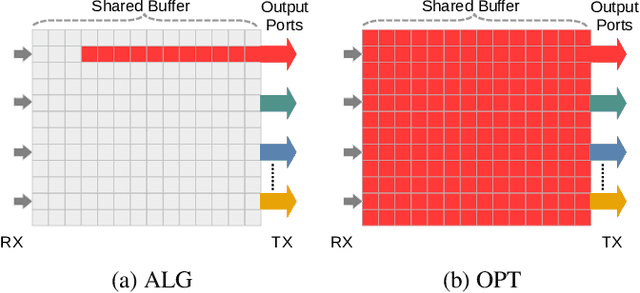
Packet buffers in datacenter switches are shared across all the switch ports in order to improve the overall throughput. The trend of shrinking buffer sizes in datacenter switches makes buffer sharing extremely challenging and a critical performance issue. Literature suggests that push-out buffer sharing algorithms have significantly better performance guarantees compared to drop-tail algorithms. Unfortunately, switches are unable to benefit from these algorithms due to lack of support for push-out operations in hardware. Our key observation is that drop-tail buffers can emulate push-out buffers if the future packet arrivals are known ahead of time. This suggests that augmenting drop-tail algorithms with predictions about the future arrivals has the potential to significantly improve performance. This paper is the first research attempt in this direction. We propose Credence, a drop-tail buffer sharing algorithm augmented with machine-learned predictions. Credence can unlock the performance only attainable by push-out algorithms so far. Its performance hinges on the accuracy of predictions. Specifically, Credence achieves near-optimal performance of the best known push-out algorithm LQD (Longest Queue Drop) with perfect predictions, but gracefully degrades to the performance of the simplest drop-tail algorithm Complete Sharing when the prediction error gets arbitrarily worse. Our evaluations show that Credence improves throughput by $1.5$x compared to traditional approaches. In terms of flow completion times, we show that Credence improves upon the state-of-the-art approaches by up to $95\%$ using off-the-shelf machine learning techniques that are also practical in today's hardware. We believe this work opens several interesting future work opportunities both in systems and theory that we discuss at the end of this paper.
Multi-GPU parallel memetic algorithm for capacitated vehicle routing problem
Mar 06, 2017


The goal of this paper is to propose and test a new memetic algorithm for the capacitated vehicle routing problem in parallel computing environment. In this paper we consider simple variation of vehicle routing problem in which the only parameter is the capacity of the vehicle and each client only needs one package. We present simple reduction to prove the existence of polynomial-time algorithm for capacity 2. We analyze the efficiency of the algorithm using hierarchical Parallel Random Access Machine (PRAM) model and run experiments with code written in CUDA (for capacities larger than 2).