 Add to Chrome
 Add to Firefox
 Add to Edge
UniDex: A Robot Foundation Suite for Universal Dexterous Hand Control from Egocentric Human Videos
Mar 23, 2026
Dexterous manipulation remains challenging due to the cost of collecting real-robot teleoperation data, the heterogeneity of hand embodiments, and the high dimensionality of control. We present UniDex, a robot foundation suite that couples a large-scale robot-centric dataset with a unified vision-language-action (VLA) policy and a practical human-data capture setup for universal dexterous hand control. First, we construct UniDex-Dataset, a robot-centric dataset over 50K trajectories across eight dexterous hands (6--24 DoFs), derived from egocentric human video datasets. To transform human data into robot-executable trajectories, we employ a human-in-the-loop retargeting procedure to align fingertip trajectories while preserving plausible hand-object contacts, and we operate on explicit 3D pointclouds with human hands masked to narrow kinematic and visual gaps. Second, we introduce the Function-Actuator-Aligned Space (FAAS), a unified action space that maps functionally similar actuators to shared coordinates, enabling cross-hand transfer. Leveraging FAAS as the action parameterization, we train UniDex-VLA, a 3D VLA policy pretrained on UniDex-Dataset and finetuned with task demonstrations. In addition, we build UniDex-Cap, a simple portable capture setup that records synchronized RGB-D streams and human hand poses and converts them into robot-executable trajectories to enable human-robot data co-training that reduces reliance on costly robot demonstrations. On challenging tool-use tasks across two different hands, UniDex-VLA achieves 81% average task progress and outperforms prior VLA baselines by a large margin, while exhibiting strong spatial, object, and zero-shot cross-hand generalization. Together, UniDex-Dataset, UniDex-VLA, and UniDex-Cap provide a scalable foundation suite for universal dexterous manipulation.

X-Distill: Cross-Architecture Vision Distillation for Visuomotor Learning
Jan 16, 2026Visuomotor policies often leverage large pre-trained Vision Transformers (ViTs) for their powerful generalization capabilities. However, their significant data requirements present a major challenge in the data-scarce context of most robotic learning settings, where compact CNNs with strong inductive biases can be more easily optimized. To address this trade-off, we introduce X-Distill, a simple yet highly effective method that synergizes the strengths of both architectures. Our approach involves an offline, cross-architecture knowledge distillation, transferring the rich visual representations of a large, frozen DINOv2 teacher to a compact ResNet-18 student on the general-purpose ImageNet dataset. This distilled encoder, now endowed with powerful visual priors, is then jointly fine-tuned with a diffusion policy head on the target manipulation tasks. Extensive experiments on $34$ simulated benchmarks and $5$ challenging real-world tasks demonstrate that our method consistently outperforms policies equipped with from-scratch ResNet or fine-tuned DINOv2 encoders. Notably, X-Distill also surpasses 3D encoders that utilize privileged point cloud observations or much larger Vision-Language Models. Our work highlights the efficacy of a simple, well-founded distillation strategy for achieving state-of-the-art performance in data-efficient robotic manipulation.
MoE-DP: An MoE-Enhanced Diffusion Policy for Robust Long-Horizon Robotic Manipulation with Skill Decomposition and Failure Recovery
Nov 07, 2025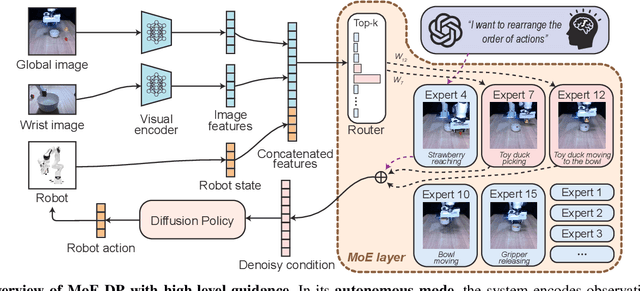
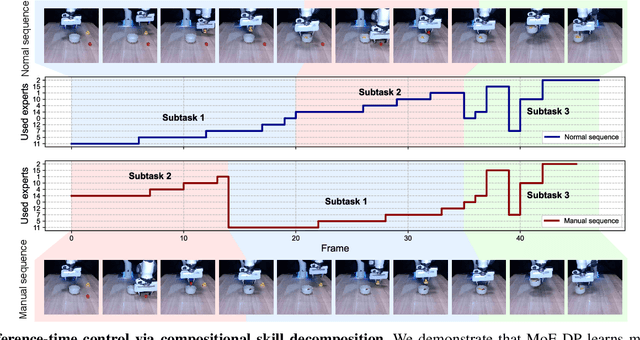
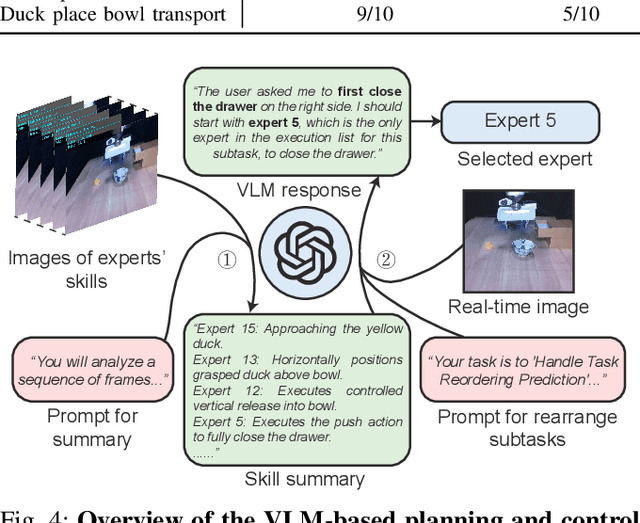
Diffusion policies have emerged as a powerful framework for robotic visuomotor control, yet they often lack the robustness to recover from subtask failures in long-horizon, multi-stage tasks and their learned representations of observations are often difficult to interpret. In this work, we propose the Mixture of Experts-Enhanced Diffusion Policy (MoE-DP), where the core idea is to insert a Mixture of Experts (MoE) layer between the visual encoder and the diffusion model. This layer decomposes the policy's knowledge into a set of specialized experts, which are dynamically activated to handle different phases of a task. We demonstrate through extensive experiments that MoE-DP exhibits a strong capability to recover from disturbances, significantly outperforming standard baselines in robustness. On a suite of 6 long-horizon simulation tasks, this leads to a 36% average relative improvement in success rate under disturbed conditions. This enhanced robustness is further validated in the real world, where MoE-DP also shows significant performance gains. We further show that MoE-DP learns an interpretable skill decomposition, where distinct experts correspond to semantic task primitives (e.g., approaching, grasping). This learned structure can be leveraged for inference-time control, allowing for the rearrangement of subtasks without any re-training.Our video and code are available at the https://moe-dp-website.github.io/MoE-DP-Website/.