 Add to Chrome
 Add to Firefox
 Add to Edge
Uncertainty-Aware Ensemble Deep Randomized Neural Networks for Classification
Aug 07, 2026
The current state-of-the-art (SOTA) deep randomized neural networks, such as deep Random Vector Functional Link (dRVFL) and ensemble deep RVFL (edRVFL), treat all training samples uniformly, which limits their robustness and effectiveness when applied to real-world datasets containing noise and outliers. Furthermore, the propagation of contaminated features across hidden layers negatively influences the decision-making capability of these models. To overcome these limitations, we propose intuitionistic fuzzy dRVFL (IF-dRVFL) and intuitionistic fuzzy edRVFL (IF-edRVFL) frameworks that enhance model robustness. The proposed models unify intuitionistic fuzzy theory to exploit sample neighborhood information in the kernel space by jointly considering membership and non-membership degrees for each sample. Membership degrees are computed based on the distance of samples from their respective class centroids, while non-membership degrees quantify sample heterogeneity within local neighborhoods. These measures are employed to assign adaptive weights to training samples, enabling effective discrimination among clean, noisy, and outlier data points. Extensive experiments conducted on UCI and KEEL benchmark datasets, with and without the presence of Gaussian noise, demonstrate the superiority of the proposed IF-dRVFL and IF-edRVFL models over existing SOTA fuzzy and non-fuzzy approaches. The source code is available at https://github.com/mtanveer1/IF-edRVFL.

Physics-Informed Broad Learning System: An Efficient Backpropagation-Free Framework for Solving Partial Differential Equations
Jul 28, 2026Physics-informed neural networks (PINNs) have emerged as a powerful paradigm for solving partial differential equations (PDEs) by embedding governing physical laws into deep neural networks. However, their reliance on computationally expensive gradient-based optimization and deep architectures often results in slow training, high computational cost, and limited scalability. In this work, we propose a novel physics-informed broad learning system (PI-BLS), the first physics-informed learning framework based on broad RdNNs. The proposed formulation embeds the governing differential operator and the associated initial and boundary constraints directly into a linear output-layer optimization problem, thereby replacing nonlinear gradient-based training with a deterministic least-squares solution obtained via the pseudoinverse. Consequently, the entire learning process is reduced to a single linear optimization stage while preserving the underlying physical constraints. As a result, PI-BLS offers an efficient learning paradigm for a physics-informed learning framework for solving PDEs that eliminates iterative backpropagation while preserving the underlying physical constraints. Experimental results on representative forward PDE benchmarks demonstrate that PI-BLS achieves competitive and often superior performance with reduced training time and model parameters compared with conventional PINNs.
Twin Restricted Kernel Machines for Multiview Classification
Dec 12, 2025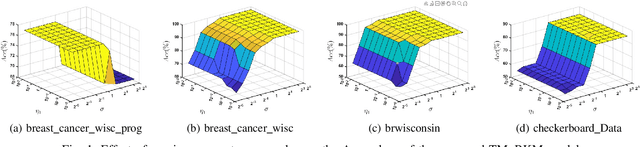
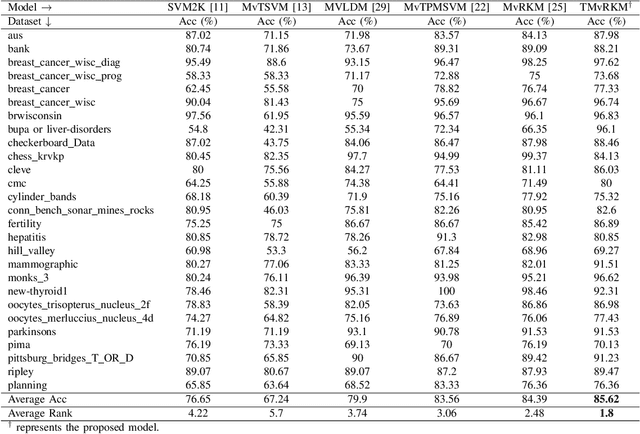
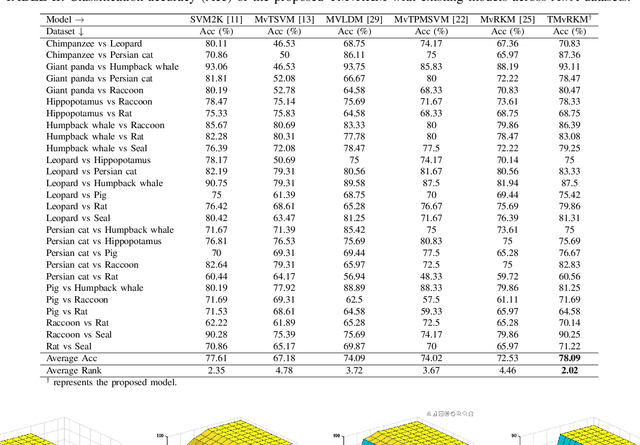
Multi-view learning (MVL) is an emerging field in machine learning that focuses on improving generalization performance by leveraging complementary information from multiple perspectives or views. Various multi-view support vector machine (MvSVM) approaches have been developed, demonstrating significant success. Moreover, these models face challenges in effectively capturing decision boundaries in high-dimensional spaces using the kernel trick. They are also prone to errors and struggle with view inconsistencies, which are common in multi-view datasets. In this work, we introduce the multiview twin restricted kernel machine (TMvRKM), a novel model that integrates the strengths of kernel machines with the multiview framework, addressing key computational and generalization challenges associated with traditional kernel-based approaches. Unlike traditional methods that rely on solving large quadratic programming problems (QPPs), the proposed TMvRKM efficiently determines an optimal separating hyperplane through a regularized least squares approach, enhancing both computational efficiency and classification performance. The primal objective of TMvRKM includes a coupling term designed to balance errors across multiple views effectively. By integrating early and late fusion strategies, TMvRKM leverages the collective information from all views during training while remaining flexible to variations specific to individual views. The proposed TMvRKM model is rigorously tested on UCI, KEEL, and AwA benchmark datasets. Both experimental results and statistical analyses consistently highlight its exceptional generalization performance, outperforming baseline models in every scenario.
* pp. 1-8
Enhancing Robustness and Efficiency of Least Square Twin SVM via Granular Computing
Oct 22, 2024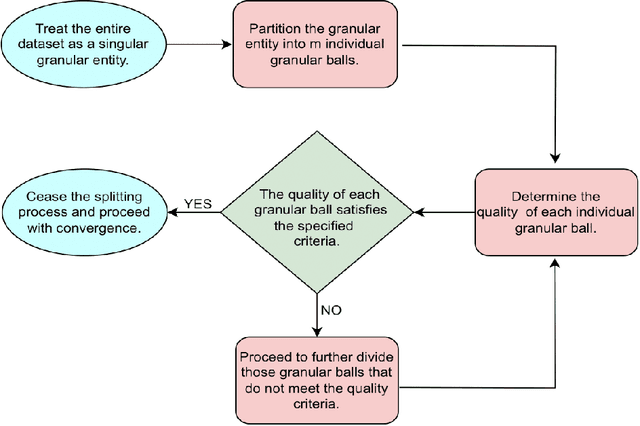

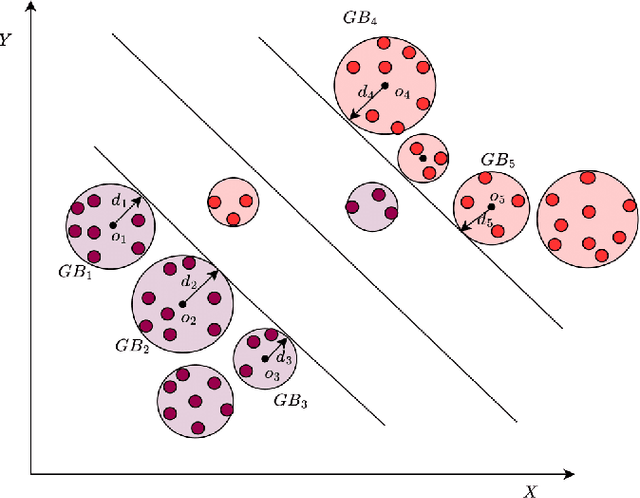

In the domain of machine learning, least square twin support vector machine (LSTSVM) stands out as one of the state-of-the-art models. However, LSTSVM suffers from sensitivity to noise and outliers, overlooking the SRM principle and instability in resampling. Moreover, its computational complexity and reliance on matrix inversions hinder the efficient processing of large datasets. As a remedy to the aforementioned challenges, we propose the robust granular ball LSTSVM (GBLSTSVM). GBLSTSVM is trained using granular balls instead of original data points. The core of a granular ball is found at its center, where it encapsulates all the pertinent information of the data points within the ball of specified radius. To improve scalability and efficiency, we further introduce the large-scale GBLSTSVM (LS-GBLSTSVM), which incorporates the SRM principle through regularization terms. Experiments are performed on UCI, KEEL, and NDC benchmark datasets; both the proposed GBLSTSVM and LS-GBLSTSVM models consistently outperform the baseline models.
Enhanced Feature Based Granular Ball Twin Support Vector Machine
Oct 08, 2024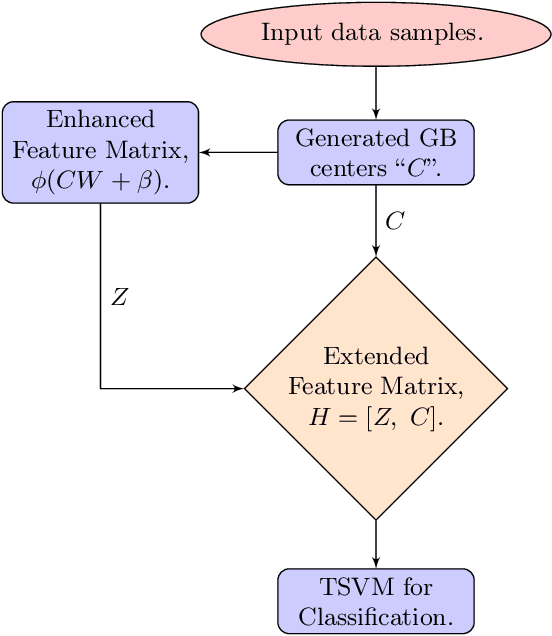
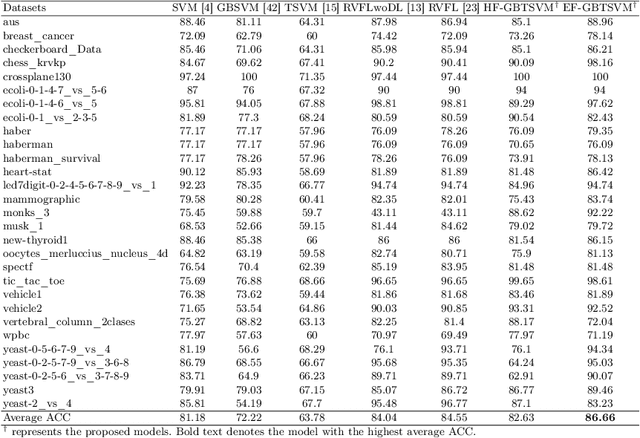
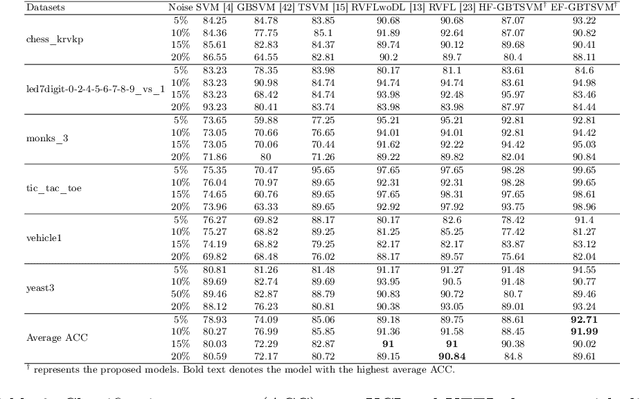
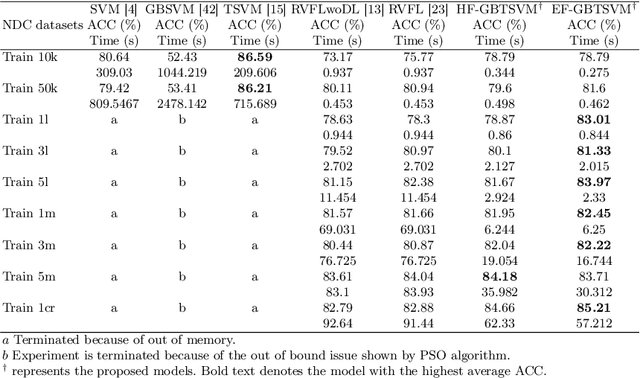
In this paper, we propose enhanced feature based granular ball twin support vector machine (EF-GBTSVM). EF-GBTSVM employs the coarse granularity of granular balls (GBs) as input rather than individual data samples. The GBs are mapped to the feature space of the hidden layer using random projection followed by the utilization of a non-linear activation function. The concatenation of original and hidden features derived from the centers of GBs gives rise to an enhanced feature space, commonly referred to as the random vector functional link (RVFL) space. This space encapsulates nuanced feature information to GBs. Further, we employ twin support vector machine (TSVM) in the RVFL space for classification. TSVM generates the two non-parallel hyperplanes in the enhanced feature space, which improves the generalization performance of the proposed EF-GBTSVM model. Moreover, the coarser granularity of the GBs enables the proposed EF-GBTSVM model to exhibit robustness to resampling, showcasing reduced susceptibility to the impact of noise and outliers. We undertake a thorough evaluation of the proposed EF-GBTSVM model on benchmark UCI and KEEL datasets. This evaluation encompasses scenarios with and without the inclusion of label noise. Moreover, experiments using NDC datasets further emphasize the proposed model's ability to handle large datasets. Experimental results, supported by thorough statistical analyses, demonstrate that the proposed EF-GBTSVM model significantly outperforms the baseline models in terms of generalization capabilities, scalability, and robustness. The source code for the proposed EF-GBTSVM model, along with additional results and further details, can be accessed at https://github.com/mtanveer1/EF-GBTSVM.
Granular Ball Twin Support Vector Machine
Oct 07, 2024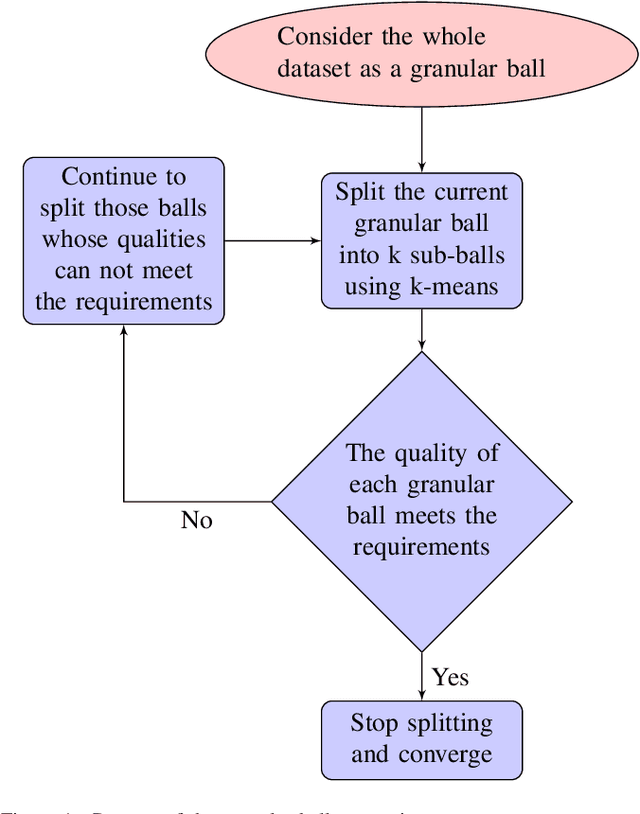
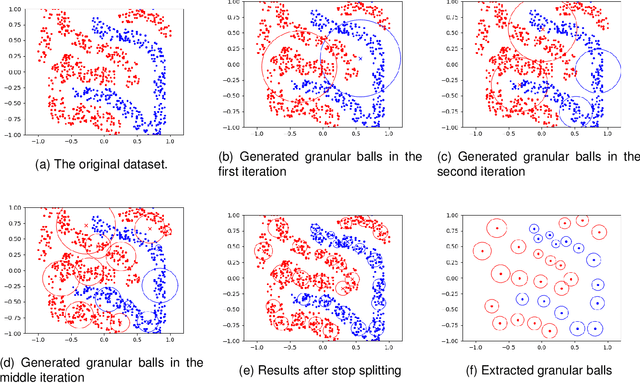
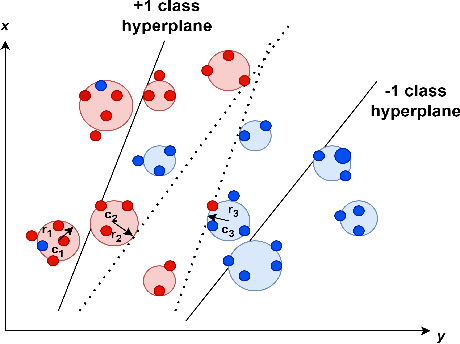

On Efficient and Scalable Computation of the Nonparametric Maximum Likelihood Estimator in Mixture ModelsTwin support vector machine (TSVM) is an emerging machine learning model with versatile applicability in classification and regression endeavors. Nevertheless, TSVM confronts noteworthy challenges: $(i)$ the imperative demand for matrix inversions presents formidable obstacles to its efficiency and applicability on large-scale datasets; $(ii)$ the omission of the structural risk minimization (SRM) principle in its primal formulation heightens the vulnerability to overfitting risks; and $(iii)$ the TSVM exhibits a high susceptibility to noise and outliers, and also demonstrates instability when subjected to resampling. In view of the aforementioned challenges, we propose the granular ball twin support vector machine (GBTSVM). GBTSVM takes granular balls, rather than individual data points, as inputs to construct a classifier. These granular balls, characterized by their coarser granularity, exhibit robustness to resampling and reduced susceptibility to the impact of noise and outliers. We further propose a novel large-scale granular ball twin support vector machine (LS-GBTSVM). LS-GBTSVM's optimization formulation ensures two critical facets: $(i)$ it eliminates the need for matrix inversions, streamlining the LS-GBTSVM's computational efficiency, and $(ii)$ it incorporates the SRM principle through the incorporation of regularization terms, effectively addressing the issue of overfitting. The proposed LS-GBTSVM exemplifies efficiency, scalability for large datasets, and robustness against noise and outliers. We conduct a comprehensive evaluation of the GBTSVM and LS-GBTSVM models on benchmark datasets from UCI, KEEL, and NDC datasets. Our experimental findings and statistical analyses affirm the superior generalization prowess of the proposed GBTSVM and LS-GBTSVM models.
* Manuscript submitted to IEEE TRANSACTIONS ON NEURAL NETWORKS AND LEARNING SYSTEMS: 19 September 2023; revised 13 February 2024 and 14 July 2024; accepted 05 October 2024
GB-RVFL: Fusion of Randomized Neural Network and Granular Ball Computing
Sep 25, 2024The random vector functional link (RVFL) network is a prominent classification model with strong generalization ability. However, RVFL treats all samples uniformly, ignoring whether they are pure or noisy, and its scalability is limited due to the need for inverting the entire training matrix. To address these issues, we propose granular ball RVFL (GB-RVFL) model, which uses granular balls (GBs) as inputs instead of training samples. This approach enhances scalability by requiring only the inverse of the GB center matrix and improves robustness against noise and outliers through the coarse granularity of GBs. Furthermore, RVFL overlooks the dataset's geometric structure. To address this, we propose graph embedding GB-RVFL (GE-GB-RVFL) model, which fuses granular computing and graph embedding (GE) to preserve the topological structure of GBs. The proposed GB-RVFL and GE-GB-RVFL models are evaluated on KEEL, UCI, NDC and biomedical datasets, demonstrating superior performance compared to baseline models.
GRVFL-2V: Graph Random Vector Functional Link Based on Two-View Learning
Sep 07, 2024The classification performance of the random vector functional link (RVFL), a randomized neural network, has been widely acknowledged. However, due to its shallow learning nature, RVFL often fails to consider all the relevant information available in a dataset. Additionally, it overlooks the geometrical properties of the dataset. To address these limitations, a novel graph random vector functional link based on two-view learning (GRVFL-2V) model is proposed. The proposed model is trained on multiple views, incorporating the concept of multiview learning (MVL), and it also incorporates the geometrical properties of all the views using the graph embedding (GE) framework. The fusion of RVFL networks, MVL, and GE framework enables our proposed model to achieve the following: i) \textit{efficient learning}: by leveraging the topology of RVFL, our proposed model can efficiently capture nonlinear relationships within the multi-view data, facilitating efficient and accurate predictions; ii) \textit{comprehensive representation}: fusing information from diverse perspectives enhance the proposed model's ability to capture complex patterns and relationships within the data, thereby improving the model's overall generalization performance; and iii) \textit{structural awareness}: by employing the GE framework, our proposed model leverages the original data distribution of the dataset by naturally exploiting both intrinsic and penalty subspace learning criteria. The evaluation of the proposed GRVFL-2V model on various datasets, including 27 UCI and KEEL datasets, 50 datasets from Corel5k, and 45 datasets from AwA, demonstrates its superior performance compared to baseline models. These results highlight the enhanced generalization capabilities of the proposed GRVFL-2V model across a diverse range of datasets.
Multiview Random Vector Functional Link Network for Predicting DNA-Binding Proteins
Sep 04, 2024The identification of DNA-binding proteins (DBPs) is a critical task due to their significant impact on various biological activities. Understanding the mechanisms underlying protein-DNA interactions is essential for elucidating various life activities. In recent years, machine learning-based models have been prominently utilized for DBP prediction. In this paper, to predict DBPs, we propose a novel framework termed a multiview random vector functional link (MvRVFL) network, which fuses neural network architecture with multiview learning. The proposed MvRVFL model combines the benefits of late and early fusion, allowing for distinct regularization parameters across different views while leveraging a closed-form solution to determine unknown parameters efficiently. The primal objective function incorporates a coupling term aimed at minimizing a composite of errors stemming from all views. From each of the three protein views of the DBP datasets, we extract five features. These features are then fused together by incorporating a hidden feature during the model training process. The performance of the proposed MvRVFL model on the DBP dataset surpasses that of baseline models, demonstrating its superior effectiveness. Furthermore, we extend our assessment to the UCI, KEEL, AwA, and Corel5k datasets, to establish the practicality of the proposed models. The consistency error bound, the generalization error bound, and empirical findings, coupled with rigorous statistical analyses, confirm the superior generalization capabilities of the MvRVFL model compared to the baseline models.
LSTMSE-Net: Long Short Term Speech Enhancement Network for Audio-visual Speech Enhancement
Sep 03, 2024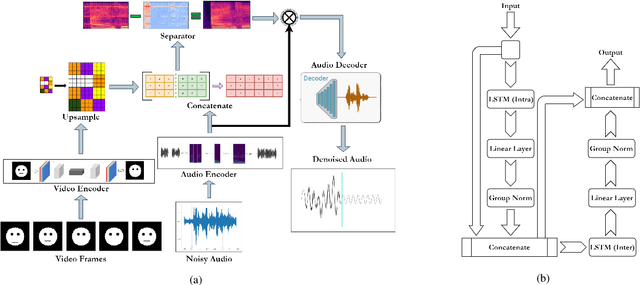

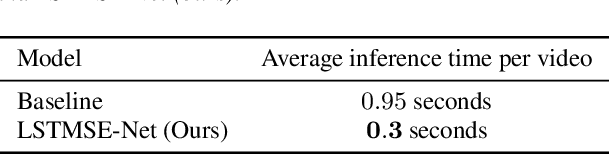
In this paper, we propose long short term memory speech enhancement network (LSTMSE-Net), an audio-visual speech enhancement (AVSE) method. This innovative method leverages the complementary nature of visual and audio information to boost the quality of speech signals. Visual features are extracted with VisualFeatNet (VFN), and audio features are processed through an encoder and decoder. The system scales and concatenates visual and audio features, then processes them through a separator network for optimized speech enhancement. The architecture highlights advancements in leveraging multi-modal data and interpolation techniques for robust AVSE challenge systems. The performance of LSTMSE-Net surpasses that of the baseline model from the COG-MHEAR AVSE Challenge 2024 by a margin of 0.06 in scale-invariant signal-to-distortion ratio (SISDR), $0.03$ in short-time objective intelligibility (STOI), and $1.32$ in perceptual evaluation of speech quality (PESQ). The source code of the proposed LSTMSE-Net is available at \url{https://github.com/mtanveer1/AVSEC-3-Challenge}.