 Add to Chrome
 Add to Firefox
 Add to Edge
RoBell-RVFL: A Robust Generalized Bell Random Vector Functional Link Network
Aug 17, 2026
The dominance of majority classes in real-world datasets poses a fundamental challenge to randomized neural networks, often biasing decision boundaries and overlooking critical minority samples. Existing remedies, such as synthetic minority over-sampling (SMOTE) and class-weighted loss functions, primarily address class proportions while neglecting intra-class distribution, making them vulnerable to label noise and outliers. In this paper, we propose \textbf{RoBell-RVFL}, a robust and lightweight \emph{quality-aware} generalized bell random vector functional link network that redefines how randomized models handle class imbalance and noisy data. RoBell-RVFL employs a dual-strategy, sample-level weighting mechanism that strictly preserves minority class information using unit weights, while adaptively regulating the influence of majority class samples through a probability-weighted generalized bell (gbell) membership function in a kernel-induced feature space. This design effectively suppresses noisy, boundary, and outlier samples within the majority class, enabling the network to learn from informative samples rather than merely abundant ones. By explicitly incorporating local class probability and class distribution information into the learning process, RoBell-RVFL achieves adaptive control over sample contributions without sacrificing the closed-form learning efficiency of RVFL networks. Extensive evaluations on UCI and KEEL benchmark datasets, along with robustness tests under up to 40\% label noise, demonstrate that RoBell-RVFL consistently and significantly outperforms recent state-of-the-art RVFL variants. The results indicate that adaptive, quality-aware sample weighting is essential for robust RVFL learning, rendering conventional global weighting schemes ineffective in noisy and imbalanced environments.

Robust Dual-Model Collaborative Random Vector Functional Link Network
Aug 13, 2026Random vector functional link (RVFL) networks are lightweight and fast neural models that offer efficient training and strong generalization through randomized hidden-layer weights and direct input-output connections. However, conventional RVFL models are sensitive to noisy labels, outliers, and imbalanced data, which limits their performance in real-world applications. To address these challenges, we propose the kernel risk-sensitive mean p-power based RVFL (KRPRVFL) model, which integrates the computational efficiency of RVFL with the robustness of the kernel risk-sensitive mean p-power (KRP) criterion. By replacing the standard least-squares objective with a KRP-based loss, KRPRVFL adaptively reduces the influence of corrupted or unreliable samples during training, resulting in improved stability and generalization. Additionally, a collaborative learning mechanism is introduced to enable adaptive interaction among model components, further enhancing robustness in complex and noisy environments. The proposed framework also leverages kernel-induced feature mapping to capture nonlinear relationships without requiring explicit hidden-layer selection, maintaining both efficiency and scalability. Extensive experiments on UCI and KEEL benchmark datasets demonstrate that KRPRVFL consistently outperforms baseline models in terms of accuracy, robustness, and statistical significance, highlighting its effectiveness as a fast, scalable, and reliable solution for challenging classification tasks.
Uncertainty-Aware Ensemble Deep Randomized Neural Networks for Classification
Aug 07, 2026The current state-of-the-art (SOTA) deep randomized neural networks, such as deep Random Vector Functional Link (dRVFL) and ensemble deep RVFL (edRVFL), treat all training samples uniformly, which limits their robustness and effectiveness when applied to real-world datasets containing noise and outliers. Furthermore, the propagation of contaminated features across hidden layers negatively influences the decision-making capability of these models. To overcome these limitations, we propose intuitionistic fuzzy dRVFL (IF-dRVFL) and intuitionistic fuzzy edRVFL (IF-edRVFL) frameworks that enhance model robustness. The proposed models unify intuitionistic fuzzy theory to exploit sample neighborhood information in the kernel space by jointly considering membership and non-membership degrees for each sample. Membership degrees are computed based on the distance of samples from their respective class centroids, while non-membership degrees quantify sample heterogeneity within local neighborhoods. These measures are employed to assign adaptive weights to training samples, enabling effective discrimination among clean, noisy, and outlier data points. Extensive experiments conducted on UCI and KEEL benchmark datasets, with and without the presence of Gaussian noise, demonstrate the superiority of the proposed IF-dRVFL and IF-edRVFL models over existing SOTA fuzzy and non-fuzzy approaches. The source code is available at https://github.com/mtanveer1/IF-edRVFL.
Mitigating Class-Tail Undercoverage in Medical Vision-Language Models under Clinical Shift
Jul 30, 2026Medical vision-language models (VLMs) can retain high observed marginal coverage after clinical shift while substantially under-covering an individual disease class. The affected class varies with acquisition protocol and backbone geometry, so source prevalence does not reliably reveal the failure. Existing localized and tail-aware conformal methods respectively adapt to test neighborhoods and source-frequency tails, leaving held-out class-wise coverage failure unmodeled. We introduce Class-Tail Adaptive Localized Conformal Deferral (CALCoDe), a post-hoc reliability layer for frozen medical VLMs. Cross-fitted validation predictions identify classes at risk of undercoverage, and a disjoint calibration split estimates their class-conditional tail thresholds. CALCoDe combines each protected threshold with a localized conformal threshold using a one-sided maximum. The resulting set contains every label admitted by the localized rule, with additional protection confined to validation-identified classes. An independently calibrated support audit defers cases with insufficient inlier support. Under exchangeability among accepted examples within each protected class, CALCoDe provides finite-sample coverage at the prespecified guard level and contains the corresponding localized conformal sets; coverage on shifted external cohorts is evaluated empirically. Among standard conformal baselines and recent VLM-specific conformal methods evaluated across two dermatology shifts (HAM10000 to ISIC 2019 and HAM10000 to PAD-UFES-20) and four frozen VLM backbones (BiomedCLIP, OpenAI CLIP ViT-B/32, PubMedCLIP ViT-B/32, and MedSigLIP-448), CALCoDe is the only approach whose observed marginal and worst-class accepted coverage both reach 0.95 in all eight settings. On HAM10000 to ISIC 2019, its average worst-class accepted coverage is 0.970, compared with 0.926 for sTACP and 0.864 for LCP-VLM.
Physics-Informed Broad Learning System: An Efficient Backpropagation-Free Framework for Solving Partial Differential Equations
Jul 28, 2026Physics-informed neural networks (PINNs) have emerged as a powerful paradigm for solving partial differential equations (PDEs) by embedding governing physical laws into deep neural networks. However, their reliance on computationally expensive gradient-based optimization and deep architectures often results in slow training, high computational cost, and limited scalability. In this work, we propose a novel physics-informed broad learning system (PI-BLS), the first physics-informed learning framework based on broad RdNNs. The proposed formulation embeds the governing differential operator and the associated initial and boundary constraints directly into a linear output-layer optimization problem, thereby replacing nonlinear gradient-based training with a deterministic least-squares solution obtained via the pseudoinverse. Consequently, the entire learning process is reduced to a single linear optimization stage while preserving the underlying physical constraints. As a result, PI-BLS offers an efficient learning paradigm for a physics-informed learning framework for solving PDEs that eliminates iterative backpropagation while preserving the underlying physical constraints. Experimental results on representative forward PDE benchmarks demonstrate that PI-BLS achieves competitive and often superior performance with reduced training time and model parameters compared with conventional PINNs.
CAWI: Copula-Aligned Weight Initialization for Randomized Neural Networks
May 12, 2026Randomized neural networks (RdNNs) enable efficient, backpropagation-free training by freezing randomly initialized input-to-hidden weights, which permits a closed-form solution for the output layer. However, conventional random initialization is blind to inter-feature dependence, ignoring correlations, asymmetries, and tail dependence in the data, which degrades conditioning and predictive performance. To the best of our knowledge, this limitation remains unaddressed in the RdNN literature. To close this gap, we propose CAWI (Copula-Aligned Weight Initialization), a framework that draws input-to-hidden weights from a data-fitted copula that matches empirical dependence, ensuring the frozen projections respect inter-feature dependence without sacrificing the closed-form solution. CAWI (i) maps each feature to the unit interval using empirical CDFs, (ii) fits a multivariate copula that captures rank-based dependence among features, and (iii) samples each weight column w_j from the fitted copula and applies a fixed inverse marginal transform to set scale. The objective, solver, and "freeze-once" paradigm remain unchanged; only the sampling law for W becomes dependence-aware. For dependence modeling, we consider two copula families: elliptical (Gaussian, t) and Archimedean (Clayton, Frank, Gumbel). This enables CAWI to handle diverse dependence, including tail dependence. We evaluate CAWI across 83 diverse classification benchmarks (binary and multiclass) and two biomedical datasets, BreaKHis and the Schizophrenia dataset, using standard shallow and deep RdNN architectures. CAWI consistently delivers significant improvements in predictive performance over conventional random initialization. Code is available at: https://github.com/mtanveer1/CAWI
A Novel Framework using Intuitionistic Fuzzy Logic with U-Net and U-Net++ Architecture: A case Study of MRI Bain Image Segmentation
Mar 15, 2026Accurate segmentation of brain images from magnetic resonance imaging (MRI) scans plays a pivotal role in brain image analysis and the diagnosis of neurological disorders. Deep learning algorithms, particularly U-Net and U-Net++, are widely used for image segmentation. However, it finds difficult to deal with uncertainty in images. To address this challenge, this work integrates intuitionistic fuzzy logic into U-Net and U-Net++, propose a novel framework, named as IFS U-Net and IFS U-Net++. These models accept input data in an intuitionistic fuzzy representation to manage uncertainty arising from vague ness and imprecise data. This approach effectively handles tissue ambiguity caused by the partial volume effect and boundary uncertainties. To evaluate the effectiveness of IFS U-Net and IFS U-Net++, experiments are conducted on two publicly available MRI brain datasets: the Internet Brain Segmentation Repository (IBSR) and the Open Access Series of Imaging Studies (OASIS). Segmentation performance is quantitatively assessed using Accuracy, Dice Coefficient, and Intersection over Union (IoU). The results demonstrate that the proposed architectures consistently improve segmentation performance by effectively addressing uncertainty
Twin Restricted Kernel Machines for Multiview Classification
Dec 12, 2025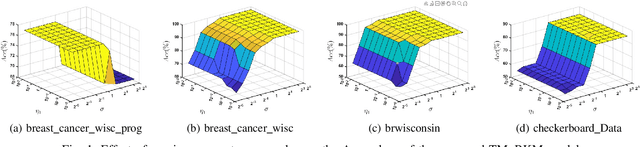
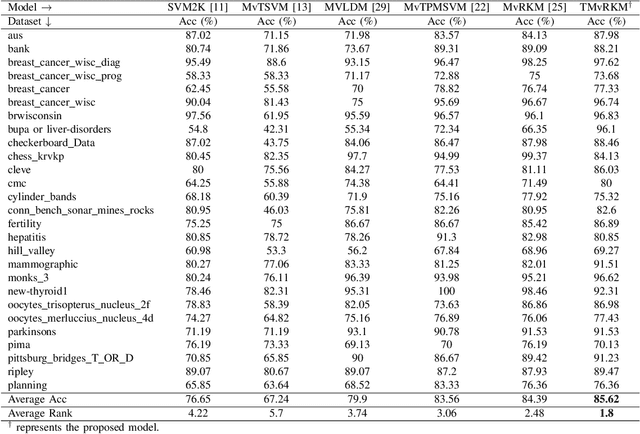
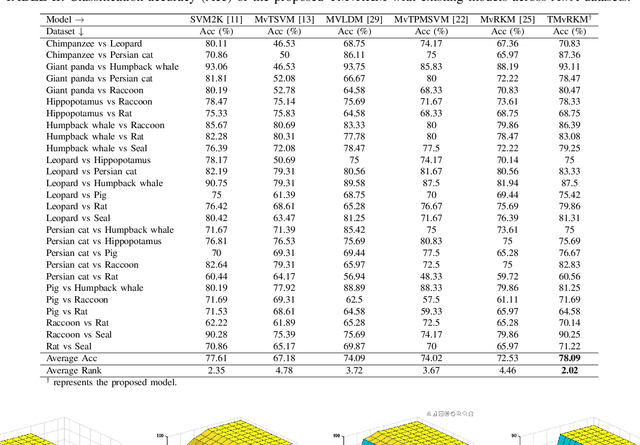
Multi-view learning (MVL) is an emerging field in machine learning that focuses on improving generalization performance by leveraging complementary information from multiple perspectives or views. Various multi-view support vector machine (MvSVM) approaches have been developed, demonstrating significant success. Moreover, these models face challenges in effectively capturing decision boundaries in high-dimensional spaces using the kernel trick. They are also prone to errors and struggle with view inconsistencies, which are common in multi-view datasets. In this work, we introduce the multiview twin restricted kernel machine (TMvRKM), a novel model that integrates the strengths of kernel machines with the multiview framework, addressing key computational and generalization challenges associated with traditional kernel-based approaches. Unlike traditional methods that rely on solving large quadratic programming problems (QPPs), the proposed TMvRKM efficiently determines an optimal separating hyperplane through a regularized least squares approach, enhancing both computational efficiency and classification performance. The primal objective of TMvRKM includes a coupling term designed to balance errors across multiple views effectively. By integrating early and late fusion strategies, TMvRKM leverages the collective information from all views during training while remaining flexible to variations specific to individual views. The proposed TMvRKM model is rigorously tested on UCI, KEEL, and AwA benchmark datasets. Both experimental results and statistical analyses consistently highlight its exceptional generalization performance, outperforming baseline models in every scenario.
* pp. 1-8
R^2VFL: A Robust Random Vector Functional Link Network with Huber-Weighted Framework
Apr 29, 2025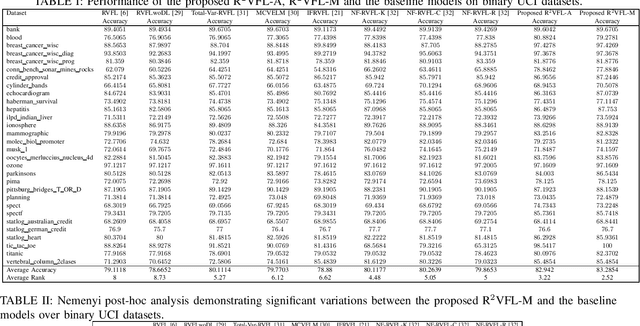
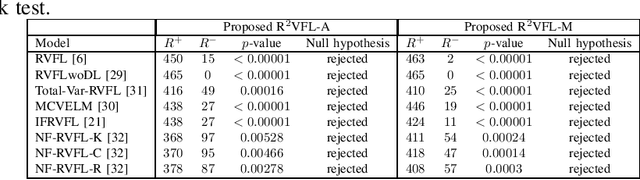
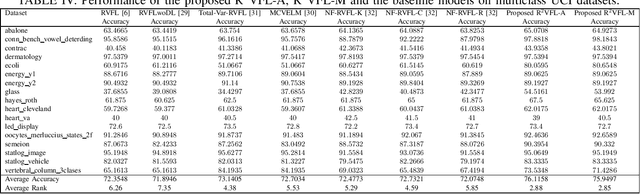
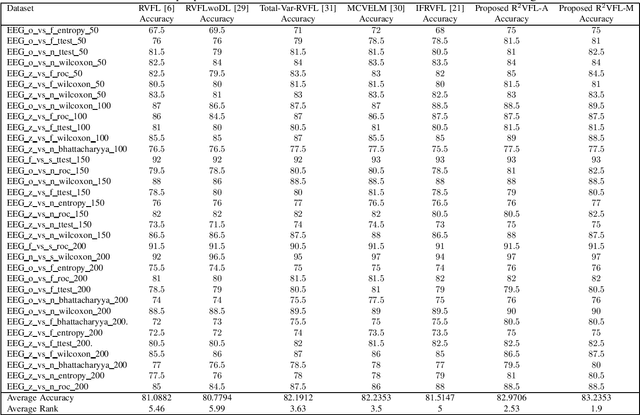
The random vector functional link (RVFL) neural network has shown significant potential in overcoming the constraints of traditional artificial neural networks, such as excessive computation time and suboptimal solutions. However, RVFL faces challenges when dealing with noise and outliers, as it assumes all data samples contribute equally. To address this issue, we propose a novel robust framework, R2VFL, RVFL with Huber weighting function and class probability, which enhances the model's robustness and adaptability by effectively mitigating the impact of noise and outliers in the training data. The Huber weighting function reduces the influence of outliers, while the class probability mechanism assigns less weight to noisy data points, resulting in a more resilient model. We explore two distinct approaches for calculating class centers within the R2VFL framework: the simple average of all data points in each class and the median of each feature, the later providing a robust alternative by minimizing the effect of extreme values. These approaches give rise to two novel variants of the model-R2VFL-A and R2VFL-M. We extensively evaluate the proposed models on 47 UCI datasets, encompassing both binary and multiclass datasets, and conduct rigorous statistical testing, which confirms the superiority of the proposed models. Notably, the models also demonstrate exceptional performance in classifying EEG signals, highlighting their practical applicability in real-world biomedical domain.
CI-RKM: A Class-Informed Approach to Robust Restricted Kernel Machines
Apr 12, 2025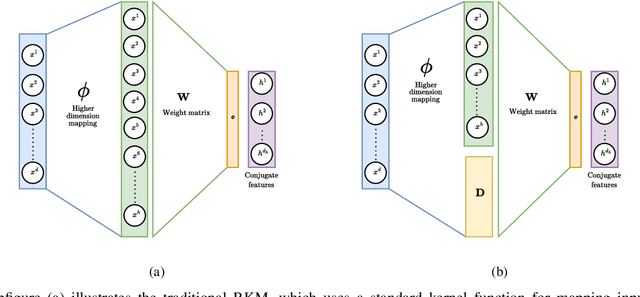
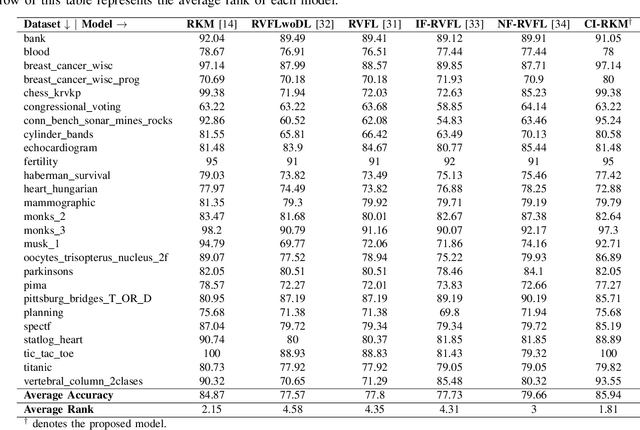
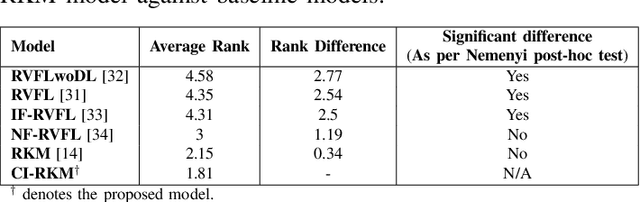
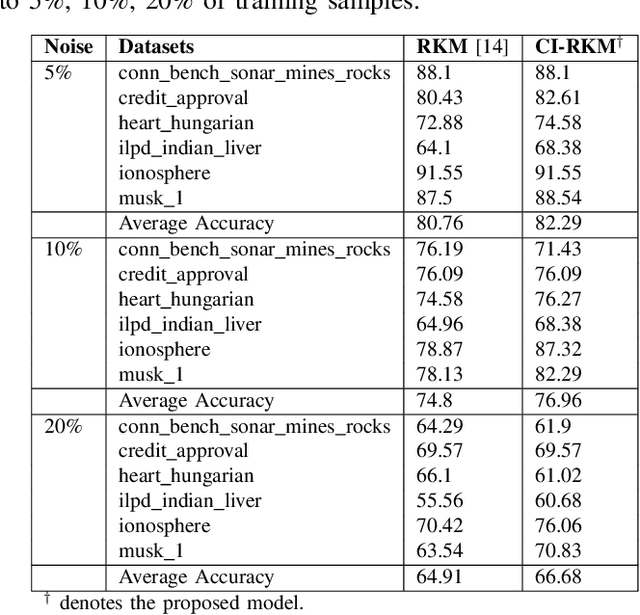
Restricted kernel machines (RKMs) represent a versatile and powerful framework within the kernel machine family, leveraging conjugate feature duality to address a wide range of machine learning tasks, including classification, regression, and feature learning. However, their performance can degrade significantly in the presence of noise and outliers, which compromises robustness and predictive accuracy. In this paper, we propose a novel enhancement to the RKM framework by integrating a class-informed weighted function. This weighting mechanism dynamically adjusts the contribution of individual training points based on their proximity to class centers and class-specific characteristics, thereby mitigating the adverse effects of noisy and outlier data. By incorporating weighted conjugate feature duality and leveraging the Schur complement theorem, we introduce the class-informed restricted kernel machine (CI-RKM), a robust extension of the RKM designed to improve generalization and resilience to data imperfections. Experimental evaluations on benchmark datasets demonstrate that the proposed CI-RKM consistently outperforms existing baselines, achieving superior classification accuracy and enhanced robustness against noise and outliers. Our proposed method establishes a significant advancement in the development of kernel-based learning models, addressing a core challenge in the field.