 Add to Chrome
 Add to Firefox
 Add to Edge
RoBell-RVFL: A Robust Generalized Bell Random Vector Functional Link Network
Aug 17, 2026
The dominance of majority classes in real-world datasets poses a fundamental challenge to randomized neural networks, often biasing decision boundaries and overlooking critical minority samples. Existing remedies, such as synthetic minority over-sampling (SMOTE) and class-weighted loss functions, primarily address class proportions while neglecting intra-class distribution, making them vulnerable to label noise and outliers. In this paper, we propose \textbf{RoBell-RVFL}, a robust and lightweight \emph{quality-aware} generalized bell random vector functional link network that redefines how randomized models handle class imbalance and noisy data. RoBell-RVFL employs a dual-strategy, sample-level weighting mechanism that strictly preserves minority class information using unit weights, while adaptively regulating the influence of majority class samples through a probability-weighted generalized bell (gbell) membership function in a kernel-induced feature space. This design effectively suppresses noisy, boundary, and outlier samples within the majority class, enabling the network to learn from informative samples rather than merely abundant ones. By explicitly incorporating local class probability and class distribution information into the learning process, RoBell-RVFL achieves adaptive control over sample contributions without sacrificing the closed-form learning efficiency of RVFL networks. Extensive evaluations on UCI and KEEL benchmark datasets, along with robustness tests under up to 40\% label noise, demonstrate that RoBell-RVFL consistently and significantly outperforms recent state-of-the-art RVFL variants. The results indicate that adaptive, quality-aware sample weighting is essential for robust RVFL learning, rendering conventional global weighting schemes ineffective in noisy and imbalanced environments.

Robust Dual-Model Collaborative Random Vector Functional Link Network
Aug 13, 2026Random vector functional link (RVFL) networks are lightweight and fast neural models that offer efficient training and strong generalization through randomized hidden-layer weights and direct input-output connections. However, conventional RVFL models are sensitive to noisy labels, outliers, and imbalanced data, which limits their performance in real-world applications. To address these challenges, we propose the kernel risk-sensitive mean p-power based RVFL (KRPRVFL) model, which integrates the computational efficiency of RVFL with the robustness of the kernel risk-sensitive mean p-power (KRP) criterion. By replacing the standard least-squares objective with a KRP-based loss, KRPRVFL adaptively reduces the influence of corrupted or unreliable samples during training, resulting in improved stability and generalization. Additionally, a collaborative learning mechanism is introduced to enable adaptive interaction among model components, further enhancing robustness in complex and noisy environments. The proposed framework also leverages kernel-induced feature mapping to capture nonlinear relationships without requiring explicit hidden-layer selection, maintaining both efficiency and scalability. Extensive experiments on UCI and KEEL benchmark datasets demonstrate that KRPRVFL consistently outperforms baseline models in terms of accuracy, robustness, and statistical significance, highlighting its effectiveness as a fast, scalable, and reliable solution for challenging classification tasks.
Uncertainty-Aware Ensemble Deep Randomized Neural Networks for Classification
Aug 07, 2026The current state-of-the-art (SOTA) deep randomized neural networks, such as deep Random Vector Functional Link (dRVFL) and ensemble deep RVFL (edRVFL), treat all training samples uniformly, which limits their robustness and effectiveness when applied to real-world datasets containing noise and outliers. Furthermore, the propagation of contaminated features across hidden layers negatively influences the decision-making capability of these models. To overcome these limitations, we propose intuitionistic fuzzy dRVFL (IF-dRVFL) and intuitionistic fuzzy edRVFL (IF-edRVFL) frameworks that enhance model robustness. The proposed models unify intuitionistic fuzzy theory to exploit sample neighborhood information in the kernel space by jointly considering membership and non-membership degrees for each sample. Membership degrees are computed based on the distance of samples from their respective class centroids, while non-membership degrees quantify sample heterogeneity within local neighborhoods. These measures are employed to assign adaptive weights to training samples, enabling effective discrimination among clean, noisy, and outlier data points. Extensive experiments conducted on UCI and KEEL benchmark datasets, with and without the presence of Gaussian noise, demonstrate the superiority of the proposed IF-dRVFL and IF-edRVFL models over existing SOTA fuzzy and non-fuzzy approaches. The source code is available at https://github.com/mtanveer1/IF-edRVFL.
Twin Restricted Kernel Machines for Multiview Classification
Dec 12, 2025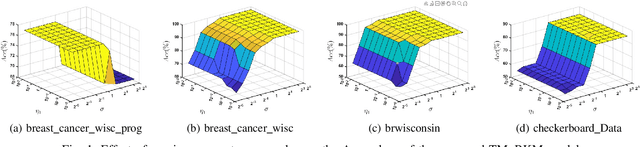
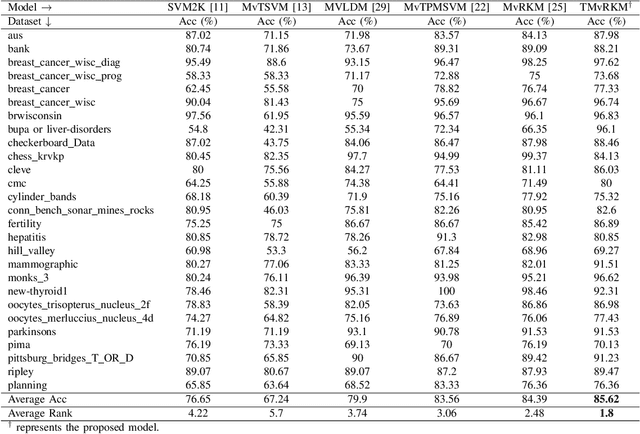
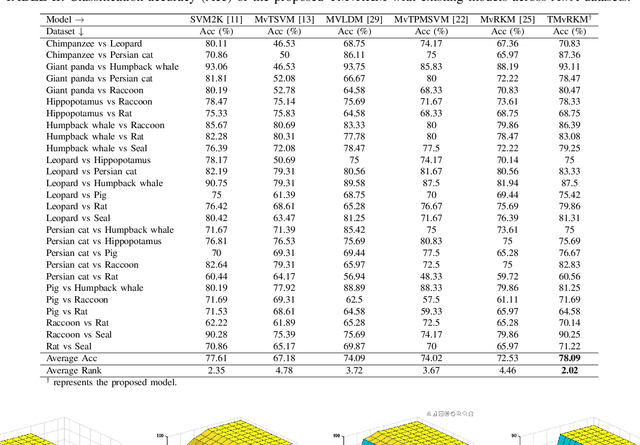
Multi-view learning (MVL) is an emerging field in machine learning that focuses on improving generalization performance by leveraging complementary information from multiple perspectives or views. Various multi-view support vector machine (MvSVM) approaches have been developed, demonstrating significant success. Moreover, these models face challenges in effectively capturing decision boundaries in high-dimensional spaces using the kernel trick. They are also prone to errors and struggle with view inconsistencies, which are common in multi-view datasets. In this work, we introduce the multiview twin restricted kernel machine (TMvRKM), a novel model that integrates the strengths of kernel machines with the multiview framework, addressing key computational and generalization challenges associated with traditional kernel-based approaches. Unlike traditional methods that rely on solving large quadratic programming problems (QPPs), the proposed TMvRKM efficiently determines an optimal separating hyperplane through a regularized least squares approach, enhancing both computational efficiency and classification performance. The primal objective of TMvRKM includes a coupling term designed to balance errors across multiple views effectively. By integrating early and late fusion strategies, TMvRKM leverages the collective information from all views during training while remaining flexible to variations specific to individual views. The proposed TMvRKM model is rigorously tested on UCI, KEEL, and AwA benchmark datasets. Both experimental results and statistical analyses consistently highlight its exceptional generalization performance, outperforming baseline models in every scenario.
* pp. 1-8
Intuitionistic Fuzzy Universum Twin Support Vector Machine for Imbalanced Data
Oct 27, 2024One of the major difficulties in machine learning methods is categorizing datasets that are imbalanced. This problem may lead to biased models, where the training process is dominated by the majority class, resulting in inadequate representation of the minority class. Universum twin support vector machine (UTSVM) produces a biased model towards the majority class, as a result, its performance on the minority class is often poor as it might be mistakenly classified as noise. Moreover, UTSVM is not proficient in handling datasets that contain outliers and noises. Inspired by the concept of incorporating prior information about the data and employing an intuitionistic fuzzy membership scheme, we propose intuitionistic fuzzy universum twin support vector machines for imbalanced data (IFUTSVM-ID). We use an intuitionistic fuzzy membership scheme to mitigate the impact of noise and outliers. Moreover, to tackle the problem of imbalanced class distribution, data oversampling and undersampling methods are utilized. Prior knowledge about the data is provided by universum data. This leads to better generalization performance. UTSVM is susceptible to overfitting risks due to the omission of the structural risk minimization (SRM) principle in their primal formulations. However, the proposed IFUTSVM-ID model incorporates the SRM principle through the incorporation of regularization terms, effectively addressing the issue of overfitting. We conduct a comprehensive evaluation of the proposed IFUTSVM-ID model on benchmark datasets from KEEL and compare it with existing baseline models. Furthermore, to assess the effectiveness of the proposed IFUTSVM-ID model in diagnosing Alzheimer's disease (AD), we applied them to the Alzheimer's Disease Neuroimaging Initiative (ADNI) dataset. Experimental results showcase the superiority of the proposed IFUTSVM-ID models compared to the baseline models.
Enhancing Robustness and Efficiency of Least Square Twin SVM via Granular Computing
Oct 22, 2024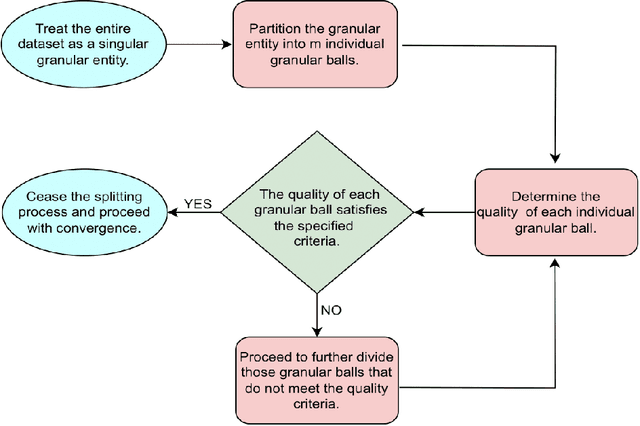

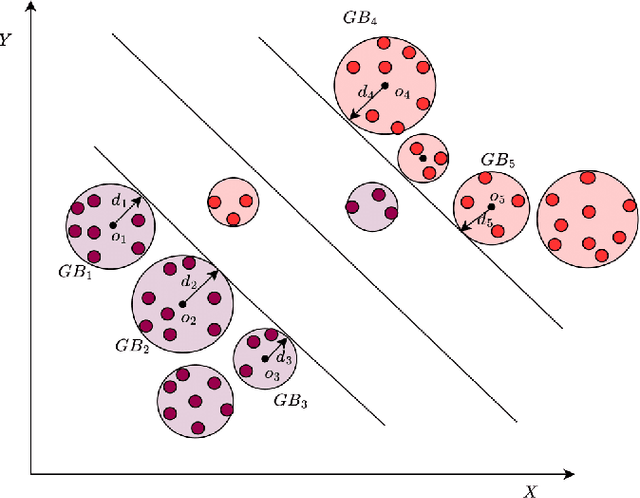

In the domain of machine learning, least square twin support vector machine (LSTSVM) stands out as one of the state-of-the-art models. However, LSTSVM suffers from sensitivity to noise and outliers, overlooking the SRM principle and instability in resampling. Moreover, its computational complexity and reliance on matrix inversions hinder the efficient processing of large datasets. As a remedy to the aforementioned challenges, we propose the robust granular ball LSTSVM (GBLSTSVM). GBLSTSVM is trained using granular balls instead of original data points. The core of a granular ball is found at its center, where it encapsulates all the pertinent information of the data points within the ball of specified radius. To improve scalability and efficiency, we further introduce the large-scale GBLSTSVM (LS-GBLSTSVM), which incorporates the SRM principle through regularization terms. Experiments are performed on UCI, KEEL, and NDC benchmark datasets; both the proposed GBLSTSVM and LS-GBLSTSVM models consistently outperform the baseline models.
Flexi-Fuzz least squares SVM for Alzheimer's diagnosis: Tackling noise, outliers, and class imbalance
Oct 18, 2024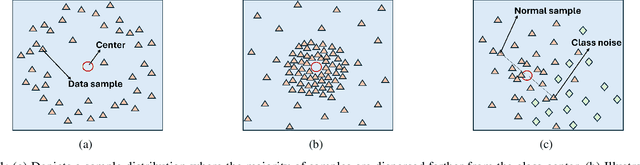
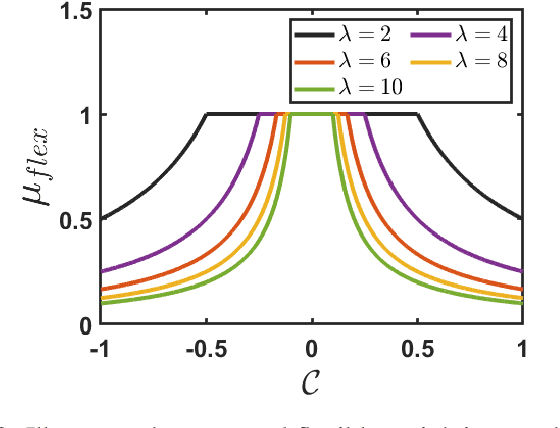


Alzheimer's disease (AD) is a leading neurodegenerative condition and the primary cause of dementia, characterized by progressive cognitive decline and memory loss. Its progression, marked by shrinkage in the cerebral cortex, is irreversible. Numerous machine learning algorithms have been proposed for the early diagnosis of AD. However, they often struggle with the issues of noise, outliers, and class imbalance. To tackle the aforementioned limitations, in this article, we introduce a novel, robust, and flexible membership scheme called Flexi-Fuzz. This scheme integrates a novel flexible weighting mechanism, class probability, and imbalance ratio. The proposed flexible weighting mechanism assigns the maximum weight to samples within a specific proximity to the center, with a gradual decrease in weight beyond a certain threshold. This approach ensures that samples near the class boundary still receive significant weight, maintaining their influence in the classification process. Class probability is used to mitigate the impact of noisy samples, while the imbalance ratio addresses class imbalance. Leveraging this, we incorporate the proposed Flexi-Fuzz membership scheme into the least squares support vector machines (LSSVM) framework, resulting in a robust and flexible model termed Flexi-Fuzz-LSSVM. We determine the class-center using two methods: the conventional mean approach and an innovative median approach, leading to two model variants, Flexi-Fuzz-LSSVM-I and Flexi-Fuzz-LSSVM-II. To validate the effectiveness of the proposed Flexi-Fuzz-LSSVM models, we evaluated them on benchmark UCI and KEEL datasets, both with and without label noise. Additionally, we tested the models on the Alzheimer's Disease Neuroimaging Initiative (ADNI) dataset for AD diagnosis. Experimental results demonstrate the superiority of the Flexi-Fuzz-LSSVM models over baseline models.
Enhanced Feature Based Granular Ball Twin Support Vector Machine
Oct 08, 2024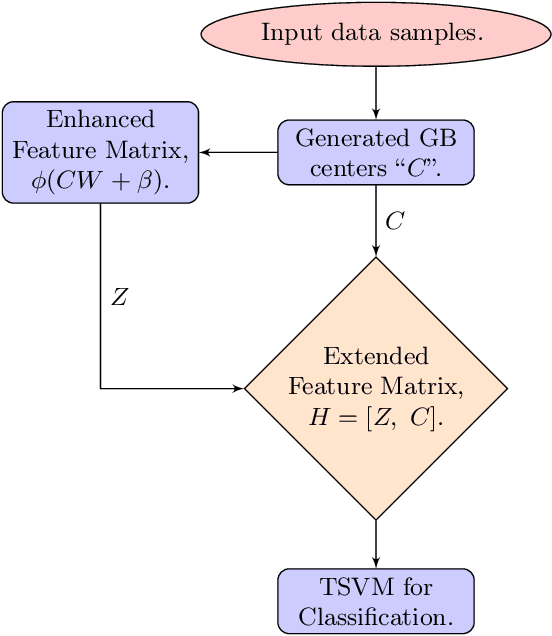
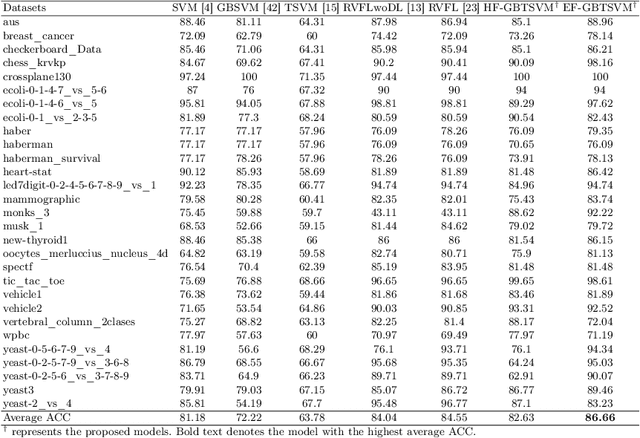
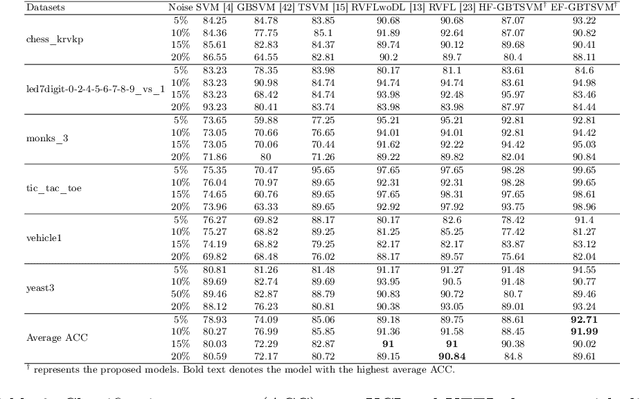
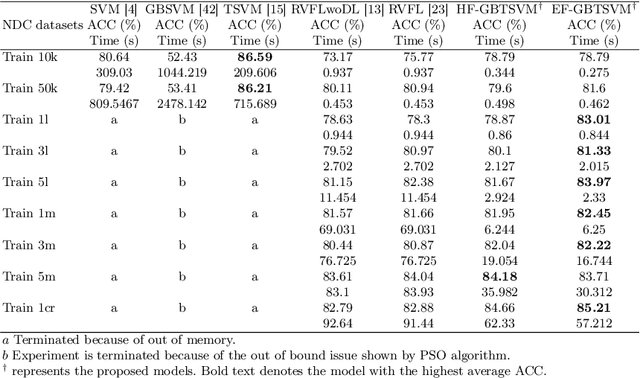
In this paper, we propose enhanced feature based granular ball twin support vector machine (EF-GBTSVM). EF-GBTSVM employs the coarse granularity of granular balls (GBs) as input rather than individual data samples. The GBs are mapped to the feature space of the hidden layer using random projection followed by the utilization of a non-linear activation function. The concatenation of original and hidden features derived from the centers of GBs gives rise to an enhanced feature space, commonly referred to as the random vector functional link (RVFL) space. This space encapsulates nuanced feature information to GBs. Further, we employ twin support vector machine (TSVM) in the RVFL space for classification. TSVM generates the two non-parallel hyperplanes in the enhanced feature space, which improves the generalization performance of the proposed EF-GBTSVM model. Moreover, the coarser granularity of the GBs enables the proposed EF-GBTSVM model to exhibit robustness to resampling, showcasing reduced susceptibility to the impact of noise and outliers. We undertake a thorough evaluation of the proposed EF-GBTSVM model on benchmark UCI and KEEL datasets. This evaluation encompasses scenarios with and without the inclusion of label noise. Moreover, experiments using NDC datasets further emphasize the proposed model's ability to handle large datasets. Experimental results, supported by thorough statistical analyses, demonstrate that the proposed EF-GBTSVM model significantly outperforms the baseline models in terms of generalization capabilities, scalability, and robustness. The source code for the proposed EF-GBTSVM model, along with additional results and further details, can be accessed at https://github.com/mtanveer1/EF-GBTSVM.
Granular Ball Twin Support Vector Machine
Oct 07, 2024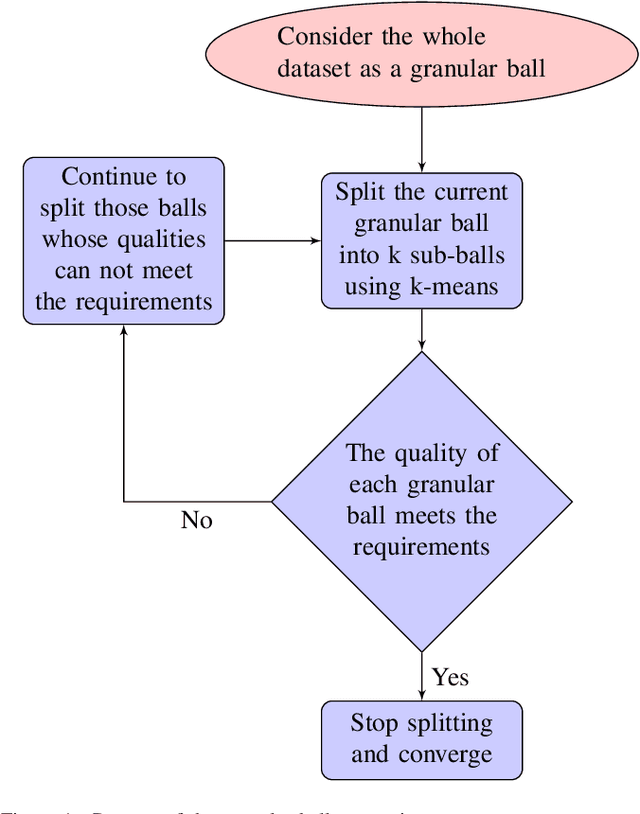
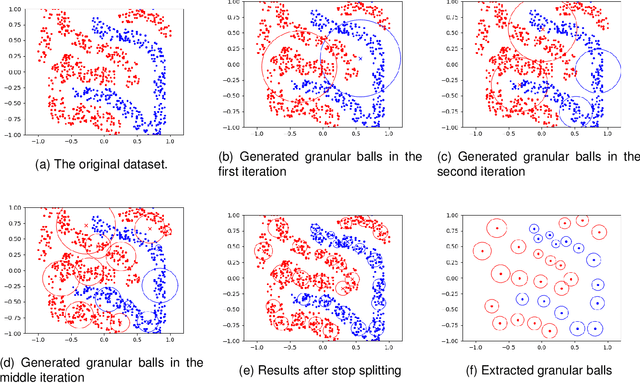
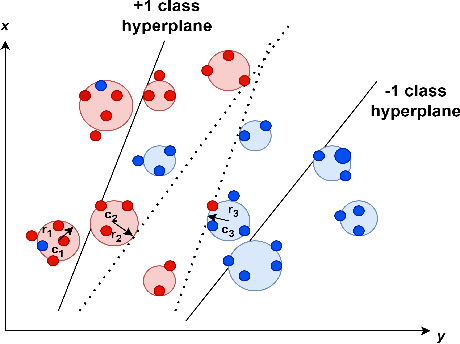

On Efficient and Scalable Computation of the Nonparametric Maximum Likelihood Estimator in Mixture ModelsTwin support vector machine (TSVM) is an emerging machine learning model with versatile applicability in classification and regression endeavors. Nevertheless, TSVM confronts noteworthy challenges: $(i)$ the imperative demand for matrix inversions presents formidable obstacles to its efficiency and applicability on large-scale datasets; $(ii)$ the omission of the structural risk minimization (SRM) principle in its primal formulation heightens the vulnerability to overfitting risks; and $(iii)$ the TSVM exhibits a high susceptibility to noise and outliers, and also demonstrates instability when subjected to resampling. In view of the aforementioned challenges, we propose the granular ball twin support vector machine (GBTSVM). GBTSVM takes granular balls, rather than individual data points, as inputs to construct a classifier. These granular balls, characterized by their coarser granularity, exhibit robustness to resampling and reduced susceptibility to the impact of noise and outliers. We further propose a novel large-scale granular ball twin support vector machine (LS-GBTSVM). LS-GBTSVM's optimization formulation ensures two critical facets: $(i)$ it eliminates the need for matrix inversions, streamlining the LS-GBTSVM's computational efficiency, and $(ii)$ it incorporates the SRM principle through the incorporation of regularization terms, effectively addressing the issue of overfitting. The proposed LS-GBTSVM exemplifies efficiency, scalability for large datasets, and robustness against noise and outliers. We conduct a comprehensive evaluation of the GBTSVM and LS-GBTSVM models on benchmark datasets from UCI, KEEL, and NDC datasets. Our experimental findings and statistical analyses affirm the superior generalization prowess of the proposed GBTSVM and LS-GBTSVM models.
* Manuscript submitted to IEEE TRANSACTIONS ON NEURAL NETWORKS AND LEARNING SYSTEMS: 19 September 2023; revised 13 February 2024 and 14 July 2024; accepted 05 October 2024
GB-RVFL: Fusion of Randomized Neural Network and Granular Ball Computing
Sep 25, 2024The random vector functional link (RVFL) network is a prominent classification model with strong generalization ability. However, RVFL treats all samples uniformly, ignoring whether they are pure or noisy, and its scalability is limited due to the need for inverting the entire training matrix. To address these issues, we propose granular ball RVFL (GB-RVFL) model, which uses granular balls (GBs) as inputs instead of training samples. This approach enhances scalability by requiring only the inverse of the GB center matrix and improves robustness against noise and outliers through the coarse granularity of GBs. Furthermore, RVFL overlooks the dataset's geometric structure. To address this, we propose graph embedding GB-RVFL (GE-GB-RVFL) model, which fuses granular computing and graph embedding (GE) to preserve the topological structure of GBs. The proposed GB-RVFL and GE-GB-RVFL models are evaluated on KEEL, UCI, NDC and biomedical datasets, demonstrating superior performance compared to baseline models.