 Add to Chrome
 Add to Firefox
 Add to Edge
Learning ground state observables from quantum computing experiments
Jun 14, 2026
Recent theoretical progress has established conditions under which machine learning models can efficiently predict ground-state properties of gapped local Hamiltonians when trained on quantum-generated data. Previous experimental demonstrations in this paradigm, however, have largely been limited to small systems or highly structured states, due to the difficulty of preparing many-body ground states on quantum processors. In this work, we demonstrate learning from experimental quantum data generated from approximate ground states of the two-dimensional Heisenberg XXZ model with system sizes up to 115 qubits. We construct a dataset of single-site expectation values, two-point correlations, and 12-body loop correlations across the antiferromagnetic phase. We then train neural networks on this data and show that they can accurately predict spatially resolved observables for previously unseen Hamiltonian parameters, both within the training distribution and in an out-of-distribution regime approaching the phase boundary. Our results demonstrate the practical realization of learning from quantum data for an interacting two-dimensional many-body system at scale, motivating a path toward regimes where quantum processors could provide training data beyond the reach of classical approximation methods.

Qiskit Machine Learning: an open-source library for quantum machine learning tasks at scale on quantum hardware and classical simulators
May 23, 2025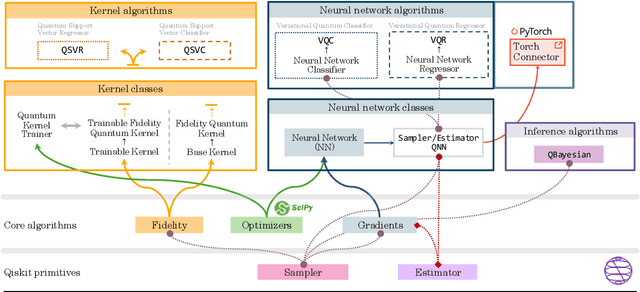
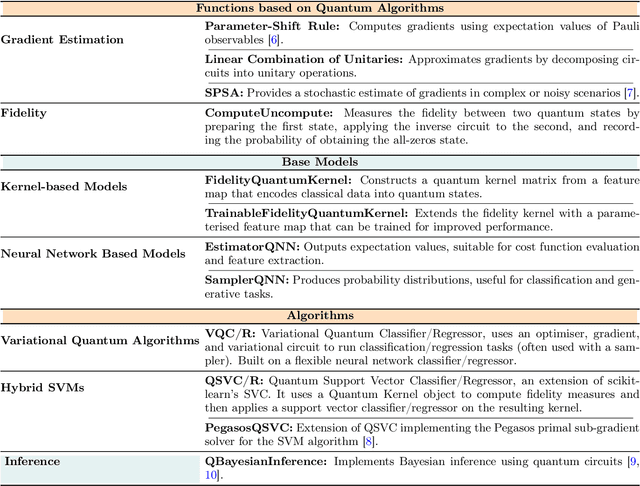
We present Qiskit Machine Learning (ML), a high-level Python library that combines elements of quantum computing with traditional machine learning. The API abstracts Qiskit's primitives to facilitate interactions with classical simulators and quantum hardware. Qiskit ML started as a proof-of-concept code in 2019 and has since been developed to be a modular, intuitive tool for non-specialist users while allowing extensibility and fine-tuning controls for quantum computational scientists and developers. The library is available as a public, open-source tool and is distributed under the Apache version 2.0 license.
Efficient Parameter Optimisation for Quantum Kernel Alignment: A Sub-sampling Approach in Variational Training
Jan 05, 2024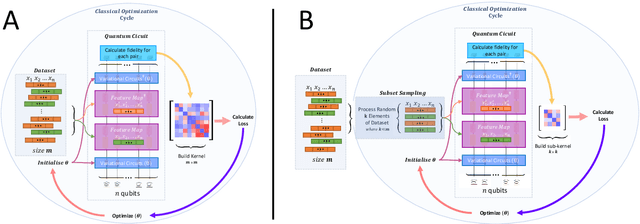
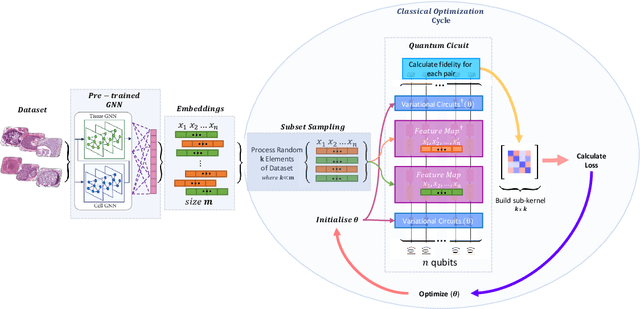
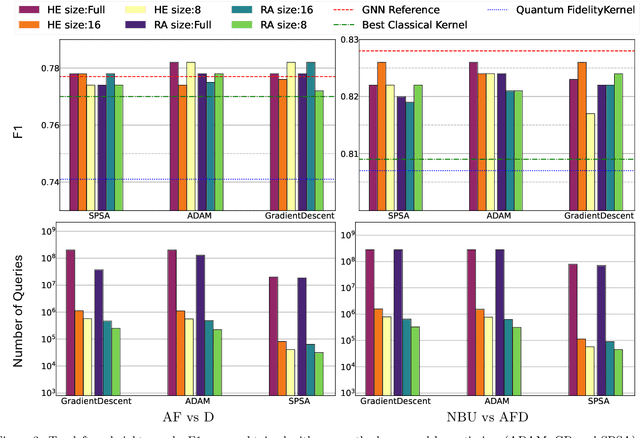
Quantum machine learning with quantum kernels for classification problems is a growing area of research. Recently, quantum kernel alignment techniques that parameterise the kernel have been developed, allowing the kernel to be trained and therefore aligned with a specific dataset. While quantum kernel alignment is a promising technique, it has been hampered by considerable training costs because the full kernel matrix must be constructed at every training iteration. Addressing this challenge, we introduce a novel method that seeks to balance efficiency and performance. We present a sub-sampling training approach that uses a subset of the kernel matrix at each training step, thereby reducing the overall computational cost of the training. In this work, we apply the sub-sampling method to synthetic datasets and a real-world breast cancer dataset and demonstrate considerable reductions in the number of circuits required to train the quantum kernel while maintaining classification accuracy.