 Add to Chrome
 Add to Firefox
 Add to Edge
Querying an astronomical database using large language models: the ALeRCE text-to-SQL system
Jun 16, 2026
We develop a text-to-SQL (structured query language) system based on large language models (LLMs) using in-context learning and apply it to the Automatic Learning for the Rapid Classification of Events (ALeRCE) astronomical database. ALeRCE is a community broker for the Zwicky Transient Facility and the Vera C. Rubin Observatory. The system enables users to query the database in natural language (NL) and generates executable SQL queries. To develop and evaluate the system, we constructed a dataset of 110 NL/SQL pairs. We propose a step-by-step generation framework comprising four modules: schema linking, query classification, prompt decomposition, and self-correction. The performance of thirteen LLMs is evaluated using in-context learning and prompt engineering techniques. Text-to-SQL performance is assessed using the perfect-match (PM) rate for row identifiers (e.g., object identifiers) and column identifiers (i.e., column names). The proposed step-by-step framework consistently outperforms a direct-inference baseline, while the self-correction module consistently reduces execution errors. For Claude Opus 4.6, PM performance on row (column) identifiers is high for simple queries, reaching 0.97 (0.94), and decreases with query complexity to 0.44 (0.72) for medium queries and 0.59 (0.49) for hard queries. Among the thirteen evaluated models, the best-performing LLMs for the text-to-SQL task are Claude Opus 4.6, Gemini 2.5 Pro, Gemini 3 Flash, and GPT-5.2-Codex.

Informative Bayesian model selection for RR Lyrae star classifiers
May 24, 2021
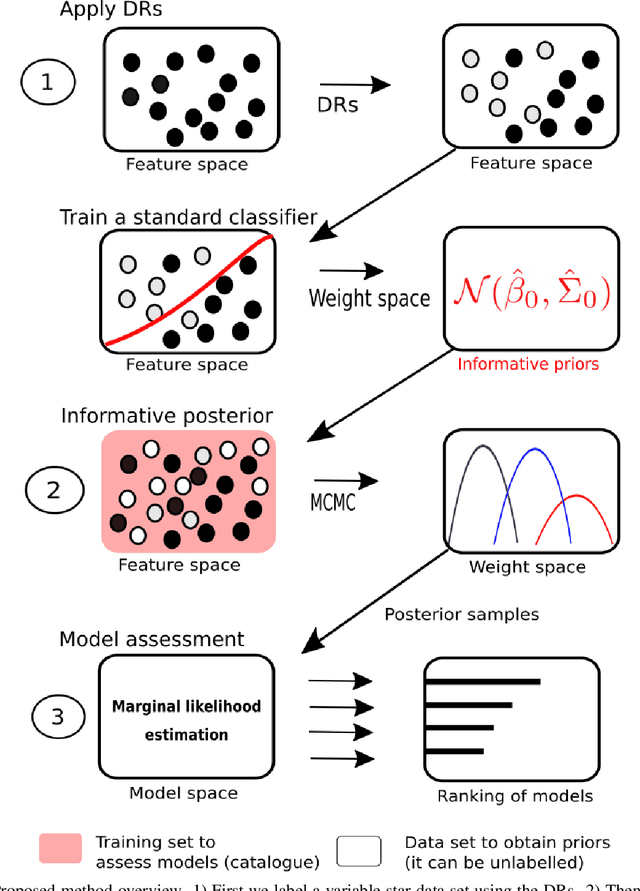


Machine learning has achieved an important role in the automatic classification of variable stars, and several classifiers have been proposed over the last decade. These classifiers have achieved impressive performance in several astronomical catalogues. However, some scientific articles have also shown that the training data therein contain multiple sources of bias. Hence, the performance of those classifiers on objects not belonging to the training data is uncertain, potentially resulting in the selection of incorrect models. Besides, it gives rise to the deployment of misleading classifiers. An example of the latter is the creation of open-source labelled catalogues with biased predictions. In this paper, we develop a method based on an informative marginal likelihood to evaluate variable star classifiers. We collect deterministic rules that are based on physical descriptors of RR Lyrae stars, and then, to mitigate the biases, we introduce those rules into the marginal likelihood estimation. We perform experiments with a set of Bayesian Logistic Regressions, which are trained to classify RR Lyraes, and we found that our method outperforms traditional non-informative cross-validation strategies, even when penalized models are assessed. Our methodology provides a more rigorous alternative to assess machine learning models using astronomical knowledge. From this approach, applications to other classes of variable stars and algorithmic improvements can be developed.