 Add to Chrome
 Add to Firefox
 Add to Edge
Querying an astronomical database using large language models: the ALeRCE text-to-SQL system
Jun 16, 2026
We develop a text-to-SQL (structured query language) system based on large language models (LLMs) using in-context learning and apply it to the Automatic Learning for the Rapid Classification of Events (ALeRCE) astronomical database. ALeRCE is a community broker for the Zwicky Transient Facility and the Vera C. Rubin Observatory. The system enables users to query the database in natural language (NL) and generates executable SQL queries. To develop and evaluate the system, we constructed a dataset of 110 NL/SQL pairs. We propose a step-by-step generation framework comprising four modules: schema linking, query classification, prompt decomposition, and self-correction. The performance of thirteen LLMs is evaluated using in-context learning and prompt engineering techniques. Text-to-SQL performance is assessed using the perfect-match (PM) rate for row identifiers (e.g., object identifiers) and column identifiers (i.e., column names). The proposed step-by-step framework consistently outperforms a direct-inference baseline, while the self-correction module consistently reduces execution errors. For Claude Opus 4.6, PM performance on row (column) identifiers is high for simple queries, reaching 0.97 (0.94), and decreases with query complexity to 0.44 (0.72) for medium queries and 0.59 (0.49) for hard queries. Among the thirteen evaluated models, the best-performing LLMs for the text-to-SQL task are Claude Opus 4.6, Gemini 2.5 Pro, Gemini 3 Flash, and GPT-5.2-Codex.

Image-Based Multi-Survey Classification of Light Curves with a Pre-Trained Vision Transformer
Jul 15, 2025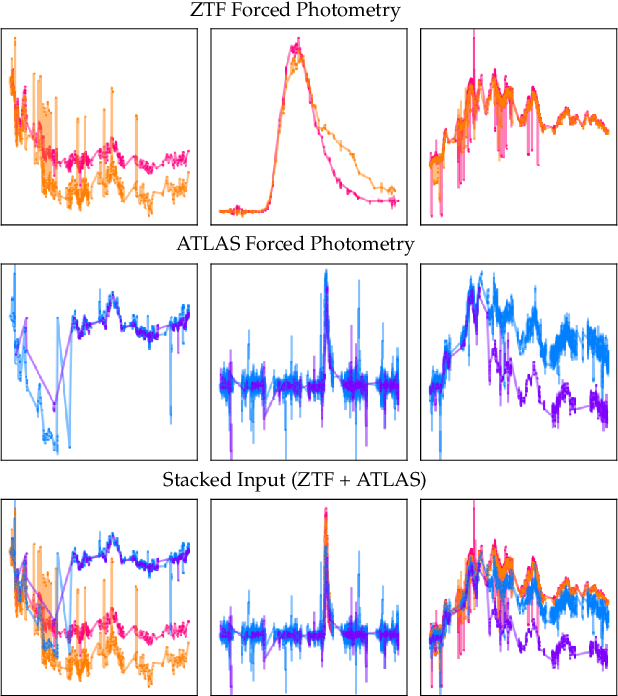
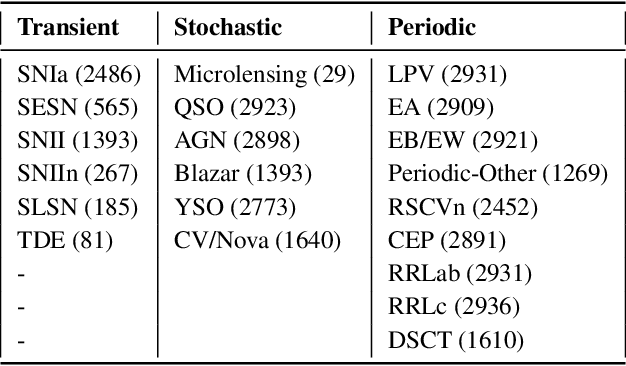
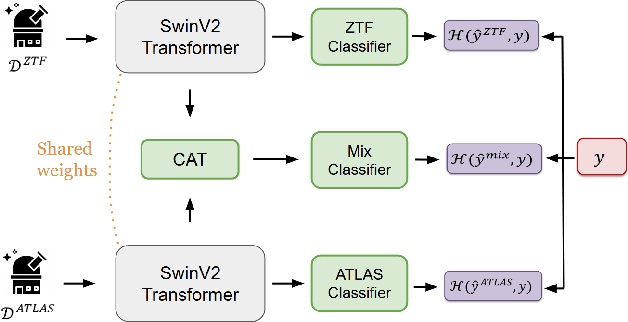
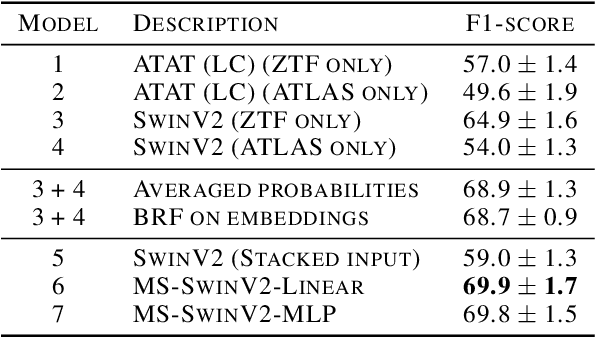
We explore the use of Swin Transformer V2, a pre-trained vision Transformer, for photometric classification in a multi-survey setting by leveraging light curves from the Zwicky Transient Facility (ZTF) and the Asteroid Terrestrial-impact Last Alert System (ATLAS). We evaluate different strategies for integrating data from these surveys and find that a multi-survey architecture which processes them jointly achieves the best performance. These results highlight the importance of modeling survey-specific characteristics and cross-survey interactions, and provide guidance for building scalable classifiers for future time-domain astronomy.