 Add to Chrome
 Add to Firefox
 Add to Edge
What's a Credit Worth? A Market Framework for Attribution-Aware Compensation in Generative Music
Jul 01, 2026
Advances in generative AI are rapidly increasing the quality and commercial value of generated music, and this progress depends on large catalogs of creators' recordings. This raises a central question for platform design: how should creators be compensated when their work is used to train generative AI models that in turn produce commercial outputs? We develop a framework for fairly compensating creators in generative-music markets, where each creator's payment depends on a data-attribution score estimating their contribution to model outputs. Compared to past compensation frameworks, our framework has two unique considerations: (1) attribution is traced to entire creator catalogs, not individual songs, and (2) the informativeness (signal-to-noise ratio) of the attribution score is an input to the payment mechanism. The framework yields a closed-form payment rule per creator and measures the welfare cost of inaccurate attribution for both creators and the platform. Whether the welfare-optimal contract is royalty-based or takes the form of fixed-fee licensing depends on how informative attribution is for that creator's catalog. We show that better attribution translates directly into welfare gains for both creators and the platform, yet under multi-platform competition a platform only captures gains from attribution improvements when its signal becomes the most precise in the market. To ground our framework in empirical behavior, we train acoustic and symbolic music generation models and measure the informativeness of scalable attribution techniques against a leave-one-catalog-out ground truth. Our experiments reveal that noisy attribution signals push payment toward fixed-fee licensing and diminish welfare for both creators and the platform, providing an economic motivation for further research on improved attribution.

When Attribution Patching Lies: Diagnosis and a Second-Order Correction
Jun 05, 2026A central goal of mechanistic interpretability is to identify which internal components causally drive a language model's behavior. Because these importance estimates serve as the evidence for identifying circuits, systematic errors can lead to the misidentification of the underlying mechanisms. While activation patching provides a gold-standard causal metric, its computational cost is prohibitive at scale. Practitioners instead rely on attribution patching, a gradient-based, first-order approximation whose reliability remains poorly understood. In this work, we characterize the source of this unreliability, demonstrating that the dominant error stems from the non-linearities in the downstream network rather than local curvature at the patched component. This insight yields three practical tools: (i) a reliability score to detect untrustworthy estimates, (ii) error bounds quantifying potential attribution mis-specifications, and (iii) a Hessian-vector-product (HVP) correction that eliminates the leading-order error with only one additional backward pass. In evaluations across five model families (124M-9B parameters) and both random-token and naturalistic (name-swap) perturbations, HVP is the only second-order correction feasible at larger scale, where standard baselines like Integrated Gradients become computationally prohibitive. In comparative experiments, a multi-step HVP variant matches or exceeds the accuracy of Integrated Gradients at significantly lower compute, outperforming prior second-order baselines. These improvements lead to higher-fidelity circuit recovery on standard benchmarks and support a Screen-Flag-Fix workflow that targets computational effort only toward the components flagged as unreliable.
Predicting Inference-Time Scaling Gains from Labeled Validation-Set Output Statistics
Jun 02, 2026Best-of-$N$ inference scaling (drawing $N$ candidate answers from a language model and returning the one a reward model ranks highest) improves accuracy by an amount that varies across models, but predicting that amount in advance currently requires running the procedure end-to-end. Prior work links cheap statistics of a model's sampled outputs and validation-set correctness (how often samples agree, how diverse they are, how confident the model is, and where correct samples appear) to model behavior, but does not isolate which of these form a stable, compact predictor of best-of-$N$ gain. We fit ridge predictors on features computed from a single labeled validation-set sampling pass, use bootstrap-Lasso as a stability analysis of the candidate feature set, and give a concentration analysis with an explicit linear-approximation residual. Across three base-model families, six post-training methods, and math and reasoning task domains, the stability analysis identifies a strict three-feature core spanning prompt-level agreement spread, label-assisted first-correct-sample position, and completion-length variance; a compact ridge predictor built from this core plus an entropy add-on reaches Spearman $ρ= 0.90$ with actual best-of-$N$ gain under a reward-model verifier. The intended use is labeled validation-set screening of candidate configurations before paying the full reward-model scoring cost.
PinpointQA: A Dataset and Benchmark for Small Object-Centric Spatial Understanding in Indoor Videos
Apr 10, 2026Small object-centric spatial understanding in indoor videos remains a significant challenge for multimodal large language models (MLLMs), despite its practical value for object search and assistive applications. Although existing benchmarks have advanced video spatial intelligence, embodied reasoning, and diagnostic perception, no existing benchmark directly evaluates whether a model can localize a target object in video and express its position with sufficient precision for downstream use. In this work, we introduce PinpointQA, the first dataset and benchmark for small object-centric spatial understanding in indoor videos. Built from ScanNet++ and ScanNet200, PinpointQA comprises 1,024 scenes and 10,094 QA pairs organized into four progressively challenging tasks: Target Presence Verification (TPV), Nearest Reference Identification (NRI), Fine-Grained Spatial Description (FSD), and Structured Spatial Prediction (SSP). The dataset is built from intermediate spatial representations, with QA pairs generated automatically and further refined through quality control. Experiments on representative MLLMs reveal a consistent capability gap along the progressive chain, with SSP remaining particularly difficult. Supervised fine-tuning on PinpointQA yields substantial gains, especially on the harder tasks, demonstrating that PinpointQA serves as both a diagnostic benchmark and an effective training dataset. The dataset and project page are available at https://rainchowz.github.io/PinpointQA.
DB3V: A Dialect Dominated Dataset of Bird Vocalisation for Cross-corpus Bird Species Recognition
Jun 11, 2024
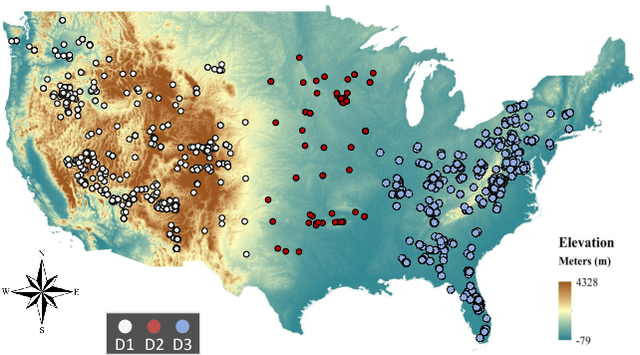
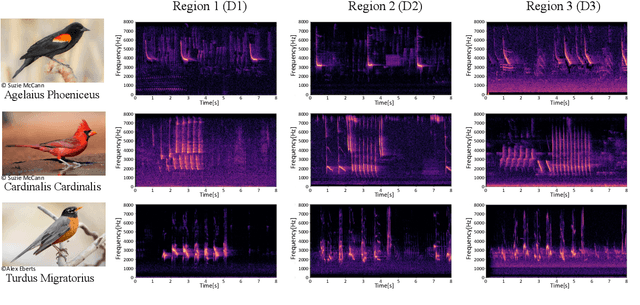

In ornithology, bird species are known to have variedit's widely acknowledged that bird species display diverse dialects in their calls across different regions. Consequently, computational methods to identify bird species onsolely through their calls face critsignificalnt challenges. There is growing interest in understanding the impact of species-specific dialects on the effectiveness of bird species recognition methods. Despite potential mitigation through the expansion of dialect datasets, the absence of publicly available testing data currently impedes robust benchmarking efforts. This paper presents the Dialect Dominated Dataset of Bird Vocalisation, the first cross-corpus dataset that focuses on dialects in bird vocalisations. The DB3V comprises more than 25 hours of audio recordings from 10 bird species distributed across three distinct regions in the contiguous United States (CONUS). In addition to presenting the dataset, we conduct analyses and establish baseline models for cross-corpus bird recognition. The data and code are publicly available online: https://zenodo.org/records/11544734