 Add to Chrome
 Add to Firefox
 Add to Edge
MindClaw: Closed-Loop Embodied Mental-State Reasoning for Precision Intervention
May 31, 2026
Theory of Mind (ToM) enables an agent to reason about another actor's beliefs, goals, and intentions, which is essential for human-centered embodied assistance. Existing ToM benchmarks have advanced text and multimodal mental-state recognition, but they mostly evaluate offline question answering or final action prediction. They do not fully test whether an embodied agent can stay connected to a changing environment, update actor-specific beliefs, decide when reasoning is needed, and intervene only when help is useful. Building on MindPower, we extend robot-centric ToM reasoning to a real-time closed-loop setting and introduce MindClaw, a framework for embodied mental-state reasoning with precision intervention. MindClaw connects multi-source inputs, belief memory, an embodied cognitive trigger skill, mental reasoning, and action generation, allowing the agent to output helpful actions at the right time while remaining silent when intervention is unnecessary. Experiments show that direct VLM baselines struggle with task awareness and intervention calibration, while MindClaw achieves the best overall performance, demonstrating the importance of trigger-skill optimization for closed-loop embodied ToM assistance.

PinpointQA: A Dataset and Benchmark for Small Object-Centric Spatial Understanding in Indoor Videos
Apr 10, 2026Small object-centric spatial understanding in indoor videos remains a significant challenge for multimodal large language models (MLLMs), despite its practical value for object search and assistive applications. Although existing benchmarks have advanced video spatial intelligence, embodied reasoning, and diagnostic perception, no existing benchmark directly evaluates whether a model can localize a target object in video and express its position with sufficient precision for downstream use. In this work, we introduce PinpointQA, the first dataset and benchmark for small object-centric spatial understanding in indoor videos. Built from ScanNet++ and ScanNet200, PinpointQA comprises 1,024 scenes and 10,094 QA pairs organized into four progressively challenging tasks: Target Presence Verification (TPV), Nearest Reference Identification (NRI), Fine-Grained Spatial Description (FSD), and Structured Spatial Prediction (SSP). The dataset is built from intermediate spatial representations, with QA pairs generated automatically and further refined through quality control. Experiments on representative MLLMs reveal a consistent capability gap along the progressive chain, with SSP remaining particularly difficult. Supervised fine-tuning on PinpointQA yields substantial gains, especially on the harder tasks, demonstrating that PinpointQA serves as both a diagnostic benchmark and an effective training dataset. The dataset and project page are available at https://rainchowz.github.io/PinpointQA.
Aligning Progress and Feasibility: A Neuro-Symbolic Dual Memory Framework for Long-Horizon LLM Agents
Apr 03, 2026Large language models (LLMs) have demonstrated strong potential in long-horizon decision-making tasks, such as embodied manipulation and web interaction. However, agents frequently struggle with endless trial-and-error loops or deviate from the main objective in complex environments. We attribute these failures to two fundamental errors: global Progress Drift and local Feasibility Violation. Existing methods typically attempt to address both issues simultaneously using a single paradigm. However, these two challenges are fundamentally distinct: the former relies on fuzzy semantic planning, while the latter demands strict logical constraints and state validation. The inherent limitations of such a single-paradigm approach pose a fundamental challenge for existing models in handling long-horizon tasks. Motivated by this insight, we propose a Neuro-Symbolic Dual Memory Framework that explicitly decouples semantic progress guidance from logical feasibility verification. Specifically, during the inference phase, the framework invokes both memory mechanisms synchronously: on one hand, a neural-network-based Progress Memory extracts semantic blueprints from successful trajectories to guide global task advancement; on the other hand, a symbolic-logic-based Feasibility Memory utilizes executable Python verification functions synthesized from failed transitions to perform strict logical validation. Experiments demonstrate that this method significantly outperforms existing competitive baselines on ALFWorld, WebShop, and TextCraft, while drastically reducing the invalid action rate and average trajectory length.
RecipeGen: A Step-Aligned Multimodal Benchmark for Real-World Recipe Generation
Jun 07, 2025
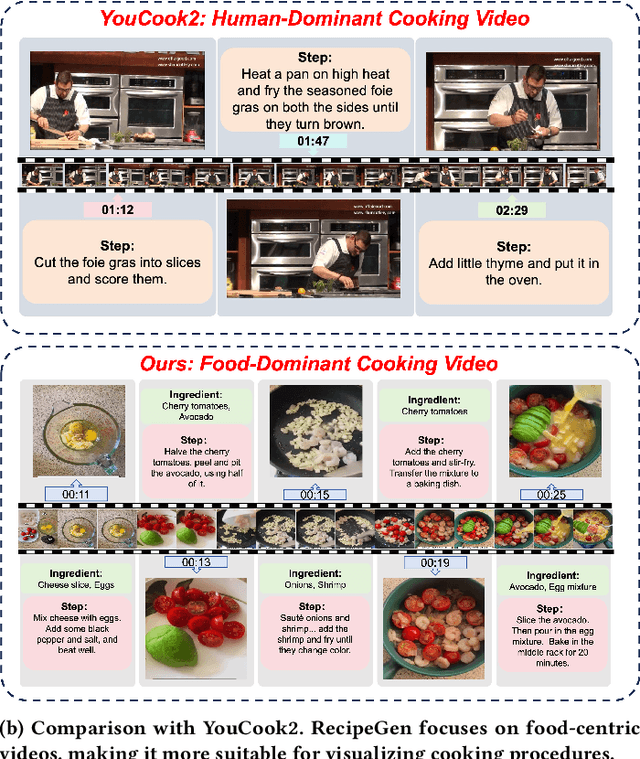
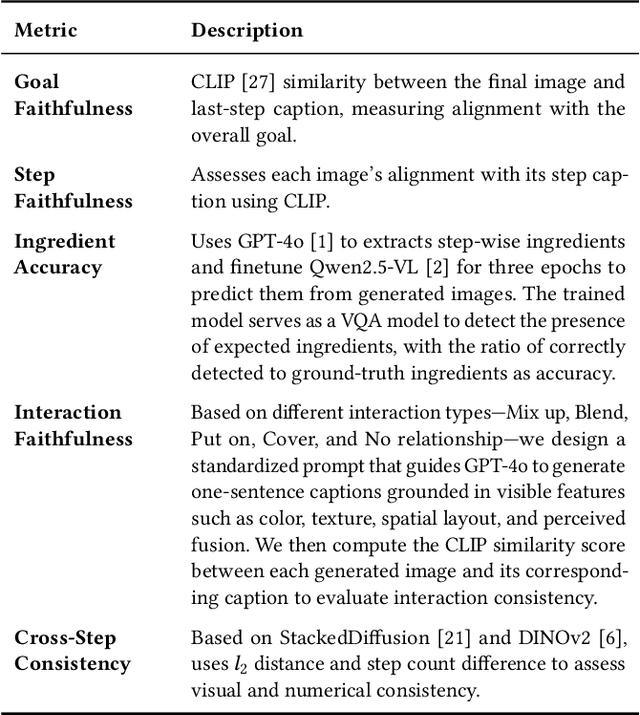
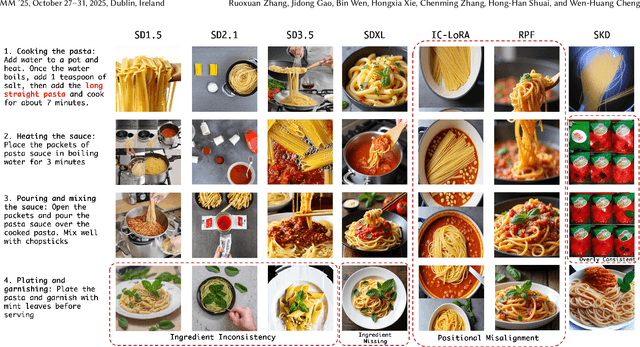
Creating recipe images is a key challenge in food computing, with applications in culinary education and multimodal recipe assistants. However, existing datasets lack fine-grained alignment between recipe goals, step-wise instructions, and visual content. We present RecipeGen, the first large-scale, real-world benchmark for recipe-based Text-to-Image (T2I), Image-to-Video (I2V), and Text-to-Video (T2V) generation. RecipeGen contains 26,453 recipes, 196,724 images, and 4,491 videos, covering diverse ingredients, cooking procedures, styles, and dish types. We further propose domain-specific evaluation metrics to assess ingredient fidelity and interaction modeling, benchmark representative T2I, I2V, and T2V models, and provide insights for future recipe generation models. Project page is available now.
RecipeGen: A Benchmark for Real-World Recipe Image Generation
Mar 07, 2025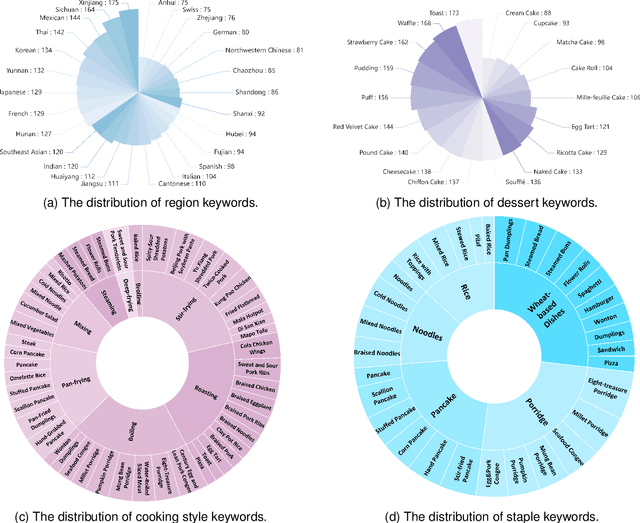
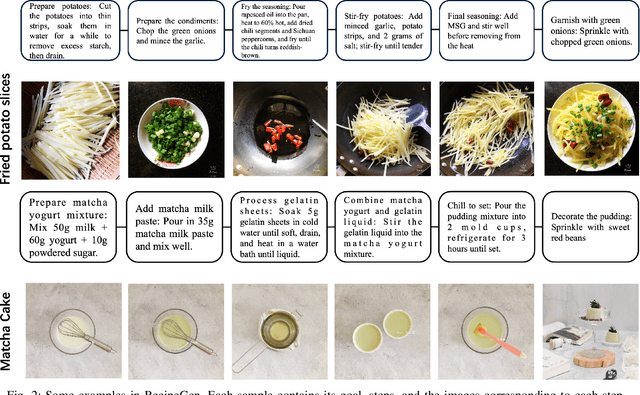
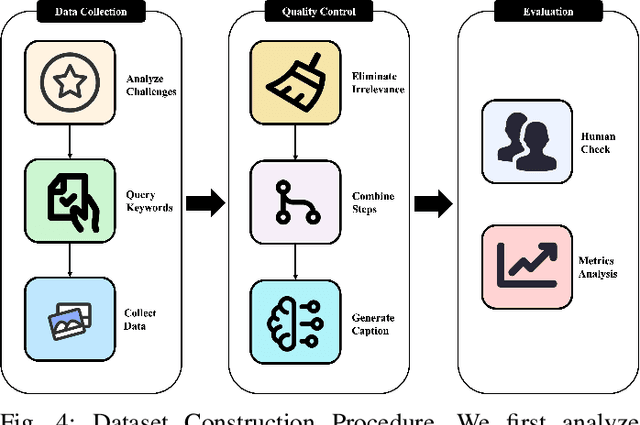

Recipe image generation is an important challenge in food computing, with applications from culinary education to interactive recipe platforms. However, there is currently no real-world dataset that comprehensively connects recipe goals, sequential steps, and corresponding images. To address this, we introduce RecipeGen, the first real-world goal-step-image benchmark for recipe generation, featuring diverse ingredients, varied recipe steps, multiple cooking styles, and a broad collection of food categories. Data is in https://github.com/zhangdaxia22/RecipeGen.