 Add to Chrome
 Add to Firefox
 Add to Edge
MoSSP: A Momentum-Based Single-Loop Stochastic Penalty Method for Nonconvex Constrained DC-Regularized Optimization
May 28, 2026
In this paper, we study a structured class of nonconvex constrained stochastic problems with difference-of-convex (DC) regularization, where the feasible set is possibly nonconvex and the concave part of the DC regularizer is allowed to be nonsmooth. The fundamental challenge lies in maintaining feasibility for nonconvex constraints while achieving favorable oracle complexity. Although single-loop algorithms efficiently solve unconstrained DC optimization problems, their potential for constrained optimization with DC structure remains largely unexplored. To address this gap, we develop MoSSP, a Momentum-based Single-loop Stochastic Penalty method for such problems with provable complexity guarantees. The key idea is to apply a single stochastic proximal-gradient step to the Moreau envelope of the penalty plus the convex DC part, with the concave part's proximal mapping computed in parallel. We derive two algorithm variants: a Polyak-momentum version with $O(\varepsilon^{-4})$ oracle complexity for finding stochastic $\varepsilon$-KKT points, and an improved $O(\varepsilon^{-3})$ version incorporating recursive momentum. Experimental results demonstrate the effectiveness of the proposed algorithms.

Deep Point-wise Prediction for Action Temporal Proposal
Sep 17, 2019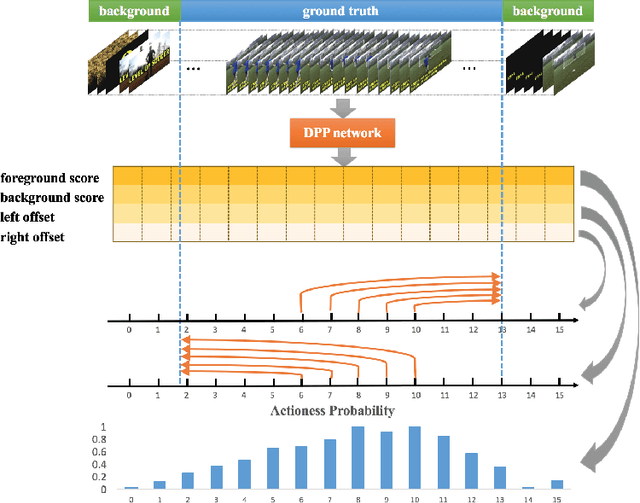
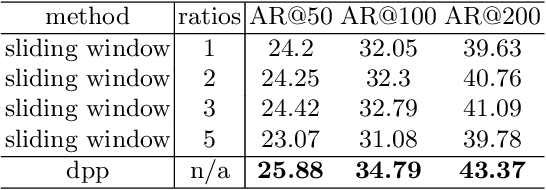
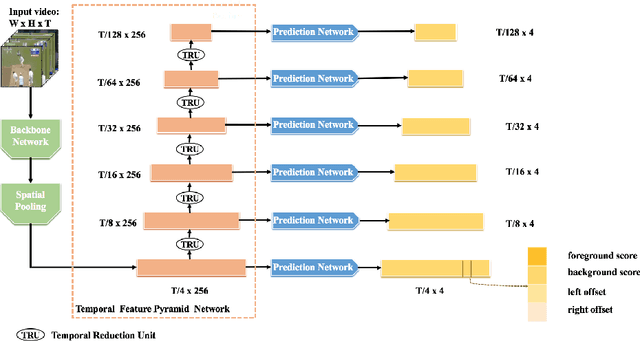
Detecting actions in videos is an important yet challenging task. Previous works usually utilize (a) sliding window paradigms, or (b) per-frame action scoring and grouping to enumerate the possible temporal locations. Their performances are also limited to the designs of sliding windows or grouping strategies. In this paper, we present a simple and effective method for temporal action proposal generation, named Deep Point-wise Prediction (DPP). DPP simultaneously predicts the action existing possibility and the corresponding temporal locations, without the utilization of any handcrafted sliding window or grouping. The whole system is end-to-end trained with joint loss of temporal action proposal classification and location prediction. We conduct extensive experiments to verify its effectiveness, generality and robustness on standard THUMOS14 dataset. DPP runs more than 1000 frames per second, which largely satisfies the real-time requirement. The code is available at https://github.com/liluxuan1997/DPP.