 Add to Chrome
 Add to Firefox
 Add to Edge
Bayesian Supervised Causal Clustering
Mar 05, 2026
Finding patient subgroups with similar characteristics is crucial for personalized decision-making in various disciplines such as healthcare and policy evaluation. While most existing approaches rely on unsupervised clustering methods, there is a growing trend toward using supervised clustering methods that identify operationalizable subgroups in the context of a specific outcome of interest. We propose Bayesian Supervised Causal Clustering (BSCC), with treatment effect as outcome to guide the clustering process. BSCC identifies homogenous subgroups of individuals who are similar in their covariate profiles as well as their treatment effects. We evaluate BSCC on simulated datasets as well as real-world dataset from the third International Stroke Trial to assess the practical usefulness of the framework.

Computational Approaches for Traditional Chinese Painting: From the "Six Principles of Painting" Perspective
Jul 26, 2023Traditional Chinese Painting (TCP) is an invaluable cultural heritage resource and a unique visual art style. In recent years, increasing interest has been placed on digitalizing TCPs to preserve and revive the culture. The resulting digital copies have enabled the advancement of computational methods for structured and systematic understanding of TCPs. To explore this topic, we conducted an in-depth analysis of 92 pieces of literature. We examined the current use of computer technologies on TCPs from three perspectives, based on numerous conversations with specialists. First, in light of the "Six Principles of Painting" theory, we categorized the articles according to their research focus on artistic elements. Second, we created a four-stage framework to illustrate the purposes of TCP applications. Third, we summarized the popular computational techniques applied to TCPs. The framework also provides insights into potential applications and future prospects, with professional opinion. The list of surveyed publications and related information is available online at https://ca4tcp.com.
ScrollTimes: Tracing the Provenance of Paintings as a Window into History
Jun 15, 2023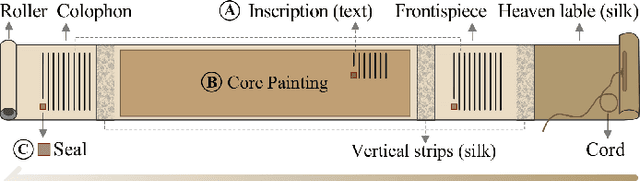
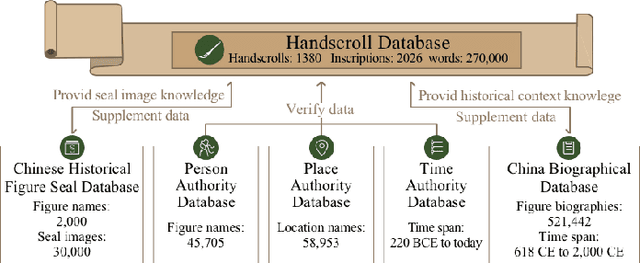
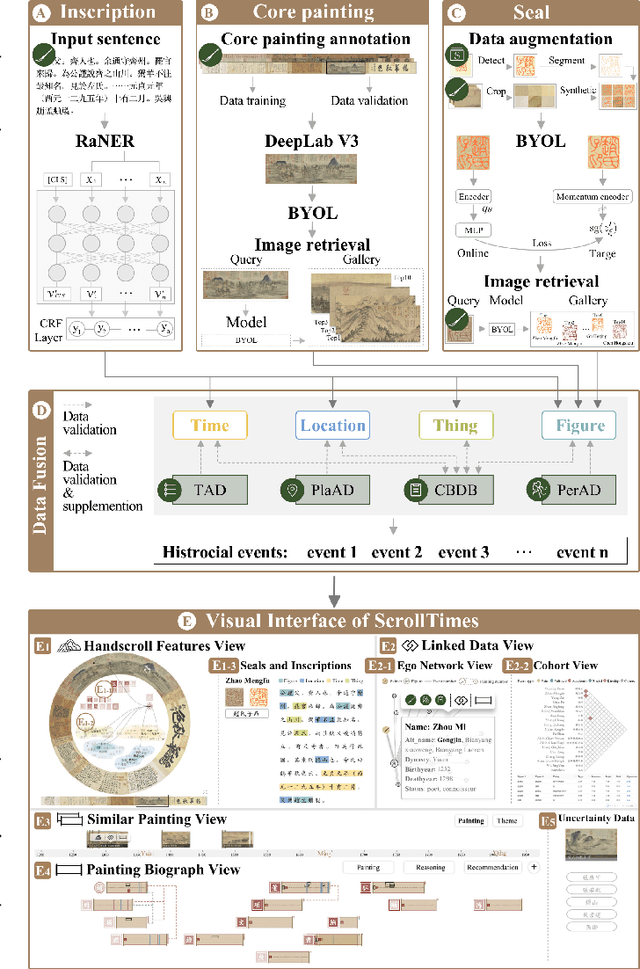
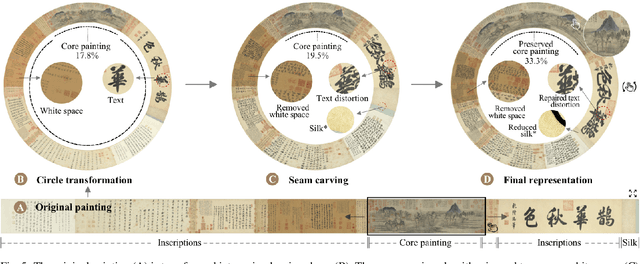
Digital humanities research has flourished due to the diverse artifacts available in cultural heritage databases. However, over-reliance on a single artifact type can result in poor contextualization and a constrained understanding of historical context. We collaborated with art historians to examine handscrolls, a form of traditional Chinese painting which offers a wealth of data for historical analysis and provides a unique opportunity for understanding history through artwork. We propose ScrollTimes, a visual analysis system for tracing handscroll historic context by linking multiple data sources. Specifically, a unique layout is developed for efficiently viewing long handscrolls. Using image processing techniques and language models, we extract, verify, and supplement elements in handscrolls with different cultural heritage databases. Furthermore, interactive biographies are constructed for handscrolls to uncover their historical narratives, provenance trajectories, and artistic legacies. Validated through case studies and expert interviews, our approach offers a window into history, fostering a holistic understanding of handscroll provenance and historical significance.