 Add to Chrome
 Add to Firefox
 Add to Edge
EgoEV-HandPose: Egocentric 3D Hand Pose Estimation and Gesture Recognition with Stereo Event Cameras
May 12, 2026
Egocentric 3D hand pose estimation and gesture recognition are essential for immersive augmented/virtual reality, human-computer interaction, and robotics. However, conventional frame-based cameras suffer from motion blur and limited dynamic range, while existing event-based methods are hindered by ego-motion interference, monocular depth ambiguity, and the lack of large-scale real-world stereo datasets. To overcome these limitations, we propose EgoEV-HandPose, an end-to-end framework for joint 3D bimanual pose estimation and gesture recognition from stereo event streams. Central to our approach is KeypointBEV, a flexible stereo fusion module that lifts features into a canonical bird's-eye-view space and employs an iterative reprojection-guided refinement loop to progressively resolve depth uncertainty and enforce kinematic consistency. In addition, we introduce EgoEVHands, the first large-scale real-world stereo event-camera dataset for egocentric hand perception, containing 5,419 annotated sequences with dense 3D/2D keypoints across 38 gesture classes under varying illumination. Extensive experiments demonstrate that EgoEV-HandPose achieves state-of-the-art performance with an MPJPE of 30.54mm and 86.87% Top-1 gesture recognition accuracy, significantly outperforming RGB-based stereo and prior event-camera methods, particularly in low-light and bimanual occlusion scenarios, thereby setting a new benchmark for event-based egocentric perception. The established dataset and source code will be publicly released at https://github.com/ZJUWang01/EgoEV-HandPose.

EgoEvGesture: Gesture Recognition Based on Egocentric Event Camera
Mar 16, 2025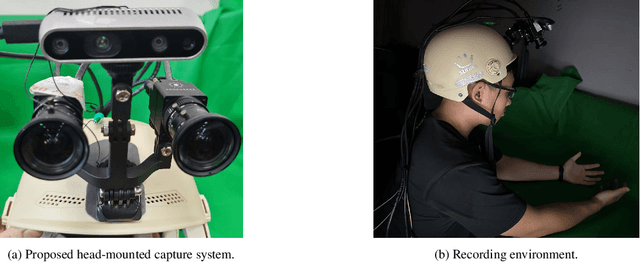
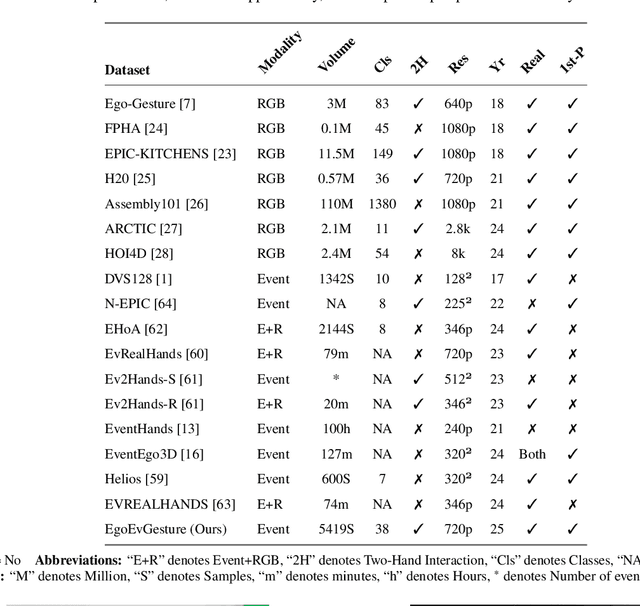
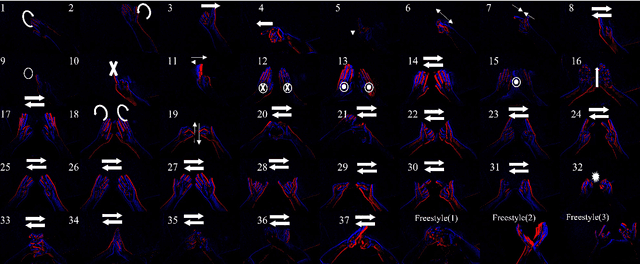
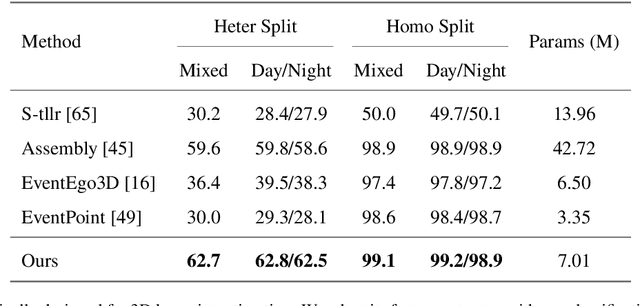
Egocentric gesture recognition is a pivotal technology for enhancing natural human-computer interaction, yet traditional RGB-based solutions suffer from motion blur and illumination variations in dynamic scenarios. While event cameras show distinct advantages in handling high dynamic range with ultra-low power consumption, existing RGB-based architectures face inherent limitations in processing asynchronous event streams due to their synchronous frame-based nature. Moreover, from an egocentric perspective, event cameras record data that include events generated by both head movements and hand gestures, thereby increasing the complexity of gesture recognition. To address this, we propose a novel network architecture specifically designed for event data processing, incorporating (1) a lightweight CNN with asymmetric depthwise convolutions to reduce parameters while preserving spatiotemporal features, (2) a plug-and-play state-space model as context block that decouples head movement noise from gesture dynamics, and (3) a parameter-free Bins-Temporal Shift Module (BSTM) that shifts features along bins and temporal dimensions to fuse sparse events efficiently. We further build the EgoEvGesture dataset, the first large-scale dataset for egocentric gesture recognition using event cameras. Experimental results demonstrate that our method achieves 62.7% accuracy in heterogeneous testing with only 7M parameters, 3.1% higher than state-of-the-art approaches. Notable misclassifications in freestyle motions stem from high inter-personal variability and unseen test patterns differing from training data. Moreover, our approach achieved a remarkable accuracy of 96.97% on DVS128 Gesture, demonstrating strong cross-dataset generalization capability. The dataset and models are made publicly available at https://github.com/3190105222/EgoEv_Gesture.