 Add to Chrome
 Add to Firefox
 Add to Edge
A Perception vs. Distortion Perspective on Score-Based Generative Channel Estimation
Jun 15, 2026
Driven by their remarkable success in computer vision and inverse problem solving, score-based models are increasingly applied to wireless communications, where they show promise across a range of physical-layer tasks. However, despite this growing interest, the current literature often lacks a rigorous analysis of when score-matching offers a tangible advantage over traditional discriminative learning. This paper aims to address this gap through the use-case of channel estimation, a fundamental inverse problem in wireless systems. We present a theoretically grounded interpretation of score-based channel estimation through the lens of the perception-distortion tradeoff, identifying the conditions where score matching excels as well as its key limitations. In particular, by modeling downstream wireless tasks (e.g., capacity maximization) as functionals of the channel estimation process, we quantify the excess risk incurred by standard distortion-minimization approaches. Extensive numerical results show that under high predictive uncertainty, the large excess risk gap can be offset by score-based estimation, enabling near Bayesian-optimal precoding via the learned posterior, whereas in the low predictive uncertainty regime, discriminative distortion-minimization approaches are preferable due to lower complexity and more efficient use of model capacity.

The Vienna 4G/5G Drive-Test Dataset
Mar 03, 2026Machine learning for mobile network analysis, planning, and optimization is often limited by the lack of large, comprehensive real-world datasets. This paper introduces the Vienna 4G/5G Drive-Test Dataset, a city-scale open dataset of georeferenced Long Term Evolution (LTE) and 5G New Radio (NR) measurements collected across Vienna, Austria. The dataset combines passive wideband scanner observations with active handset logs, providing complementary network-side and user-side views of deployed radio access networks. The measurements cover diverse urban and suburban settings and are aligned with time and location information to support consistent evaluation. For a representative subset of base stations (BSs), we provide inferred deployment descriptors, including estimated BS locations, sector azimuths, and antenna heights. The release further includes high-resolution building and terrain models, enabling geometry-conditioned learning and calibration of deterministic approaches such as ray tracing. To facilitate practical reuse, the data are organized into scanner, handset, estimated cell information, and city-model components, and the accompanying documentation describes the available fields and intended joins between them. The dataset enables reproducible benchmarking across environment-aware learning, propagation modeling, coverage analysis, and ray-tracing calibration workflows.
Deep Learning-based mmWave MIMO Channel Estimation using sub-6 GHz Channel Information: CNN and UNet Approaches
Jun 13, 2025
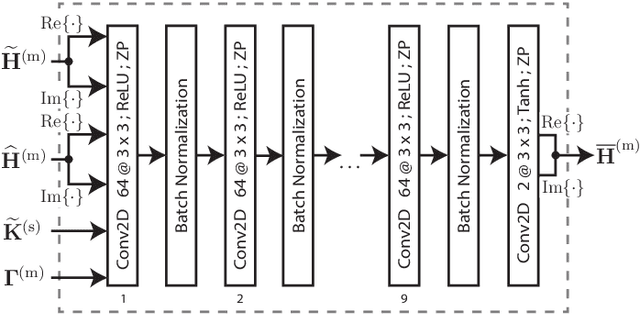
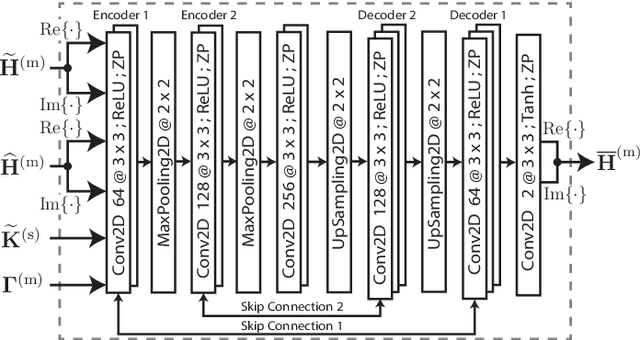
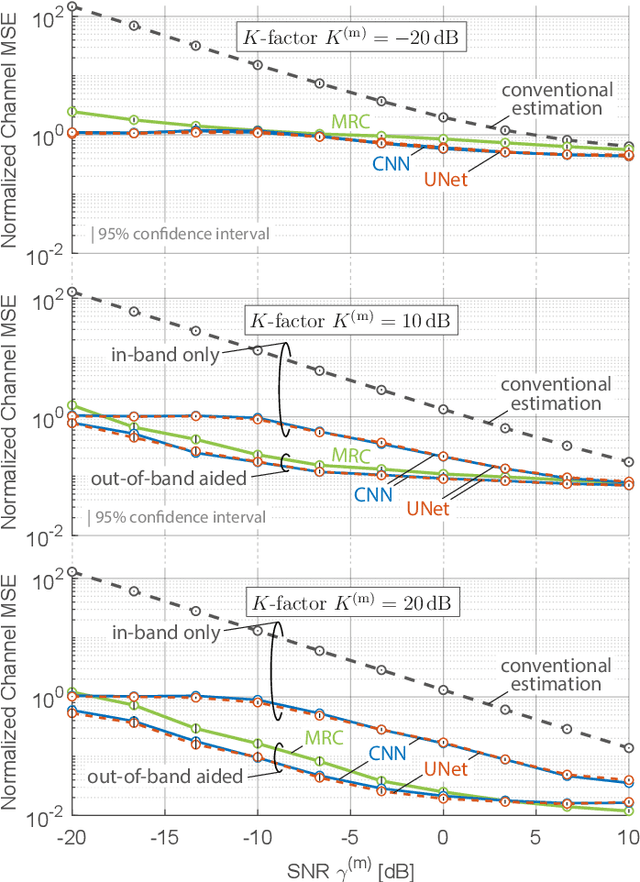
Future wireless multiple-input multiple-output (MIMO) systems will integrate both sub-6 GHz and millimeter wave (mmWave) frequency bands to meet the growing demands for high data rates. MIMO link establishment typically requires accurate channel estimation, which is particularly challenging at mmWave frequencies due to the low signal-to-noise ratio (SNR). In this paper, we propose two novel deep learning-based methods for estimating mmWave MIMO channels by leveraging out-of-band information from the sub-6 GHz band. The first method employs a convolutional neural network (CNN), while the second method utilizes a UNet architecture. We compare these proposed methods against deep-learning methods that rely solely on in-band information and with other state-of-the-art out-of-band aided methods. Simulation results show that our proposed out-of-band aided deep-learning methods outperform existing alternatives in terms of achievable spectral efficiency.
* Submitted to IEEE Conference on Computer Communications Workshops (INFOCOM WKSHPS), 2025