 Add to Chrome
 Add to Firefox
 Add to Edge
Multi-Band Patch Antenna Array for Out-of-Band Aided Millimeter Wave Communication
Apr 03, 2026
Future wireless communication systems will integrate both sub-6 GHz and millimeter wave (mmWave) frequency bands within multi-antenna architectures to meet the increasing demand for high data rates. In such multi-band systems, reliable information obtained from the sub-6 GHz band can be exploited to support communication at mmWave frequencies. To ensure that both systems experience similar multi-path propagation effects, the sub-6GHz and mmWave antenna arrays have to be colocated and precisely aligned. However, such a configuration may adversely alter the radiation characteristics of the arrays, potentially degrading their performance. In this paper, we investigate the impact of positioning a mmWave antenna structure in front of a sub-6 GHz antenna structure. Through both simulations and measurements, we evaluate how the presence of the mmWave structure affects the radiation pattern of the sub-6 GHz one. The results demonstrate that the influence of the mmWave structure on the sub-6 GHz performance is minor, indicating that co-located configurations are feasible with negligible degradation.
* Published at the IEEE International Workshop on Antenna Technology (iWAT), 2026

Exploiting Out-of-Band Information for Millimeter-Wave MIMO Channel Estimation: Performance in Static and Dynamic Scenarios
Apr 03, 2026To support the high data rates for latency-critical applications, future wireless systems will employ fully digital beamforming multiple-input multiple-output (MIMO) architectures at millimeter wave (mmWave) frequencies. Moreover, mmWave MIMO deployments will coexist with conventional sub-6 GHz MIMO systems, creating opportunities to exploit out-of-band sub-6 GHz information to enhance channel estimation at mmWave frequencies. In this work, we analyze the pilot-aided channel estimation performance of mmWave MIMO systems under various pilot configurations in both static and dynamic environments. We evaluate the system performance in terms of spectral efficiency (SE) for line-of-sight and non-line-of-sight propagation conditions. Simulation results show that incorporating out-of-band sub-6 GHz information yields notable SE gains in both static and dynamic scenarios.
* Accepted to be presented at the European Conference on Networks and Communications and the 6G Summit (EuCNC & 6G Summit), 2026
Time-Varying Rician K-factor in Measured Vehicular Channels at cmWave and mmWave Bands
Jan 22, 2026Future vehicular communication systems will integrate millimeter wave (mmWave) technology to enhance data transmission rates. To investigate the propagation effects and small-scale fading differences between mmWave and conventional centimeter wave (cmWave) bands, multi-band channel measurements have to be conducted. One key parameter to characterize small-scale fading is the Rician K-factor. In this paper, we analyze the time-varying K-factor of vehicle-to-infrastructure (V2I) channels across multiple frequency bands, measured in an urban street environment. Specifically, we investigate three frequency bands with center frequencies of 3.2 GHz, 34.3 GHz and 62.35 GHz using measurement data with 155.5 MHz bandwidth and a sounding repetition rate of 31.25 μs. Furthermore, we analyze the relationship between K-factor and root-mean-square (RMS) delay spread. We show that the Ricean K-factor is similar at different frequency bands and that is correlated with the RMS delay spread.
* Published at the 19th European Conference on Antennas and Propagation (EuCAP), 2025
Performance Analysis of Digital Beamforming mmWave MIMO with Low-Resolution DACs/ADCs
Jan 22, 2026Future wireless communications will rely on multiple-input multiple-output (MIMO) beamforming operating at millimeter wave (mmWave) frequency bands to deliver high data rates. To support flexible spatial processing and meet the demands of latency critical applications, it is essential to use fully digital mmWave MIMO beamforming, which relies on accurate channel estimation. However, ensuring power efficiency in fully digital mmWave MIMO systems requires the use of low-resolution digital-to-analog converters (DACs) and analog-to-digital converters (ADCs). The reduced resolution of these quantizers introduces distortion in both transmitted and received signals, ultimately degrading system performance. In this paper, we investigate the channel estimation performance of mmWave MIMO systems employing fully digital beamforming with low-resolution quantization, under practical system constraints. We evaluate the system performance in terms of spectral efficiency (SE) and energy efficiency (EE). Simulation results demonstrate that a moderate quantization resolutions of 4-bit per DAC/ADC offers a favorable trade-off between energy consumption and achievable data rate.
* Published at the IEEE Radio and Antenna Days of the Indian Ocean (RADIO), 2025
Deep Learning-based mmWave MIMO Channel Estimation using sub-6 GHz Channel Information: CNN and UNet Approaches
Jun 13, 2025
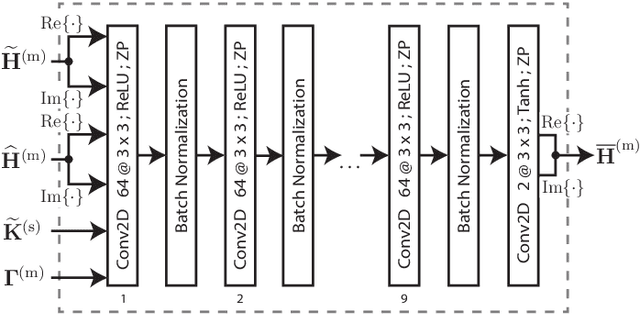
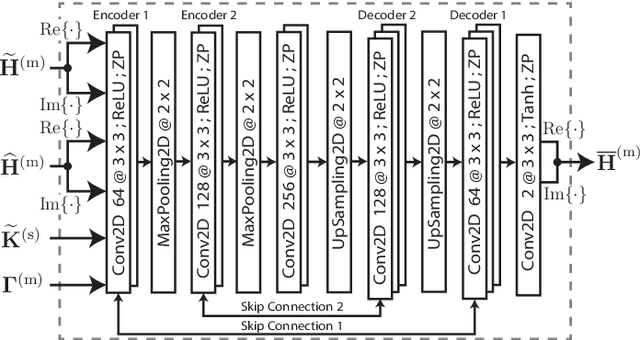
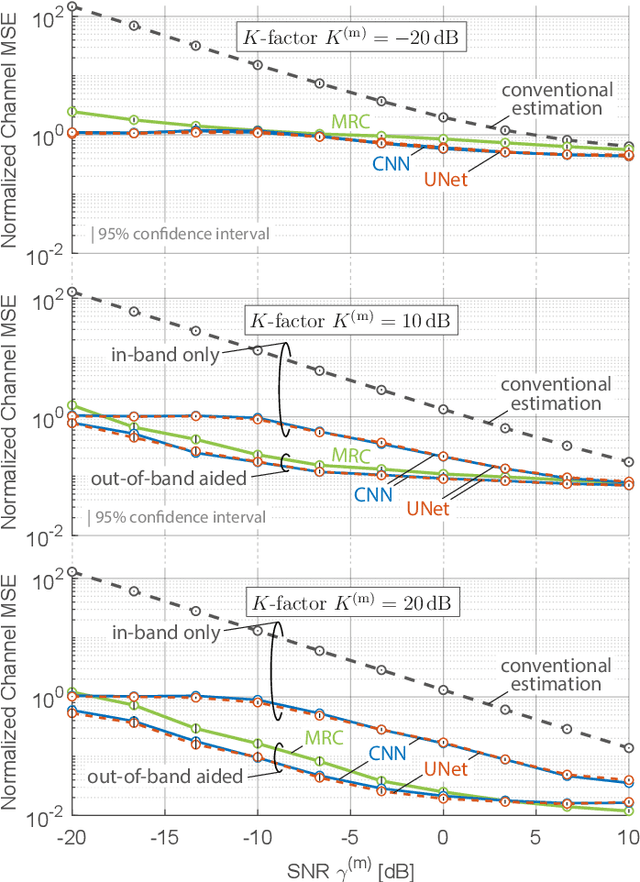
Future wireless multiple-input multiple-output (MIMO) systems will integrate both sub-6 GHz and millimeter wave (mmWave) frequency bands to meet the growing demands for high data rates. MIMO link establishment typically requires accurate channel estimation, which is particularly challenging at mmWave frequencies due to the low signal-to-noise ratio (SNR). In this paper, we propose two novel deep learning-based methods for estimating mmWave MIMO channels by leveraging out-of-band information from the sub-6 GHz band. The first method employs a convolutional neural network (CNN), while the second method utilizes a UNet architecture. We compare these proposed methods against deep-learning methods that rely solely on in-band information and with other state-of-the-art out-of-band aided methods. Simulation results show that our proposed out-of-band aided deep-learning methods outperform existing alternatives in terms of achievable spectral efficiency.
* Submitted to IEEE Conference on Computer Communications Workshops (INFOCOM WKSHPS), 2025
Channel Estimation for mmWave MIMO using sub-6 GHz Out-of-Band Information
Nov 16, 2023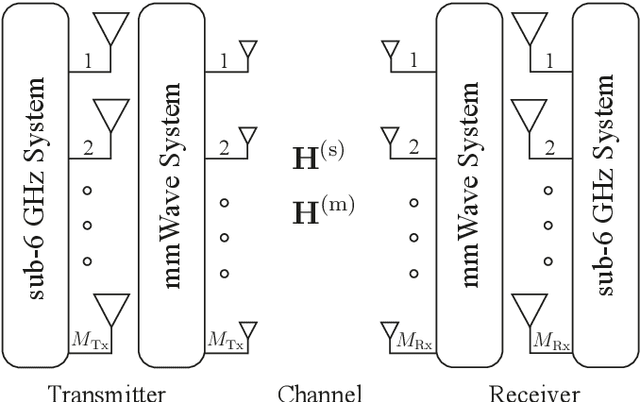
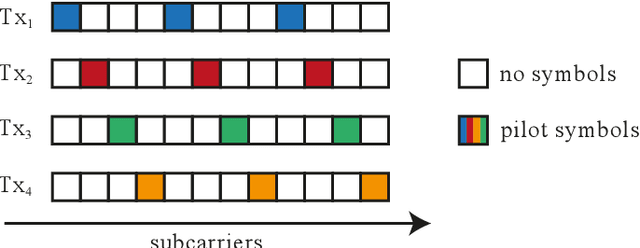
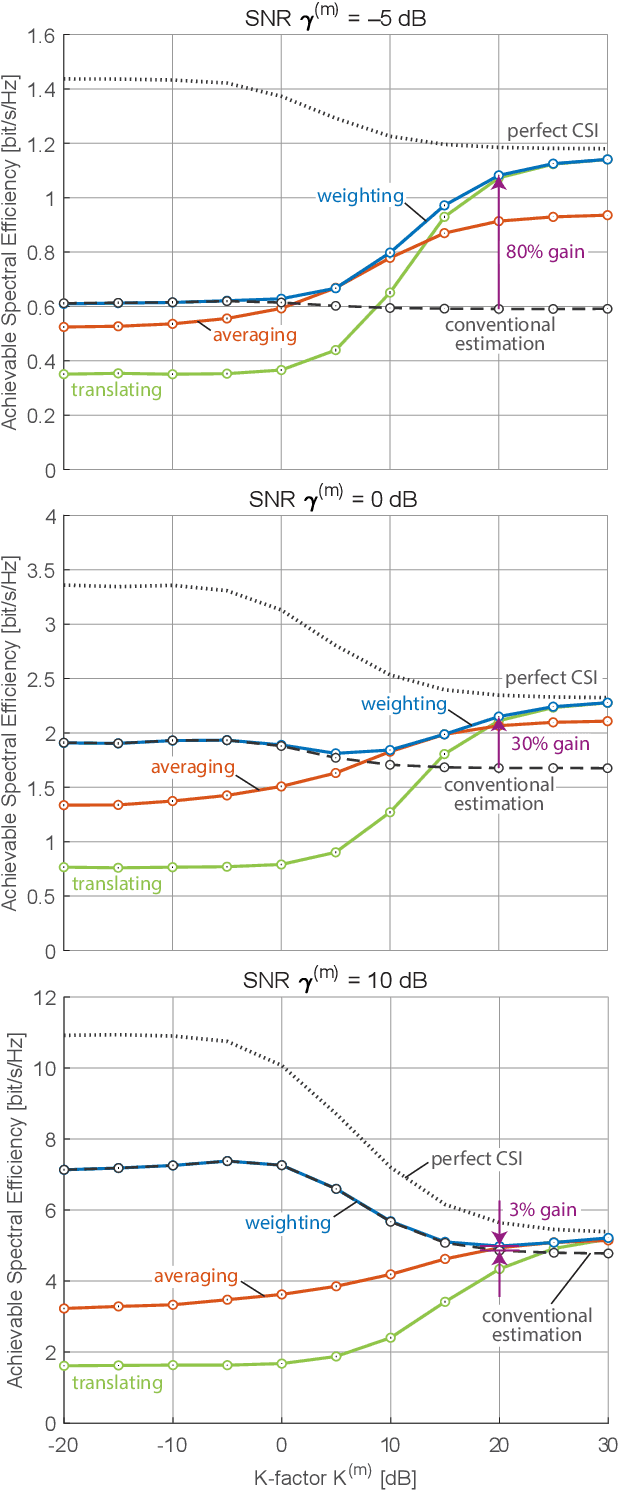
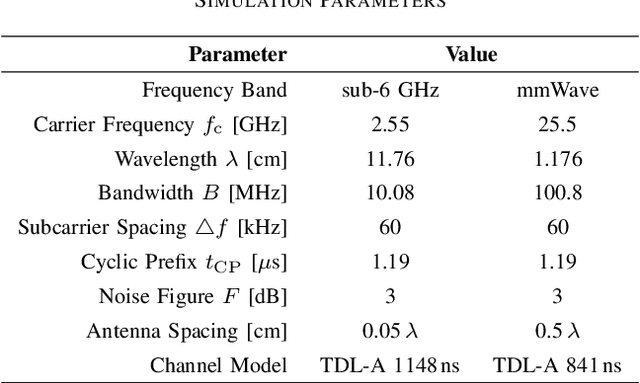
Future wireless multiple-input multiple-output (MIMO) communication systems will employ sub-6 GHz and millimeter wave (mmWave) frequency bands working cooperatively. Establishing a MIMO communication link usually relies on estimating channel state information (CSI) which is difficult to acquire at mmWave frequencies due to a low signal-to-noise ratio (SNR). In this paper, we propose three novel methods to estimate mmWave MIMO channels using out-of-band information obtained from the sub-6GHz band. We compare the proposed channel estimation methods with a conventional one utilizing only in-band information. Simulation results show that the proposed methods outperform the conventional mmWave channel estimation method in terms of achievable spectral efficiency, especially at low SNR and high K-factor.
Evaluation of stationarity regions in measured non-WSSUS 60 GHz mmWave V2V channels
Oct 06, 2022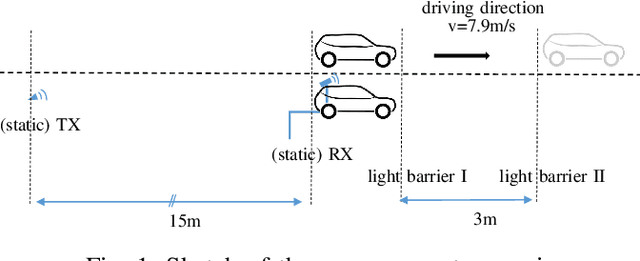
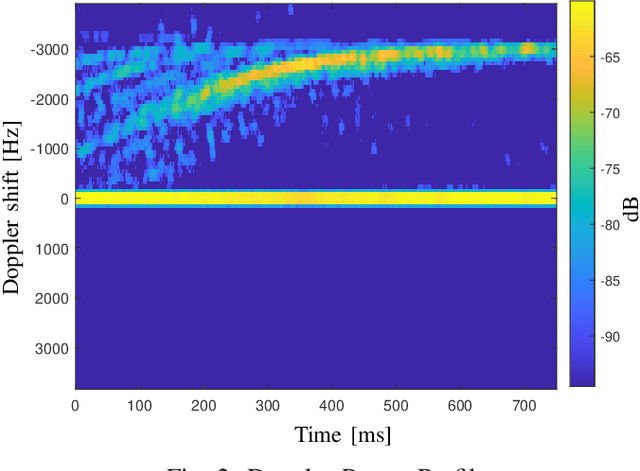
Due to high mobility in multipath propagation environments, vehicle-to-vehicle (V2V) channels are generally time and frequency variant. Therefore, the criteria for wide-sense stationarity (WSS) and uncorrelated scattering (US) are just satisfied over very limited intervals in the time and frequency domains, respectively. We test the validity of these criteria in measured vehicular 60 GHz millimeter wave (mmWave) channels, by estimating the local scattering functions (LSFs) from the measured data. Based on the variation of the LSFs, we define time-frequency stationarity regions, over which the WSSUS assumption is assumed to be fulfilled approximately. We analyze and compare both line-of-sight (LOS) and non-LOS (NLOS) V2V communication conditions. We observe large stationarity regions for channels with a dominant LOS connection, without relative movement between the transmitting and receiving vehicle. In the same measured urban driving scenario, modified by eliminating the LOS component in the post-processing, the channel is dominated by specular components reflected from an overpassing vehicle with a relative velocity of 56 km/h. Here, we observe a stationarity bandwidth of 270 MHz. Furthermore, the NLOS channel, dominated by a single strong specular component, shows a relatively large average stationarity time of 16 ms, while the stationarity time for the channel with a rich multipath profile is much shorter, in the order of 5 ms.