 Add to Chrome
 Add to Firefox
 Add to Edge
HydroGym: A Reinforcement Learning Platform for Fluid Dynamics
Dec 19, 2025
Modeling and controlling fluid flows is critical for several fields of science and engineering, including transportation, energy, and medicine. Effective flow control can lead to, e.g., lift increase, drag reduction, mixing enhancement, and noise reduction. However, controlling a fluid faces several significant challenges, including high-dimensional, nonlinear, and multiscale interactions in space and time. Reinforcement learning (RL) has recently shown great success in complex domains, such as robotics and protein folding, but its application to flow control is hindered by a lack of standardized benchmark platforms and the computational demands of fluid simulations. To address these challenges, we introduce HydroGym, a solver-independent RL platform for flow control research. HydroGym integrates sophisticated flow control benchmarks, scalable runtime infrastructure, and state-of-the-art RL algorithms. Our platform includes 42 validated environments spanning from canonical laminar flows to complex three-dimensional turbulent scenarios, validated over a wide range of Reynolds numbers. We provide non-differentiable solvers for traditional RL and differentiable solvers that dramatically improve sample efficiency through gradient-enhanced optimization. Comprehensive evaluation reveals that RL agents consistently discover robust control principles across configurations, such as boundary layer manipulation, acoustic feedback disruption, and wake reorganization. Transfer learning studies demonstrate that controllers learned at one Reynolds number or geometry adapt efficiently to new conditions, requiring approximately 50% fewer training episodes. The HydroGym platform is highly extensible and scalable, providing a framework for researchers in fluid dynamics, machine learning, and control to add environments, surrogate models, and control algorithms to advance science and technology.

Koopman-Assisted Reinforcement Learning
Mar 04, 2024The Bellman equation and its continuous form, the Hamilton-Jacobi-Bellman (HJB) equation, are ubiquitous in reinforcement learning (RL) and control theory. However, these equations quickly become intractable for systems with high-dimensional states and nonlinearity. This paper explores the connection between the data-driven Koopman operator and Markov Decision Processes (MDPs), resulting in the development of two new RL algorithms to address these limitations. We leverage Koopman operator techniques to lift a nonlinear system into new coordinates where the dynamics become approximately linear, and where HJB-based methods are more tractable. In particular, the Koopman operator is able to capture the expectation of the time evolution of the value function of a given system via linear dynamics in the lifted coordinates. By parameterizing the Koopman operator with the control actions, we construct a ``Koopman tensor'' that facilitates the estimation of the optimal value function. Then, a transformation of Bellman's framework in terms of the Koopman tensor enables us to reformulate two max-entropy RL algorithms: soft value iteration and soft actor-critic (SAC). This highly flexible framework can be used for deterministic or stochastic systems as well as for discrete or continuous-time dynamics. Finally, we show that these Koopman Assisted Reinforcement Learning (KARL) algorithms attain state-of-the-art (SOTA) performance with respect to traditional neural network-based SAC and linear quadratic regulator (LQR) baselines on four controlled dynamical systems: a linear state-space system, the Lorenz system, fluid flow past a cylinder, and a double-well potential with non-isotropic stochastic forcing.
On the Relationships between Graph Neural Networks for the Simulation of Physical Systems and Classical Numerical Methods
Mar 31, 2023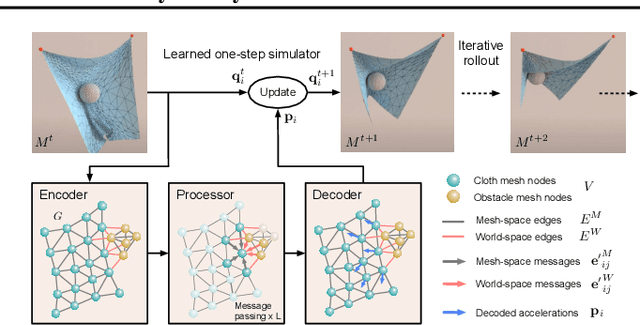
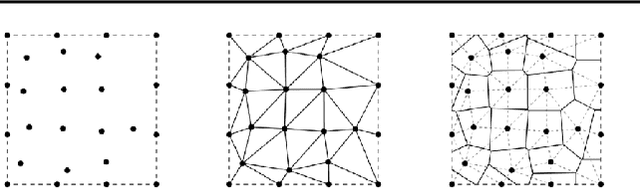

Recent developments in Machine Learning approaches for modelling physical systems have begun to mirror the past development of numerical methods in the computational sciences. In this survey, we begin by providing an example of this with the parallels between the development trajectories of graph neural network acceleration for physical simulations and particle-based approaches. We then give an overview of simulation approaches, which have not yet found their way into state-of-the-art Machine Learning methods and hold the potential to make Machine Learning approaches more accurate and more efficient. We conclude by presenting an outlook on the potential of these approaches for making Machine Learning models for science more efficient.