 Add to Chrome
 Add to Firefox
 Add to Edge
Learning Individual Dynamics from Sparse Cross-Sectional Snapshots
May 22, 2026
Predicting how a dynamical unit evolves over time - how an individual ages, an epidemic spreads, or a physical system degrades - typically requires dense longitudinal tracking. When only extremely sparse or entirely cross-sectional data is available, inferring individualized, continuous-time trajectories is fundamentally ill-posed. Existing methods force a strict compromise: sequence models (e.g. latent ODEs) require dense longitudinal data, while cross-sectional methods (e.g. optimal transport, flow matching-based) map aggregate populations, losing individual dynamics. In this paper, we demonstrate that this dichotomy can be broken. We introduce CADENCE, a principled probabilistic framework that recovers continuous individual trajectories from isolated snapshots by anchoring latent dynamics to static, individual-level contexts. We provide novel identifiability guarantees for single-timepoint trajectory inference. By combining a score-based spatial encoder (bijective Probability Flow ODE) to eliminate diffeomorphic ambiguities with a Soft Mixture-of-Experts (SMoE) router, we show that individual dynamical parameters and routing function are jointly identifiable. Across a suite of benchmarks spanning physical systems to real-world biological data, CADENCE, trained strictly on extremely sparse snapshots with context structure, matches or exceeds the performance of state-of-the-art sequential models trained on dense, full-trajectory data.

HydroGym: A Reinforcement Learning Platform for Fluid Dynamics
Dec 19, 2025Modeling and controlling fluid flows is critical for several fields of science and engineering, including transportation, energy, and medicine. Effective flow control can lead to, e.g., lift increase, drag reduction, mixing enhancement, and noise reduction. However, controlling a fluid faces several significant challenges, including high-dimensional, nonlinear, and multiscale interactions in space and time. Reinforcement learning (RL) has recently shown great success in complex domains, such as robotics and protein folding, but its application to flow control is hindered by a lack of standardized benchmark platforms and the computational demands of fluid simulations. To address these challenges, we introduce HydroGym, a solver-independent RL platform for flow control research. HydroGym integrates sophisticated flow control benchmarks, scalable runtime infrastructure, and state-of-the-art RL algorithms. Our platform includes 42 validated environments spanning from canonical laminar flows to complex three-dimensional turbulent scenarios, validated over a wide range of Reynolds numbers. We provide non-differentiable solvers for traditional RL and differentiable solvers that dramatically improve sample efficiency through gradient-enhanced optimization. Comprehensive evaluation reveals that RL agents consistently discover robust control principles across configurations, such as boundary layer manipulation, acoustic feedback disruption, and wake reorganization. Transfer learning studies demonstrate that controllers learned at one Reynolds number or geometry adapt efficiently to new conditions, requiring approximately 50% fewer training episodes. The HydroGym platform is highly extensible and scalable, providing a framework for researchers in fluid dynamics, machine learning, and control to add environments, surrogate models, and control algorithms to advance science and technology.
Learning Latent Dynamics via Invariant Decomposition and (Spatio-)Temporal Transformers
Jun 21, 2023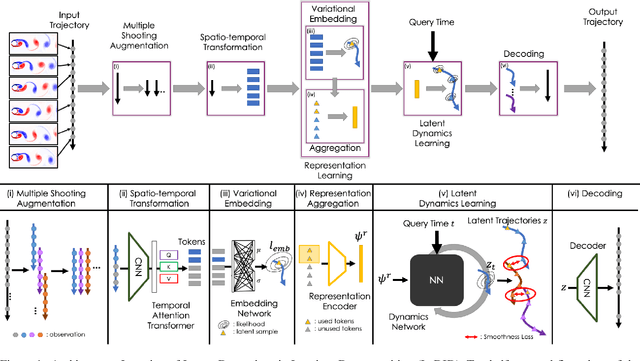
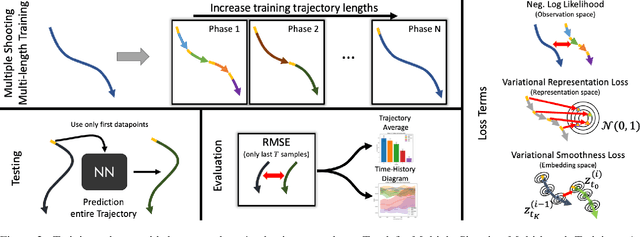
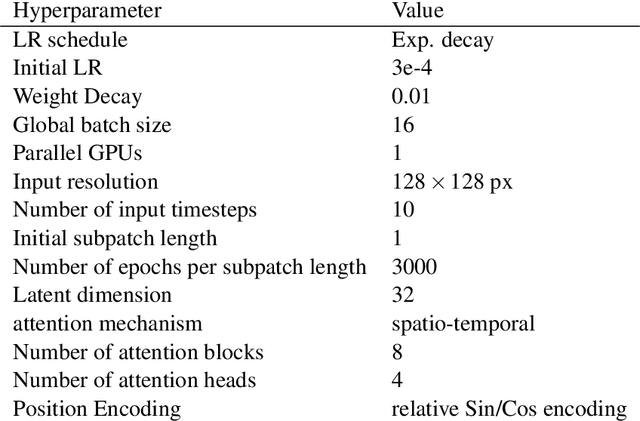
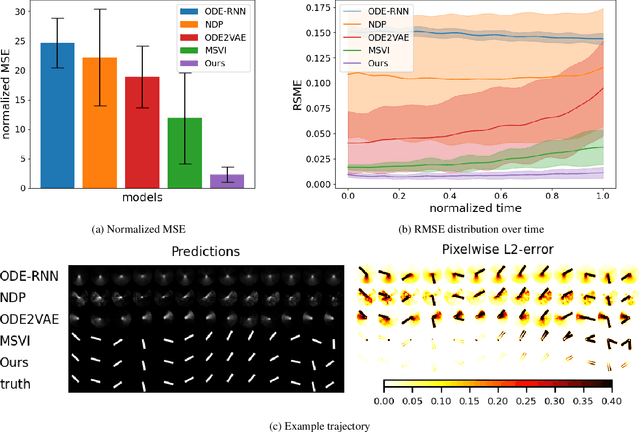
We propose a method for learning dynamical systems from high-dimensional empirical data that combines variational autoencoders and (spatio-)temporal attention within a framework designed to enforce certain scientifically-motivated invariances. We focus on the setting in which data are available from multiple different instances of a system whose underlying dynamical model is entirely unknown at the outset. The approach rests on a separation into an instance-specific encoding (capturing initial conditions, constants etc.) and a latent dynamics model that is itself universal across all instances/realizations of the system. The separation is achieved in an automated, data-driven manner and only empirical data are required as inputs to the model. The approach allows effective inference of system behaviour at any continuous time but does not require an explicit neural ODE formulation, which makes it efficient and highly scalable. We study behaviour through simple theoretical analyses and extensive experiments on synthetic and real-world datasets. The latter investigate learning the dynamics of complex systems based on finite data and show that the proposed approach can outperform state-of-the-art neural-dynamical models. We study also more general inductive bias in the context of transfer to data obtained under entirely novel system interventions. Overall, our results provide a promising new framework for efficiently learning dynamical models from heterogeneous data with potential applications in a wide range of fields including physics, medicine, biology and engineering.
Deep Learning of Causal Structures in High Dimensions
Dec 09, 2022Recent years have seen rapid progress at the intersection between causality and machine learning. Motivated by scientific applications involving high-dimensional data, in particular in biomedicine, we propose a deep neural architecture for learning causal relationships between variables from a combination of empirical data and prior causal knowledge. We combine convolutional and graph neural networks within a causal risk framework to provide a flexible and scalable approach. Empirical results include linear and nonlinear simulations (where the underlying causal structures are known and can be directly compared against), as well as a real biological example where the models are applied to high-dimensional molecular data and their output compared against entirely unseen validation experiments. These results demonstrate the feasibility of using deep learning approaches to learn causal networks in large-scale problems spanning thousands of variables.