 Add to Chrome
 Add to Firefox
 Add to Edge
CataractSAM-2: A Domain-Adapted Model for Anterior Segment Surgery Segmentation and Scalable Ground-Truth Annotation
Mar 23, 2026
We present CataractSAM-2, a domain-adapted extension of Meta's Segment Anything Model 2, designed for real-time semantic segmentation of cataract ophthalmic surgery videos with high accuracy. Positioned at the intersection of computer vision and medical robotics, CataractSAM-2 enables precise intraoperative perception crucial for robotic-assisted and computer-guided surgical systems. Furthermore, to alleviate the burden of manual labeling, we introduce an interactive annotation framework that combines sparse prompts with video-based mask propagation. This tool significantly reduces annotation time and facilitates the scalable creation of high-quality ground-truth masks, accelerating dataset development for ocular anterior segment surgeries. We also demonstrate the model's strong zero-shot generalization to glaucoma trabeculectomy procedures, confirming its cross-procedural utility and potential for broader surgical applications. The trained model and annotation toolkit are released as open-source resources, establishing CataractSAM-2 as a foundation for expanding anterior ophthalmic surgical datasets and advancing real-time AI-driven solutions in medical robotics, as well as surgical video understanding.

Common and Rare Fundus Diseases Identification Using Vision-Language Foundation Model with Knowledge of Over 400 Diseases
Jun 13, 2024

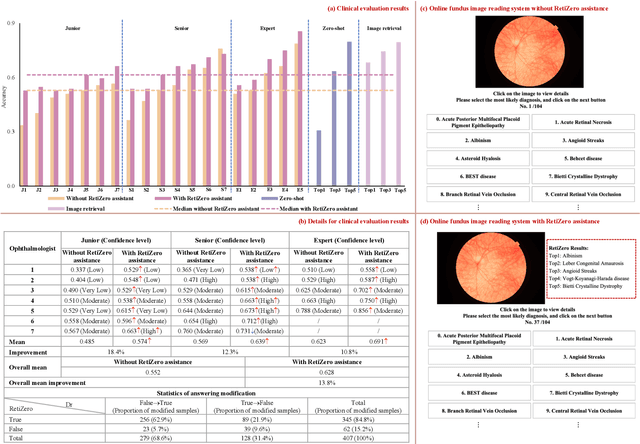

The current retinal artificial intelligence models were trained using data with a limited category of diseases and limited knowledge. In this paper, we present a retinal vision-language foundation model (RetiZero) with knowledge of over 400 fundus diseases. Specifically, we collected 341,896 fundus images paired with text descriptions from 29 publicly available datasets, 180 ophthalmic books, and online resources, encompassing over 400 fundus diseases across multiple countries and ethnicities. RetiZero achieved outstanding performance across various downstream tasks, including zero-shot retinal disease recognition, image-to-image retrieval, internal domain and cross-domain retinal disease classification, and few-shot fine-tuning. Specially, in the zero-shot scenario, RetiZero achieved a Top5 score of 0.8430 and 0.7561 on 15 and 52 fundus diseases respectively. In the image-retrieval task, RetiZero achieved a Top5 score of 0.9500 and 0.8860 on 15 and 52 retinal diseases respectively. Furthermore, clinical evaluations by ophthalmology experts from different countries demonstrate that RetiZero can achieve performance comparable to experienced ophthalmologists using zero-shot and image retrieval methods without requiring model retraining. These capabilities of retinal disease identification strengthen our RetiZero foundation model in clinical implementation.