 Add to Chrome
 Add to Firefox
 Add to Edge
Hard or Just Unreached? Diagnosing the Sampling Blind Spot in Math-Reasoning Difficulty Estimation
Jun 17, 2026
Math and science reasoning benchmarks rely on pass@k, the fraction of sampled chains that reach gold, as the canonical per-example difficulty signal. The same signal drives RL with verifiable rewards, math data curation, synthetic curricula, and verifier training. We show this proxy has a persistent blind spot on its hardest stratum: on the eight free-form math cells we test (GSM8K and MATH across four open-weight models), 10.3-22.9% of the examples that no sampling seed solves in six tries are instead solved at matched compute by a six-chain deterministic regime. These are greedy decoding plus five cheap residual-stream perturbations applied via activation grafting, while greedy alone solves at most 6% on these math cells. Recovery scales with the additional budget, across perturbations whose mechanistic distinctness we verify across all twelve cells (cross-kind fix-set Jaccard <= 0.47 in every setup). Activation grafting is used as an intervention on internal representations, not a decoding method; we use it purely as a diagnostic and diversification tool, and our recovered items show that the pass@k= 0 % stratum is structurally identifiable in the residual stream rather than that the unmodified model reaches them under ordinary inference.

Tail-Shape Estimation in LLM Evaluation Is Fragile: A Protocol for Diagnosing False Positives
Jun 15, 2026Recent work motivates moving large language model (LLM) evaluation from mean-based to tail-aware metrics, including conditional value-at-risk and tail-index estimates of reward-model error. We ask whether the canonical extreme-value-theory tail-index parameter, which isolates how heavy a tail is from how large the tail mass is, adds discriminative information beyond the mean and a standard tail-magnitude statistic in LLM evaluation. We pre-register a protocol covering admissibility, goodness-of-fit, threshold-stability, and effect-size requirements for any positive tail-shape claim. The protocol is the contribution of this paper; the empirical study below is a demonstration of what its gates catch. Applied to a standard LLM toxicity-evaluation setup under two structurally different scorer families, the protocol catches three distinct modes of false positives that a naive analysis would have published, and rejects the headline tail-shape claim on both scorers. We conclude that tail-shape estimation in the LLM toxicity-evaluation setups we examined is more fragile than the recent literature suggests, and recommend the protocol as a starting point for tail-index claims in similar setups.
Zero-Shot Quantization via Weight-Space Arithmetic
Apr 03, 2026We show that robustness to post-training quantization (PTQ) is a transferable direction in weight space. We call this direction the quantization vector: extracted from a donor task by simple weight-space arithmetic, it can be used to patch a receiver model and improve robustness to PTQ-induced noise by as much as 60%, without receiver-side quantization-aware training (QAT). Because the method requires no receiver training data, it provides a zero-shot, low-cost alternative to QAT for extremely low-bit deployment. We demonstrate this on Vision Transformer (ViT) models. More broadly, our results suggest that quantization robustness is not merely a byproduct of task-specific training, but a reusable feature of weight-space geometry that can be transferred rather than retrained.
Demystifying Mergeability: Interpretable Properties to Predict Model Merging Success
Jan 29, 2026Model merging combines knowledge from separately fine-tuned models, yet success factors remain poorly understood. While recent work treats mergeability as an intrinsic property, we show with an architecture-agnostic framework that it fundamentally depends on both the merging method and the partner tasks. Using linear optimization over a set of interpretable pairwise metrics (e.g., gradient L2 distance), we uncover properties correlating with post-merge performance across four merging methods. We find substantial variation in success drivers (46.7% metric overlap; 55.3% sign agreement), revealing method-specific "fingerprints". Crucially, however, subspace overlap and gradient alignment metrics consistently emerge as foundational, method-agnostic prerequisites for compatibility. These findings provide a diagnostic foundation for understanding mergeability and motivate future fine-tuning strategies that explicitly encourage these properties.
ATM: Improving Model Merging by Alternating Tuning and Merging
Nov 05, 2024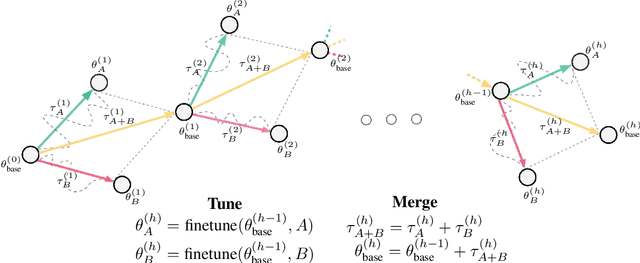
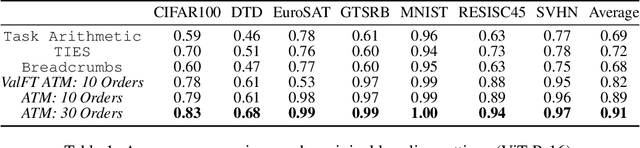
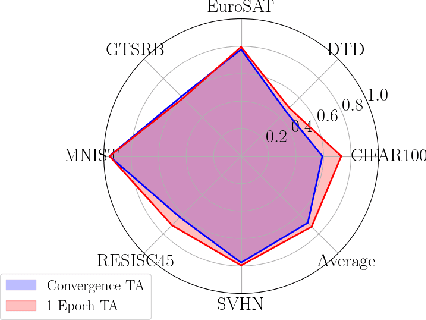
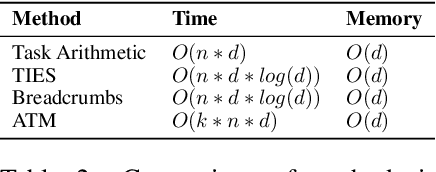
Model merging has recently emerged as a cost-efficient paradigm for multi-task learning. Among current approaches, task arithmetic stands out for its simplicity and effectiveness. In this paper, we motivate the effectiveness of task vectors by linking them to multi-task gradients. We show that in a single-epoch scenario, task vectors are mathematically equivalent to the gradients obtained via gradient descent in a multi-task setting, and still approximate these gradients in subsequent epochs. Furthermore, we show that task vectors perform optimally when equality is maintained, and their effectiveness is largely driven by the first epoch's gradient. Building on this insight, we propose viewing model merging as a single step in an iterative process that Alternates between Tuning and Merging (ATM). This method acts as a bridge between model merging and multi-task gradient descent, achieving state-of-the-art results with the same data and computational requirements. We extensively evaluate ATM across diverse settings, achieving up to 20% higher accuracy in computer vision and NLP tasks, compared to the best baselines.Finally, we provide both empirical and theoretical support for its effectiveness, demonstrating increased orthogonality between task vectors and proving that ATM minimizes an upper bound on the loss obtained by jointly finetuning all tasks.