 Add to Chrome
 Add to Firefox
 Add to Edge
Zero-Shot Quantization via Weight-Space Arithmetic
Apr 03, 2026
We show that robustness to post-training quantization (PTQ) is a transferable direction in weight space. We call this direction the quantization vector: extracted from a donor task by simple weight-space arithmetic, it can be used to patch a receiver model and improve robustness to PTQ-induced noise by as much as 60%, without receiver-side quantization-aware training (QAT). Because the method requires no receiver training data, it provides a zero-shot, low-cost alternative to QAT for extremely low-bit deployment. We demonstrate this on Vision Transformer (ViT) models. More broadly, our results suggest that quantization robustness is not merely a byproduct of task-specific training, but a reusable feature of weight-space geometry that can be transferred rather than retrained.

MASS: MoErging through Adaptive Subspace Selection
Apr 06, 2025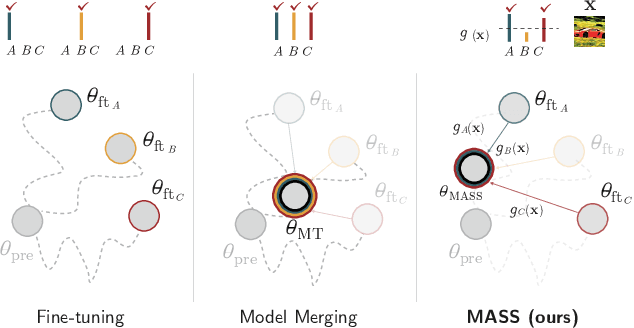
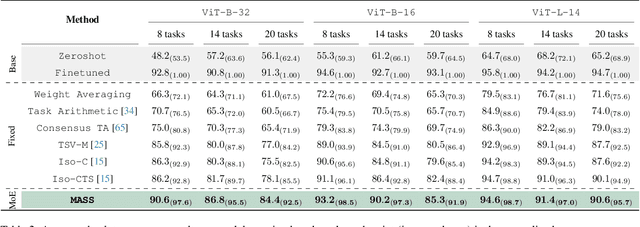
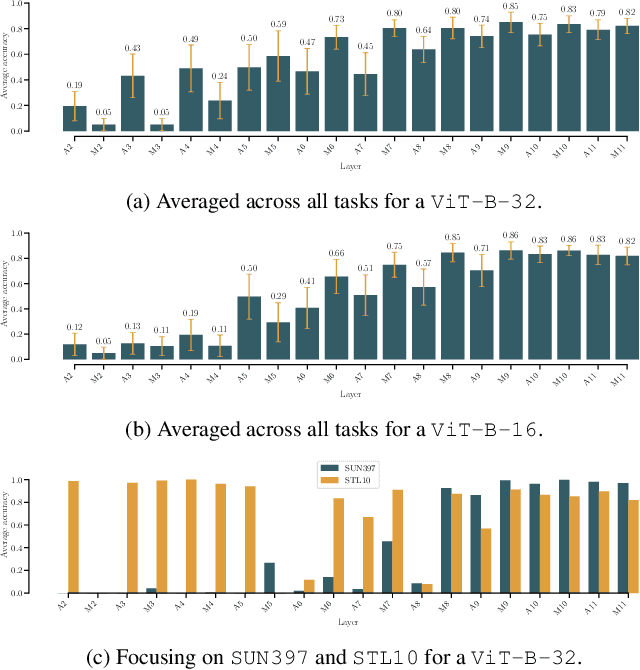
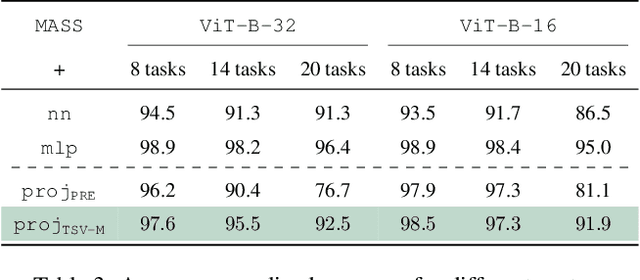
Model merging has recently emerged as a lightweight alternative to ensembling, combining multiple fine-tuned models into a single set of parameters with no additional training overhead. Yet, existing merging methods fall short of matching the full accuracy of separately fine-tuned endpoints. We present MASS (MoErging through Adaptive Subspace Selection), a new approach that closes this gap by unifying multiple fine-tuned models while retaining near state-of-the-art performance across tasks. Building on the low-rank decomposition of per-task updates, MASS stores only the most salient singular components for each task and merges them into a shared model. At inference time, a non-parametric, data-free router identifies which subspace (or combination thereof) best explains an input's intermediate features and activates the corresponding task-specific block. This procedure is fully training-free and introduces only a two-pass inference overhead plus a ~2 storage factor compared to a single pretrained model, irrespective of the number of tasks. We evaluate MASS on CLIP-based image classification using ViT-B-16, ViT-B-32 and ViT-L-14 for benchmarks of 8, 14 and 20 tasks respectively, establishing a new state-of-the-art. Most notably, MASS recovers up to ~98% of the average accuracy of individual fine-tuned models, making it a practical alternative to ensembling at a fraction of the storage cost.