 Add to Chrome
 Add to Firefox
 Add to Edge
Relative Entropy Estimation in Function Space: Theory and Applications to Trajectory Inference
Apr 22, 2026
Trajectory Inference (TI) seeks to recover latent dynamical processes from snapshot data, where only independent samples from time-indexed marginals are observed. In applications such as single-cell genomics, destructive measurements make path-space laws non-identifiable from finitely many marginals, leaving held-out marginal prediction as the dominant but limited evaluation protocol. We introduce a general framework for estimating the Kullback-Leibler divergence (KL) divergence between probability measures on function space, yielding a tractable, data-driven estimator that is scalable to realistic snapshot datasets. We validate the accuracy of our estimator on a benchmark suite, where the estimated functional KL closely matches the analytic KL. Applying this framework to synthetic and real scRNA-seq datasets, we show that current evaluation metrics often give inconsistent assessments, whereas path-space KL enables a coherent comparison of trajectory inference methods and exposes discrepancies in inferred dynamics, especially in regions with sparse or missing data. These results support functional KL as a principled criterion for evaluating trajectory inference under partial observability.

Variational Inference for Quantum HyperNetworks
Jun 06, 2025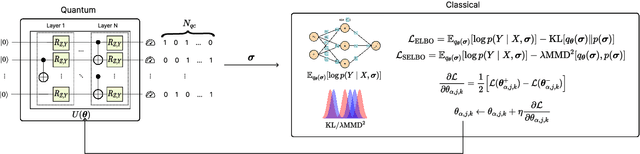
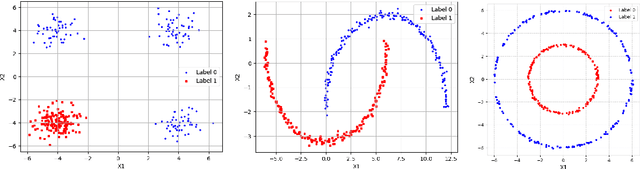
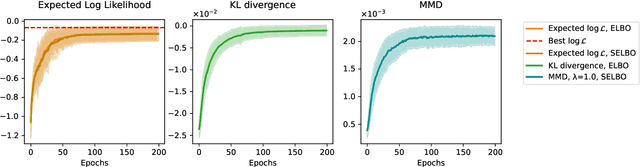
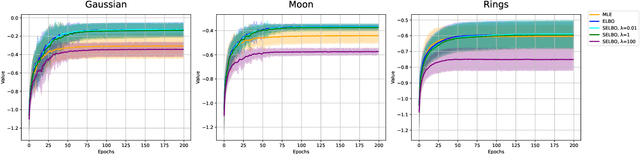
Binary Neural Networks (BiNNs), which employ single-bit precision weights, have emerged as a promising solution to reduce memory usage and power consumption while maintaining competitive performance in large-scale systems. However, training BiNNs remains a significant challenge due to the limitations of conventional training algorithms. Quantum HyperNetworks offer a novel paradigm for enhancing the optimization of BiNN by leveraging quantum computing. Specifically, a Variational Quantum Algorithm is employed to generate binary weights through quantum circuit measurements, while key quantum phenomena such as superposition and entanglement facilitate the exploration of a broader solution space. In this work, we establish a connection between this approach and Bayesian inference by deriving the Evidence Lower Bound (ELBO), when direct access to the output distribution is available (i.e., in simulations), and introducing a surrogate ELBO based on the Maximum Mean Discrepancy (MMD) metric for scenarios involving implicit distributions, as commonly encountered in practice. Our experimental results demonstrate that the proposed methods outperform standard Maximum Likelihood Estimation (MLE), improving trainability and generalization.