 Add to Chrome
 Add to Firefox
 Add to Edge
G-EDF-Loc: 3D Continuous Gaussian Distance Field for Robust Gradient-Based 6DoF Localization
Apr 06, 2026
This paper presents a robust 6-DoF localization framework based on a direct, CPU-based scan-to-map registration pipeline. The system leverages G-EDF, a novel continuous and memory-efficient 3D distance field representation. The approach models the Euclidean Distance Field (EDF) using a Block-Sparse Gaussian Mixture Model with adaptive spatial partitioning, ensuring $C^1$ continuity across block transitions and mitigating boundary artifacts. By leveraging the analytical gradients of this continuous map, which maintain Eikonal consistency, the proposed method achieves high-fidelity spatial reconstruction and real-time localization. Experimental results on large-scale datasets demonstrate that G-EDF-Loc performs competitively against state-of-the-art methods, exhibiting exceptional resilience even under severe odometry degradation or in the complete absence of IMU priors.

ars548_ros. An ARS 548 RDI radar driver for ROS2
Apr 06, 2024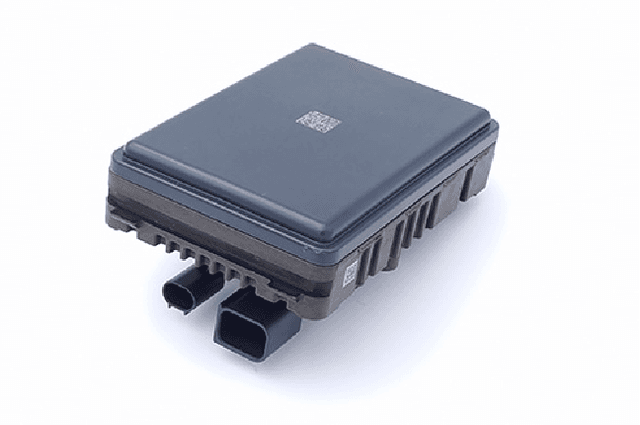
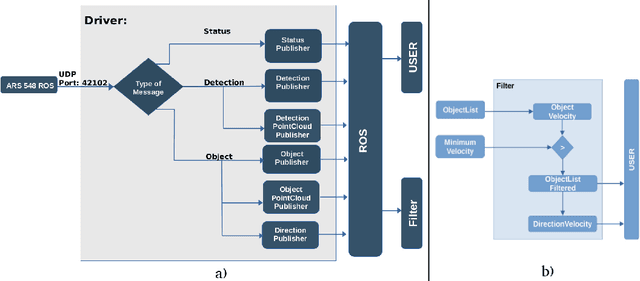
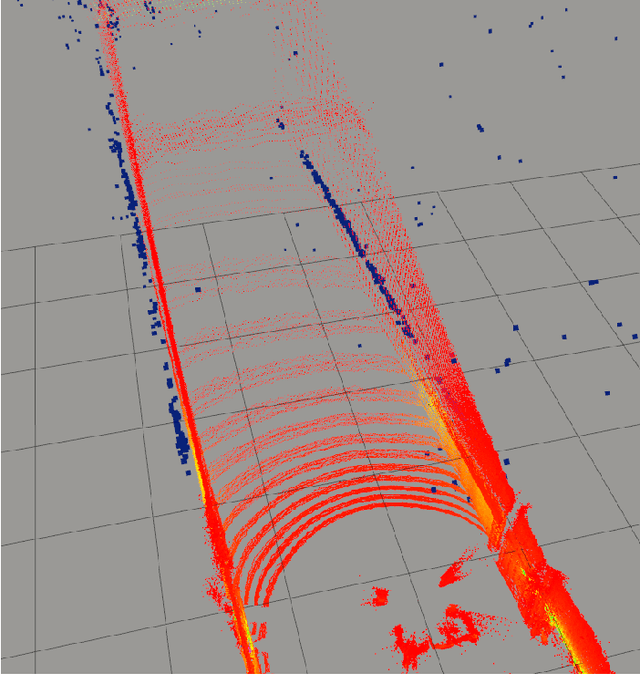
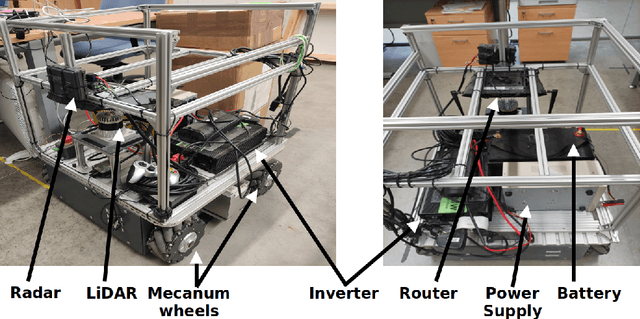
The ARS 548 RDI Radar is a premium model of the fifth generation of 77 GHz long range radar sensors with new RF antenna arrays, which offer digital beam forming. This radar measures independently the distance, speed and angle of objects without any reflectors in one measurement cycle based on Pulse Compression with New Frequency Modulation [1]. Unfortunately, there were not any drivers available for Linux systems to make the user able to analyze the data acquired from this sensor to the best of our knowledge. In this paper, we present a driver that is able to interpret the data from the ARS 548 RDI sensor and produce data in Robot Operation System version 2 (ROS2). Thus, this data can be stored, represented and analyzed by using the powerful tools offered by ROS2. Besides, our driver offers advanced object features provided by the sensor, such as relative estimated velocity and acceleration of each object, its orientation and angular velocity. We focus on the configuration of the sensor and the use of our driver and advanced filtering and representation tools, offering a video tutorial for these purposes. Finally, a dataset acquired with this sensor and an Ouster OS1-32 LiDAR sensor for baseline purposes is available, so that the user can check the correctness of our driver.