 Add to Chrome
 Add to Firefox
 Add to Edge
In-Tunnel Single-Anchor Localization Exploiting Near-Field and Radio-Reflective Road Markings
Apr 05, 2026
Accurate vehicular localization in Global Navigation Satellite System (GNSS)-denied environments, such as road tunnels, remains a key challenge for cooperative intelligent transport systems (C-ITS). This paper investigates single-anchor positioning by exploiting near-field (NF) propagation and passive radio-reflective structures. We first derive a geometric validity condition for the single-reflector NF (SR-NF) channel model, establishing a bound on the array size under which multipath can be consistently modeled by a single reflector, and linking it to Fresnel-region scaling. Building on this result, we propose JAVELIN, a single-anchor localization framework combining tensor-based NF parameter estimation, adaptive NF/far-field (FF) processing, and recursive Bayesian tracking. The method integrates angle, delay difference, and curvature measurements into a variable-dimension extended Kalman filter with gated nearest-neighbor (NN) association, enabling operation without prior environmental knowledge. Radio-reflective road markings (RRMs) are further introduced to enhance geometric diversity. Simulation results in realistic tunnel scenarios demonstrate accurate and robust localization under different line-of-sight (LoS) conditions, outperforming state-of-the-art single-anchor approaches and benefiting from passive reflector deployment.

A Tutorial on 5G Positioning
Nov 17, 2023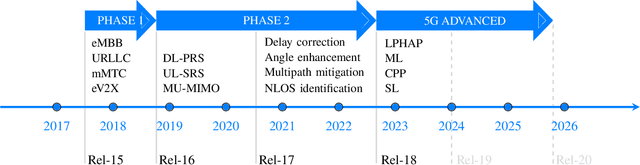
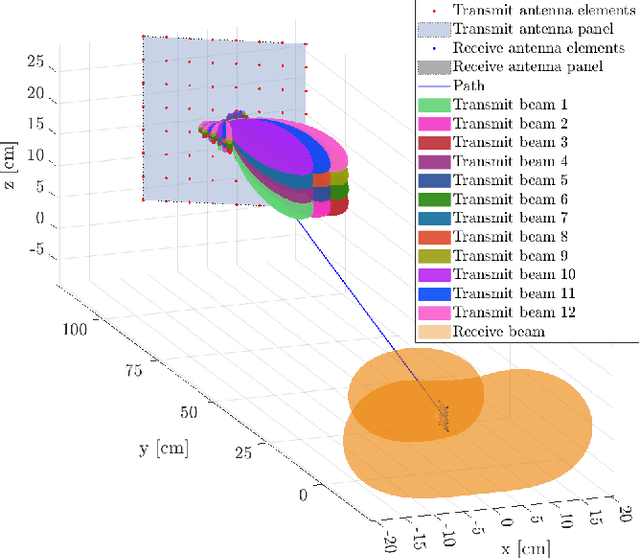
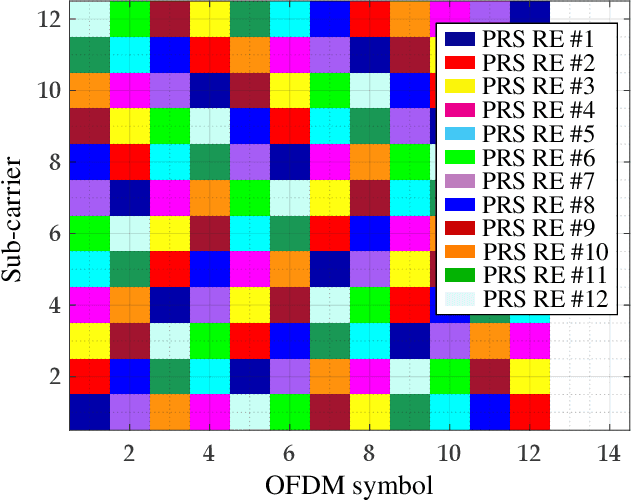
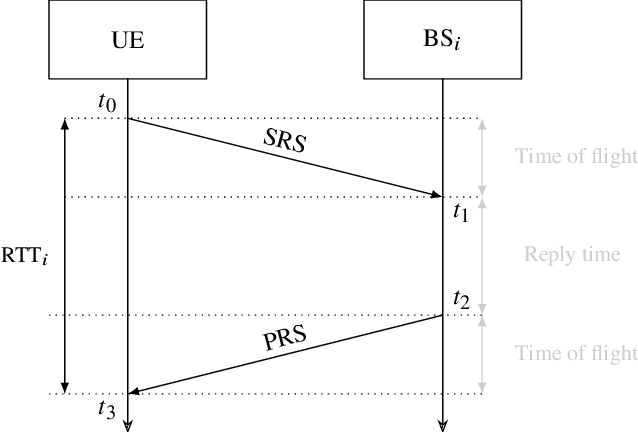
The widespread adoption of the fifth generation (5G) of cellular networks has brought new opportunities for localization-based services. High-precision positioning use cases and functionalities defined by the standards are drawing the interest of vertical industries. In the transition to the deployment, this paper aims to provide an in-depth tutorial on 5G positioning, summarizing the historical events that led to the standardization of cellular-based positioning, describing current and forthcoming releases of the Third Generation Partnership Project (3GPP) standard, and discussing about the major research trends. This paper is intended to represent an exhaustive guide for researchers and practitioners by providing fundamental notions on wireless localization, comprehensive definitions of measurements and architectures, examples of algorithms, and details on simulation approaches. Our approach aims to merge practical aspects of enabled use cases and related requirements with theoretical methodologies and fundamental bounds, allowing to understand the trade-off between system complexity and achievable, i.e., tangible, benefits of 5G positioning services. We also discuss about current limitations to be resolved for delivering accurate positioning solutions. We evaluate the performances of 3GPP Rel-16 positioning in outdoor and indoor environments, providing thorough analyses of the effect of changing the system configuration.