 Add to Chrome
 Add to Firefox
 Add to Edge
A theory of learning data statistics in diffusion models, from easy to hard
Mar 13, 2026
While diffusion models have emerged as a powerful class of generative models, their learning dynamics remain poorly understood. We address this issue first by empirically showing that standard diffusion models trained on natural images exhibit a distributional simplicity bias, learning simple, pair-wise input statistics before specializing to higher-order correlations. We reproduce this behaviour in simple denoisers trained on a minimal data model, the mixed cumulant model, where we precisely control both pair-wise and higher-order correlations of the inputs. We identify a scalar invariant of the model that governs the sample complexity of learning pair-wise and higher-order correlations that we call the diffusion information exponent, in analogy to related invariants in different learning paradigms. Using this invariant, we prove that the denoiser learns simple, pair-wise statistics of the inputs at linear sample complexity, while more complex higher-order statistics, such as the fourth cumulant, require at least cubic sample complexity. We also prove that the sample complexity of learning the fourth cumulant is linear if pair-wise and higher-order statistics share a correlated latent structure. Our work describes a key mechanism for how diffusion models can learn distributions of increasing complexity.

A solvable high-dimensional model where nonlinear autoencoders learn structure invisible to PCA while test loss misaligns with generalization
Feb 11, 2026Many real-world datasets contain hidden structure that cannot be detected by simple linear correlations between input features. For example, latent factors may influence the data in a coordinated way, even though their effect is invisible to covariance-based methods such as PCA. In practice, nonlinear neural networks often succeed in extracting such hidden structure in unsupervised and self-supervised learning. However, constructing a minimal high-dimensional model where this advantage can be rigorously analyzed has remained an open theoretical challenge. We introduce a tractable high-dimensional spiked model with two latent factors: one visible to covariance, and one statistically dependent yet uncorrelated, appearing only in higher-order moments. PCA and linear autoencoders fail to recover the latter, while a minimal nonlinear autoencoder provably extracts both. We analyze both the population risk, and empirical risk minimization. Our model also provides a tractable example where self-supervised test loss is poorly aligned with representation quality: nonlinear autoencoders recover latent structure that linear methods miss, even though their reconstruction loss is higher.
Feature learning from non-Gaussian inputs: the case of Independent Component Analysis in high dimensions
Mar 31, 2025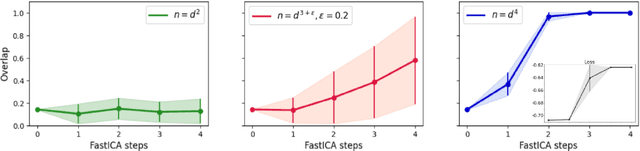
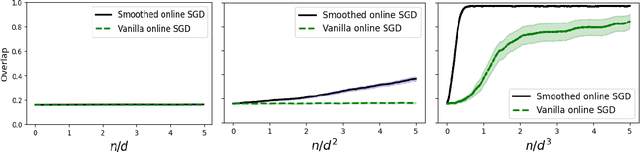
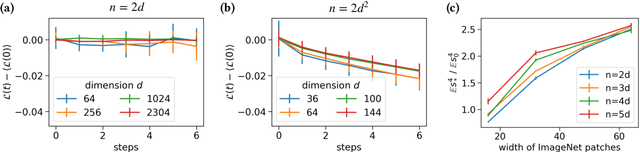
Deep neural networks learn structured features from complex, non-Gaussian inputs, but the mechanisms behind this process remain poorly understood. Our work is motivated by the observation that the first-layer filters learnt by deep convolutional neural networks from natural images resemble those learnt by independent component analysis (ICA), a simple unsupervised method that seeks the most non-Gaussian projections of its inputs. This similarity suggests that ICA provides a simple, yet principled model for studying feature learning. Here, we leverage this connection to investigate the interplay between data structure and optimisation in feature learning for the most popular ICA algorithm, FastICA, and stochastic gradient descent (SGD), which is used to train deep networks. We rigorously establish that FastICA requires at least $n\gtrsim d^4$ samples to recover a single non-Gaussian direction from $d$-dimensional inputs on a simple synthetic data model. We show that vanilla online SGD outperforms FastICA, and prove that the optimal sample complexity $n \gtrsim d^2$ can be reached by smoothing the loss, albeit in a data-dependent way. We finally demonstrate the existence of a search phase for FastICA on ImageNet, and discuss how the strong non-Gaussianity of said images compensates for the poor sample complexity of FastICA.
Sliding down the stairs: how correlated latent variables accelerate learning with neural networks
Apr 12, 2024

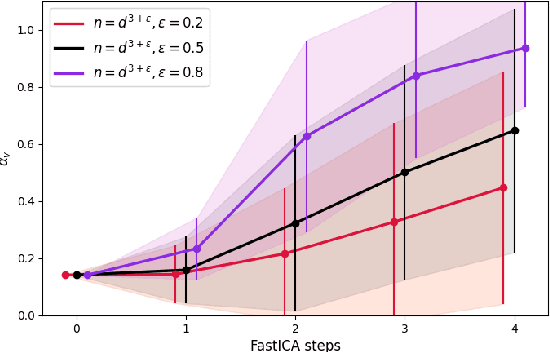
Neural networks extract features from data using stochastic gradient descent (SGD). In particular, higher-order input cumulants (HOCs) are crucial for their performance. However, extracting information from the $p$th cumulant of $d$-dimensional inputs is computationally hard: the number of samples required to recover a single direction from an order-$p$ tensor (tensor PCA) using online SGD grows as $d^{p-1}$, which is prohibitive for high-dimensional inputs. This result raises the question of how neural networks extract relevant directions from the HOCs of their inputs efficiently. Here, we show that correlations between latent variables along the directions encoded in different input cumulants speed up learning from higher-order correlations. We show this effect analytically by deriving nearly sharp thresholds for the number of samples required by a single neuron to weakly-recover these directions using online SGD from a random start in high dimensions. Our analytical results are confirmed in simulations of two-layer neural networks and unveil a new mechanism for hierarchical learning in neural networks.
Learning from higher-order statistics, efficiently: hypothesis tests, random features, and neural networks
Dec 22, 2023Neural networks excel at discovering statistical patterns in high-dimensional data sets. In practice, higher-order cumulants, which quantify the non-Gaussian correlations between three or more variables, are particularly important for the performance of neural networks. But how efficient are neural networks at extracting features from higher-order cumulants? We study this question in the spiked cumulant model, where the statistician needs to recover a privileged direction or "spike" from the order-$p\ge 4$ cumulants of~$d$-dimensional inputs. We first characterise the fundamental statistical and computational limits of recovering the spike by analysing the number of samples~$n$ required to strongly distinguish between inputs from the spiked cumulant model and isotropic Gaussian inputs. We find that statistical distinguishability requires $n\gtrsim d$ samples, while distinguishing the two distributions in polynomial time requires $n \gtrsim d^2$ samples for a wide class of algorithms, i.e. those covered by the low-degree conjecture. These results suggest the existence of a wide statistical-to-computational gap in this problem. Numerical experiments show that neural networks learn to distinguish the two distributions with quadratic sample complexity, while "lazy" methods like random features are not better than random guessing in this regime. Our results show that neural networks extract information from higher-order correlations in the spiked cumulant model efficiently, and reveal a large gap in the amount of data required by neural networks and random features to learn from higher-order cumulants.