 Add to Chrome
 Add to Firefox
 Add to Edge
How Width and Data Shape Generalization Scaling Laws in Quadratic Neural Networks
Jun 26, 2026
Understanding how performance scales jointly with model size and data is a central problem in modern machine learning. Existing theoretical works on scaling laws typically describe generalization as a function of data or compute, often in fixed-feature or infinite-width regimes and for online SGD. Here, we instead study how generalization scales with the number of trainable parameters and the number of samples in a feature-learning model. We analyze $\ell_2$-regularized empirical test error minimization in a quadratic two-layer network in a finite-sample setting with structured data. This setting allows for an explicit characterization of the generalization error as a function of the number of samples, model width, and regularization. Our results reveal a phase diagram with distinct scaling regimes as the number of parameters varies. In particular, the generalization error follows data-dependent power laws controlled by the spectral structure of the target. We further characterize the transitions between regimes, including the onset of interpolation, and their impact on generalization.

The Rules-and-Facts Model for Simultaneous Generalization and Memorization in Neural Networks
Mar 26, 2026A key capability of modern neural networks is their capacity to simultaneously learn underlying rules and memorize specific facts or exceptions. Yet, theoretical understanding of this dual capability remains limited. We introduce the Rules-and-Facts (RAF) model, a minimal solvable setting that enables precise characterization of this phenomenon by bridging two classical lines of work in the statistical physics of learning: the teacher-student framework for generalization and Gardner-style capacity analysis for memorization. In the RAF model, a fraction $1 - \varepsilon$ of training labels is generated by a structured teacher rule, while a fraction $\varepsilon$ consists of unstructured facts with random labels. We characterize when the learner can simultaneously recover the underlying rule - allowing generalization to new data - and memorize the unstructured examples. Our results quantify how overparameterization enables the simultaneous realization of these two objectives: sufficient excess capacity supports memorization, while regularization and the choice of kernel or nonlinearity control the allocation of capacity between rule learning and memorization. The RAF model provides a theoretical foundation for understanding how modern neural networks can infer structure while storing rare or non-compressible information.
Rigorous Asymptotics for First-Order Algorithms Through the Dynamical Cavity Method
Mar 15, 2026Dynamical Mean Field Theory (DMFT) provides an asymptotic description of the dynamics of macroscopic observables in certain disordered systems. Originally pioneered in the context of spin glasses by Sompolinsky and Zippelius (1982), it has since been used to derive asymptotic dynamical equations for a wide range of models in physics, high-dimensional statistics and machine learning. One of the main tools used by physicists to obtain these equations is the dynamical cavity method, which has remained largely non-rigorous. In contrast, existing mathematical formalizations have relied on alternative approaches, including Gaussian conditioning, large deviations over paths, or Fourier analysis. In this work, we formalize the dynamical cavity method and use it to give a new proof of the DMFT equations for General First Order Methods, a broad class of dynamics encompassing algorithms such as Gradient Descent and Approximate Message Passing.
A solvable high-dimensional model where nonlinear autoencoders learn structure invisible to PCA while test loss misaligns with generalization
Feb 11, 2026Many real-world datasets contain hidden structure that cannot be detected by simple linear correlations between input features. For example, latent factors may influence the data in a coordinated way, even though their effect is invisible to covariance-based methods such as PCA. In practice, nonlinear neural networks often succeed in extracting such hidden structure in unsupervised and self-supervised learning. However, constructing a minimal high-dimensional model where this advantage can be rigorously analyzed has remained an open theoretical challenge. We introduce a tractable high-dimensional spiked model with two latent factors: one visible to covariance, and one statistically dependent yet uncorrelated, appearing only in higher-order moments. PCA and linear autoencoders fail to recover the latter, while a minimal nonlinear autoencoder provably extracts both. We analyze both the population risk, and empirical risk minimization. Our model also provides a tractable example where self-supervised test loss is poorly aligned with representation quality: nonlinear autoencoders recover latent structure that linear methods miss, even though their reconstruction loss is higher.
Dataset distillation for memorized data: Soft labels can leak held-out teacher knowledge
Jun 17, 2025Dataset distillation aims to compress training data into fewer examples via a teacher, from which a student can learn effectively. While its success is often attributed to structure in the data, modern neural networks also memorize specific facts, but if and how such memorized information is can transferred in distillation settings remains less understood. In this work, we show that students trained on soft labels from teachers can achieve non-trivial accuracy on held-out memorized data they never directly observed. This effect persists on structured data when the teacher has not generalized.To analyze it in isolation, we consider finite random i.i.d. datasets where generalization is a priori impossible and a successful teacher fit implies pure memorization. Still, students can learn non-trivial information about the held-out data, in some cases up to perfect accuracy. In those settings, enough soft labels are available to recover the teacher functionally - the student matches the teacher's predictions on all possible inputs, including the held-out memorized data. We show that these phenomena strongly depend on the temperature with which the logits are smoothed, but persist across varying network capacities, architectures and dataset compositions.
On the existence of consistent adversarial attacks in high-dimensional linear classification
Jun 14, 2025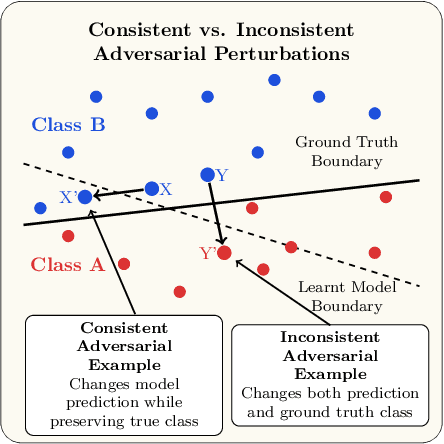
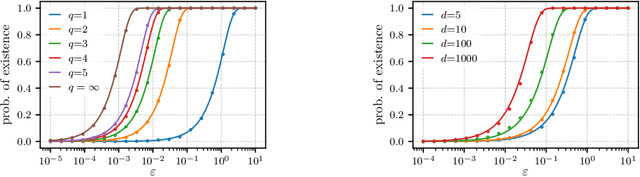
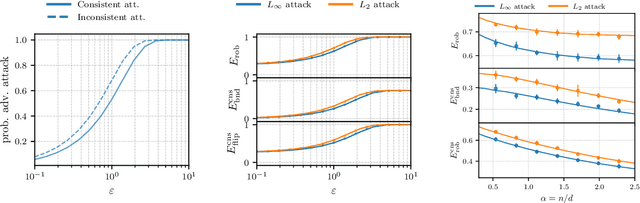
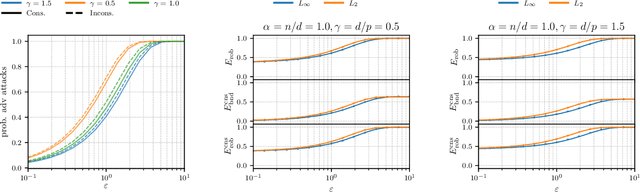
What fundamentally distinguishes an adversarial attack from a misclassification due to limited model expressivity or finite data? In this work, we investigate this question in the setting of high-dimensional binary classification, where statistical effects due to limited data availability play a central role. We introduce a new error metric that precisely capture this distinction, quantifying model vulnerability to consistent adversarial attacks -- perturbations that preserve the ground-truth labels. Our main technical contribution is an exact and rigorous asymptotic characterization of these metrics in both well-specified models and latent space models, revealing different vulnerability patterns compared to standard robust error measures. The theoretical results demonstrate that as models become more overparameterized, their vulnerability to label-preserving perturbations grows, offering theoretical insight into the mechanisms underlying model sensitivity to adversarial attacks.
Learning with Restricted Boltzmann Machines: Asymptotics of AMP and GD in High Dimensions
May 23, 2025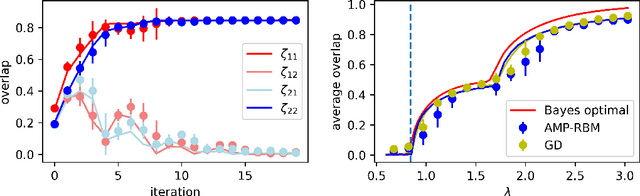
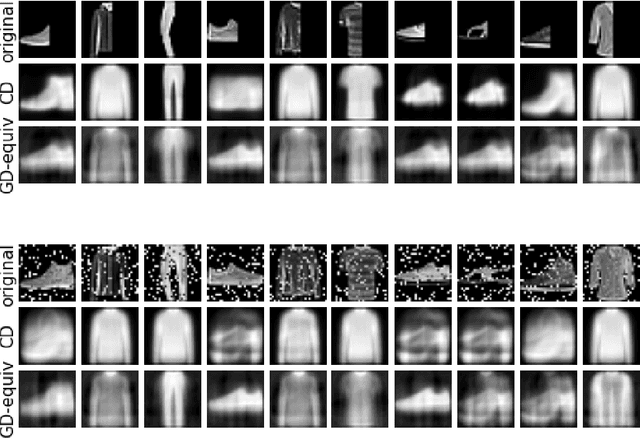
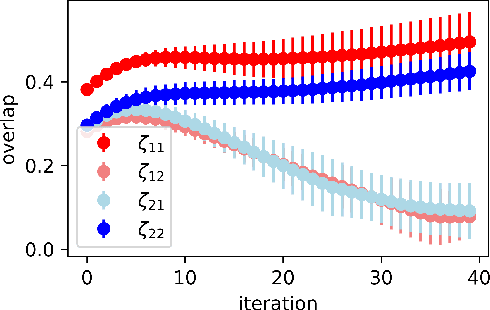
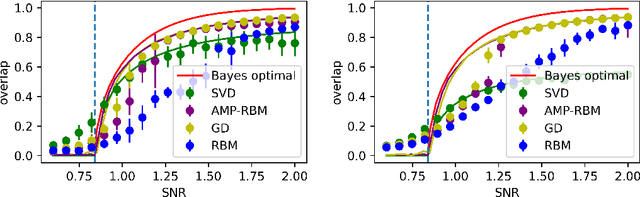
The Restricted Boltzmann Machine (RBM) is one of the simplest generative neural networks capable of learning input distributions. Despite its simplicity, the analysis of its performance in learning from the training data is only well understood in cases that essentially reduce to singular value decomposition of the data. Here, we consider the limit of a large dimension of the input space and a constant number of hidden units. In this limit, we simplify the standard RBM training objective into a form that is equivalent to the multi-index model with non-separable regularization. This opens a path to analyze training of the RBM using methods that are established for multi-index models, such as Approximate Message Passing (AMP) and its state evolution, and the analysis of Gradient Descent (GD) via the dynamical mean-field theory. We then give rigorous asymptotics of the training dynamics of RBM on data generated by the spiked covariance model as a prototype of a structure suitable for unsupervised learning. We show in particular that RBM reaches the optimal computational weak recovery threshold, aligning with the BBP transition, in the spiked covariance model.
The Nuclear Route: Sharp Asymptotics of ERM in Overparameterized Quadratic Networks
May 23, 2025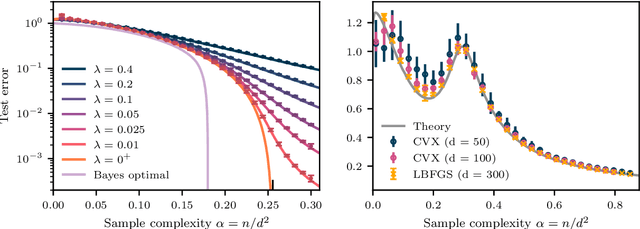
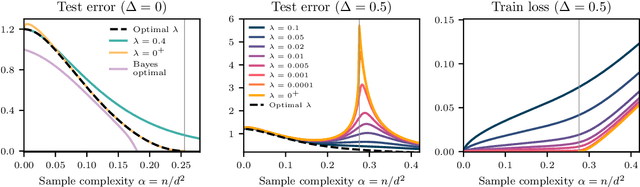
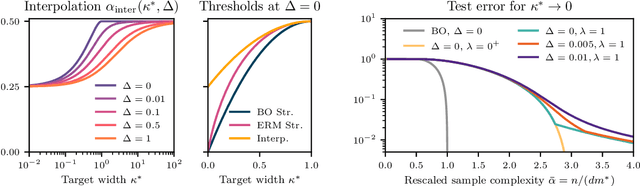
We study the high-dimensional asymptotics of empirical risk minimization (ERM) in over-parametrized two-layer neural networks with quadratic activations trained on synthetic data. We derive sharp asymptotics for both training and test errors by mapping the $\ell_2$-regularized learning problem to a convex matrix sensing task with nuclear norm penalization. This reveals that capacity control in such networks emerges from a low-rank structure in the learned feature maps. Our results characterize the global minima of the loss and yield precise generalization thresholds, showing how the width of the target function governs learnability. This analysis bridges and extends ideas from spin-glass methods, matrix factorization, and convex optimization and emphasizes the deep link between low-rank matrix sensing and learning in quadratic neural networks.
Fundamental Limits of Matrix Sensing: Exact Asymptotics, Universality, and Applications
Mar 18, 2025In the matrix sensing problem, one wishes to reconstruct a matrix from (possibly noisy) observations of its linear projections along given directions. We consider this model in the high-dimensional limit: while previous works on this model primarily focused on the recovery of low-rank matrices, we consider in this work more general classes of structured signal matrices with potentially large rank, e.g. a product of two matrices of sizes proportional to the dimension. We provide rigorous asymptotic equations characterizing the Bayes-optimal learning performance from a number of samples which is proportional to the number of entries in the matrix. Our proof is composed of three key ingredients: $(i)$ we prove universality properties to handle structured sensing matrices, related to the ''Gaussian equivalence'' phenomenon in statistical learning, $(ii)$ we provide a sharp characterization of Bayes-optimal learning in generalized linear models with Gaussian data and structured matrix priors, generalizing previously studied settings, and $(iii)$ we leverage previous works on the problem of matrix denoising. The generality of our results allow for a variety of applications: notably, we mathematically establish predictions obtained via non-rigorous methods from statistical physics in [ETB+24] regarding Bilinear Sequence Regression, a benchmark model for learning from sequences of tokens, and in [MTM+24] on Bayes-optimal learning in neural networks with quadratic activation function, and width proportional to the dimension.
The Computational Advantage of Depth: Learning High-Dimensional Hierarchical Functions with Gradient Descent
Feb 19, 2025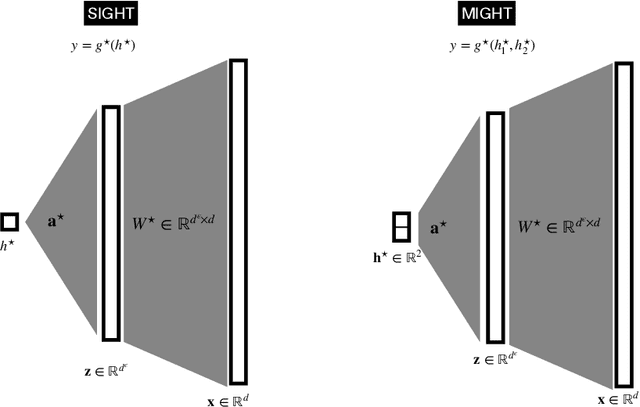
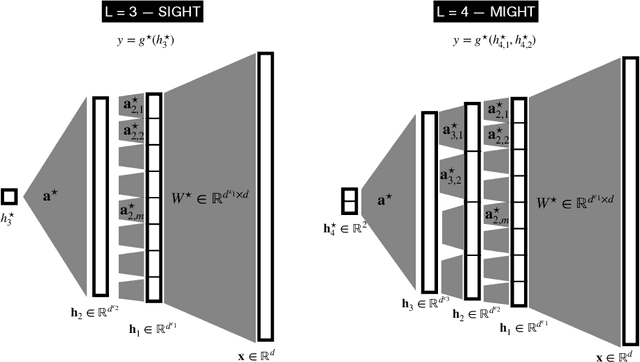
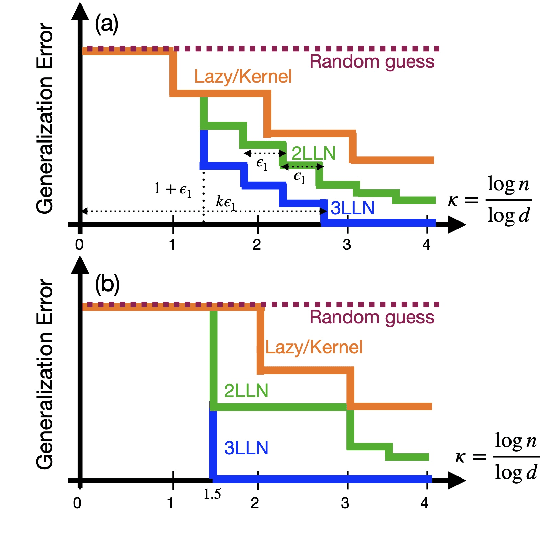
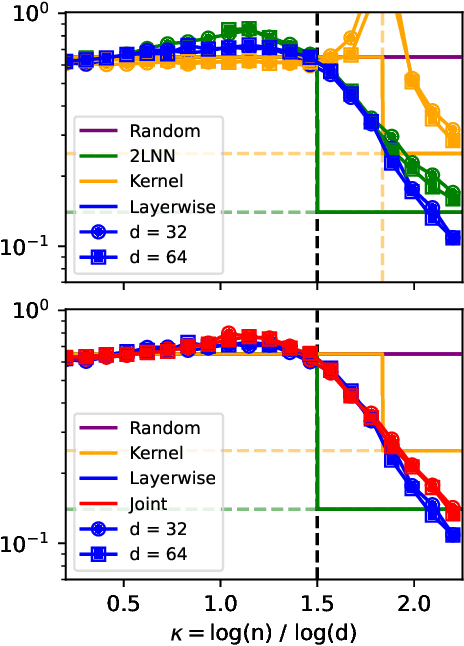
Understanding the advantages of deep neural networks trained by gradient descent (GD) compared to shallow models remains an open theoretical challenge. While the study of multi-index models with Gaussian data in high dimensions has provided analytical insights into the benefits of GD-trained neural networks over kernels, the role of depth in improving sample complexity and generalization in GD-trained networks remains poorly understood. In this paper, we introduce a class of target functions (single and multi-index Gaussian hierarchical targets) that incorporate a hierarchy of latent subspace dimensionalities. This framework enables us to analytically study the learning dynamics and generalization performance of deep networks compared to shallow ones in the high-dimensional limit. Specifically, our main theorem shows that feature learning with GD reduces the effective dimensionality, transforming a high-dimensional problem into a sequence of lower-dimensional ones. This enables learning the target function with drastically less samples than with shallow networks. While the results are proven in a controlled training setting, we also discuss more common training procedures and argue that they learn through the same mechanisms. These findings open the way to further quantitative studies of the crucial role of depth in learning hierarchical structures with deep networks.