 Add to Chrome
 Add to Firefox
 Add to Edge
Local Coverage Governs Memorization in Diffusion Models
Jun 12, 2026
Memorization in diffusion models is often treated as a global property of the model or dataset. In practice, however, a single diffusion model can simultaneously generate both memorized and novel samples. Which training samples are most likely to be memorized? In this work, we show that memorization is governed by \emph{local data coverage}. Leveraging the connection between diffusion models and kernel density estimation (KDE), we derive a theoretical criterion that predicts whether a point is memorized based on the density of training data in its neighborhood and the size of the training dataset. In the high-dimensional limit, this leads to a sharp, local transition: regions of low coverage are dominated by isolated training samples, which are memorized, while dense regions support interpolation and generalization. We validate these predictions empirically, showing that memorization increases with local sparsity and that diffusion models exhibit a coexistence of memorized and novel samples within the same model. Extending this framework to multi-class settings, we further show that classes with higher intra-class sparsity (and thus lower local coverage) are more strongly memorized. Our results provide a local view of memorization in diffusion models, explaining when and where memorization occurs in terms of data geometry.

A theory of learning data statistics in diffusion models, from easy to hard
Mar 13, 2026While diffusion models have emerged as a powerful class of generative models, their learning dynamics remain poorly understood. We address this issue first by empirically showing that standard diffusion models trained on natural images exhibit a distributional simplicity bias, learning simple, pair-wise input statistics before specializing to higher-order correlations. We reproduce this behaviour in simple denoisers trained on a minimal data model, the mixed cumulant model, where we precisely control both pair-wise and higher-order correlations of the inputs. We identify a scalar invariant of the model that governs the sample complexity of learning pair-wise and higher-order correlations that we call the diffusion information exponent, in analogy to related invariants in different learning paradigms. Using this invariant, we prove that the denoiser learns simple, pair-wise statistics of the inputs at linear sample complexity, while more complex higher-order statistics, such as the fourth cumulant, require at least cubic sample complexity. We also prove that the sample complexity of learning the fourth cumulant is linear if pair-wise and higher-order statistics share a correlated latent structure. Our work describes a key mechanism for how diffusion models can learn distributions of increasing complexity.
Generalization Dynamics of Linear Diffusion Models
May 30, 2025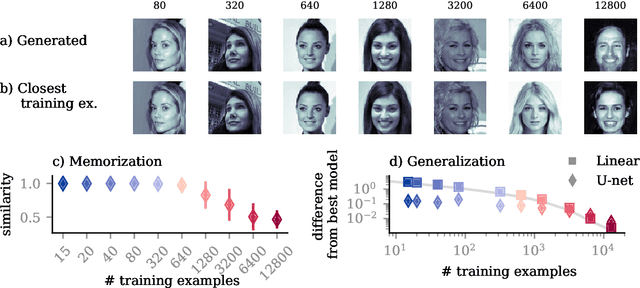
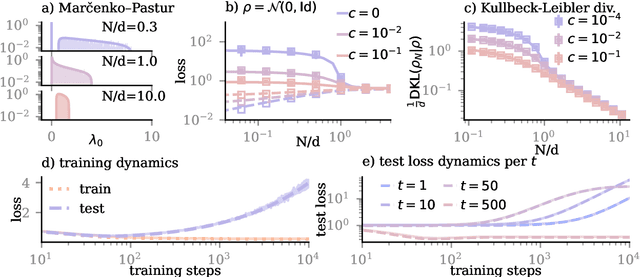
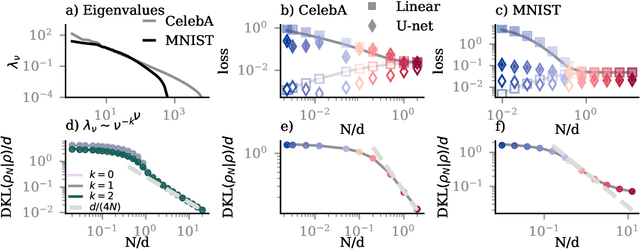
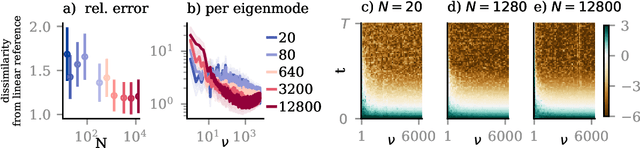
Diffusion models trained on finite datasets with $N$ samples from a target distribution exhibit a transition from memorisation, where the model reproduces training examples, to generalisation, where it produces novel samples that reflect the underlying data distribution. Understanding this transition is key to characterising the sample efficiency and reliability of generative models, but our theoretical understanding of this transition is incomplete. Here, we analytically study the memorisation-to-generalisation transition in a simple model using linear denoisers, which allow explicit computation of test errors, sampling distributions, and Kullback-Leibler divergences between samples and target distribution. Using these measures, we predict that this transition occurs roughly when $N \asymp d$, the dimension of the inputs. When $N$ is smaller than the dimension of the inputs $d$, so that only a fraction of relevant directions of variation are present in the training data, we demonstrate how both regularization and early stopping help to prevent overfitting. For $N > d$, we find that the sampling distributions of linear diffusion models approach their optimum (measured by the Kullback-Leibler divergence) linearly with $d/N$, independent of the specifics of the data distribution. Our work clarifies how sample complexity governs generalisation in a simple model of diffusion-based generative models and provides insight into the training dynamics of linear denoisers.