 Add to Chrome
 Add to Firefox
 Add to Edge
Robust Low-Tubal-Rank Tensor Completion under Cross-Concentrated Sampling
Aug 05, 2026
Tensor cross-concentrated sampling (t-CCS) bridges entrywise sampling and t-CUR slice-wise sampling by observing entries only within selected horizontal and lateral slices. Existing t-CCS completion methods, however, assume that the observations are free of gross corruption. In this work, we study robust recovery of a third-order low-tubal-rank tensor from partial t-CCS observations contaminated by sparse, arbitrarily large outliers. We propose Robust Iterative t-CUR (R-ItCUR), a tensor-native algorithm that partitions the sampled tensor cross into two exterior blocks and an intersection block, applies adaptive blockwise Welsch correction for outlier suppression, and updates the low-rank component through projected blockwise gradient descent. By operating directly on the sampled cross, R-ItCUR avoids reconstructing the full tensor throughout the iterations, resulting in substantial memory and computational savings. Experiments on synthetic tensors, cardiac MRI data, and three-dimensional seismic data demonstrate accurate recovery and strong robustness to sparse gross corruptions. The results further highlight the importance of explicitly exploiting the cross-concentrated sampling structure in robust tensor completion.

How Far Can Sharpness and Complexity Jointly Explain Generalization?
Jun 27, 2026Sharpness and complexity are two central factors in the generalization analysis of deep neural networks. Existing quantitative evaluations of generalization measures have largely focused on individual scalar measures, leaving the joint explanatory power of sharpness and complexity largely unexplored. This work studies how far sharpness and complexity can jointly explain generalization. We use linear regression and introduce a Pareto-based analysis to quantitatively evaluate the joint explanatory power of these two factors. Beyond the existing parameter-level definitions, we further propose realizations of sharpness and complexity that are closer to function space and less dependent on raw parameter representations. We find that function-oriented definitions of these two quantities expand the explanatory scope of the two-factor view beyond what is achieved by existing parameter-level metrics. Overall, our results support the sharpness-complexity perspective as an informative lens for understanding generalization across diverse settings. At the same time, the remaining failures indicate that whether this two-factor view can serve as a complete theory of generalization remains open.
Property Inheritance for Subtensors in Tensor Train Decompositions
Apr 15, 2025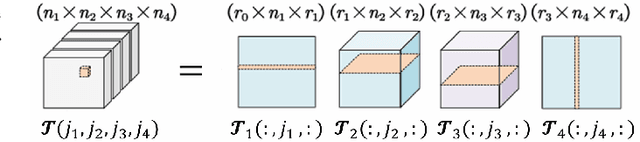
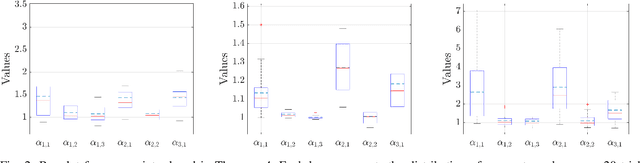
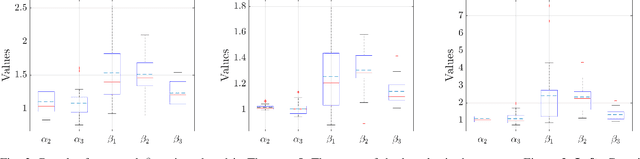
Tensor dimensionality reduction is one of the fundamental tools for modern data science. To address the high computational overhead, fiber-wise sampled subtensors that preserve the original tensor rank are often used in designing efficient and scalable tensor dimensionality reduction. However, the theory of property inheritance for subtensors is still underdevelopment, that is, how the essential properties of the original tensor will be passed to its subtensors. This paper theoretically studies the property inheritance of the two key tensor properties, namely incoherence and condition number, under the tensor train setting. We also show how tensor train rank is preserved through fiber-wise sampling. The key parameters introduced in theorems are numerically evaluated under various settings. The results show that the properties of interest can be well preserved to the subtensors formed via fiber-wise sampling. Overall, this paper provides several handy analytic tools for developing efficient tensor analysis
* 2025 IEEE International Symposium on Information Theory (ISIT 2025)
Three-dimensional signal processing: a new approach in dynamical sampling via tensor products
Feb 04, 2025The dynamical sampling problem is centered around reconstructing signals that evolve over time according to a dynamical process, from spatial-temporal samples that may be noisy. This topic has been thoroughly explored for one-dimensional signals. Multidimensional signal recovery has also been studied, but primarily in scenarios where the driving operator is a convolution operator. In this work, we shift our focus to the dynamical sampling problem in the context of three-dimensional signal recovery, where the evolution system can be characterized by tensor products. Specifically, we provide a necessary condition for the sampling set that ensures successful recovery of the three-dimensional signal. Furthermore, we reformulate the reconstruction problem as an optimization task, which can be solved efficiently. To demonstrate the effectiveness of our approach, we include some straightforward numerical simulations that showcase the reconstruction performance.
Learnable Scaled Gradient Descent for Guaranteed Robust Tensor PCA
Jan 08, 2025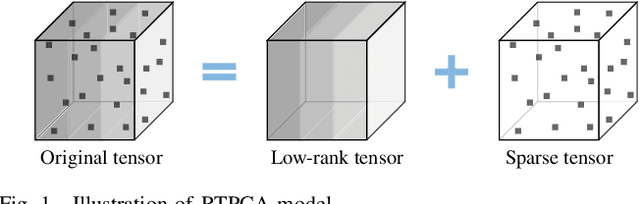
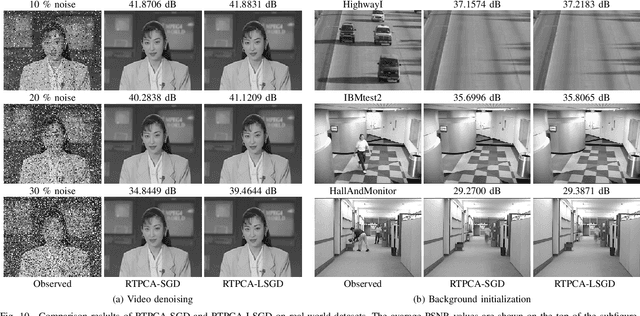
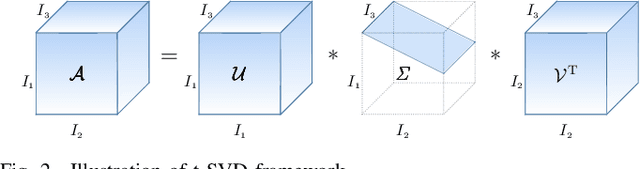
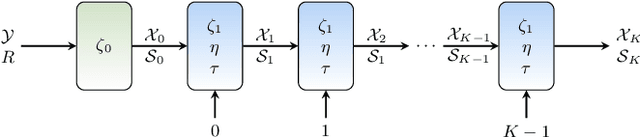
Robust tensor principal component analysis (RTPCA) aims to separate the low-rank and sparse components from multi-dimensional data, making it an essential technique in the signal processing and computer vision fields. Recently emerging tensor singular value decomposition (t-SVD) has gained considerable attention for its ability to better capture the low-rank structure of tensors compared to traditional matrix SVD. However, existing methods often rely on the computationally expensive tensor nuclear norm (TNN), which limits their scalability for real-world tensors. To address this issue, we explore an efficient scaled gradient descent (SGD) approach within the t-SVD framework for the first time, and propose the RTPCA-SGD method. Theoretically, we rigorously establish the recovery guarantees of RTPCA-SGD under mild assumptions, demonstrating that with appropriate parameter selection, it achieves linear convergence to the true low-rank tensor at a constant rate, independent of the condition number. To enhance its practical applicability, we further propose a learnable self-supervised deep unfolding model, which enables effective parameter learning. Numerical experiments on both synthetic and real-world datasets demonstrate the superior performance of the proposed methods while maintaining competitive computational efficiency, especially consuming less time than RTPCA-TNN.
Guaranteed Sampling Flexibility for Low-tubal-rank Tensor Completion
Jun 16, 2024While Bernoulli sampling is extensively studied in tensor completion, t-CUR sampling approximates low-tubal-rank tensors via lateral and horizontal subtensors. However, both methods lack sufficient flexibility for diverse practical applications. To address this, we introduce Tensor Cross-Concentrated Sampling (t-CCS), a novel and straightforward sampling model that advances the matrix cross-concentrated sampling concept within a tensor framework. t-CCS effectively bridges the gap between Bernoulli and t-CUR sampling, offering additional flexibility that can lead to computational savings in various contexts. A key aspect of our work is the comprehensive theoretical analysis provided. We establish a sufficient condition for the successful recovery of a low-rank tensor from its t-CCS samples. In support of this, we also develop a theoretical framework validating the feasibility of t-CUR via uniform random sampling and conduct a detailed theoretical sampling complexity analysis for tensor completion problems utilizing the general Bernoulli sampling model. Moreover, we introduce an efficient non-convex algorithm, the Iterative t-CUR Tensor Completion (ITCURTC) algorithm, specifically designed to tackle the t-CCS-based tensor completion. We have intensively tested and validated the effectiveness of the t-CCS model and the ITCURTC algorithm across both synthetic and real-world datasets.
Accelerating Ill-conditioned Hankel Matrix Recovery via Structured Newton-like Descent
Jun 11, 2024
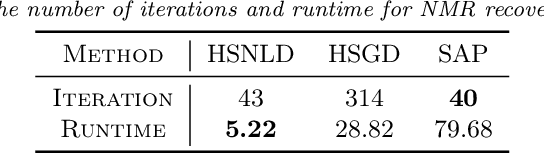
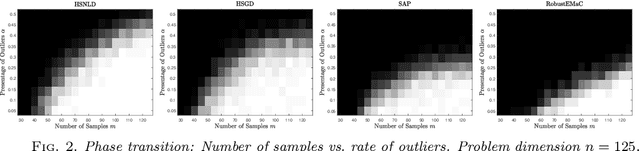
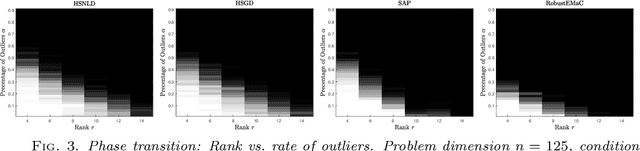
This paper studies the robust Hankel recovery problem, which simultaneously removes the sparse outliers and fulfills missing entries from the partial observation. We propose a novel non-convex algorithm, coined Hankel Structured Newton-Like Descent (HSNLD), to tackle the robust Hankel recovery problem. HSNLD is highly efficient with linear convergence, and its convergence rate is independent of the condition number of the underlying Hankel matrix. The recovery guarantee has been established under some mild conditions. Numerical experiments on both synthetic and real datasets show the superior performance of HSNLD against state-of-the-art algorithms.
Symmetric Matrix Completion with ReLU Sampling
Jun 09, 2024We study the problem of symmetric positive semi-definite low-rank matrix completion (MC) with deterministic entry-dependent sampling. In particular, we consider rectified linear unit (ReLU) sampling, where only positive entries are observed, as well as a generalization to threshold-based sampling. We first empirically demonstrate that the landscape of this MC problem is not globally benign: Gradient descent (GD) with random initialization will generally converge to stationary points that are not globally optimal. Nevertheless, we prove that when the matrix factor with a small rank satisfies mild assumptions, the nonconvex objective function is geodesically strongly convex on the quotient manifold in a neighborhood of a planted low-rank matrix. Moreover, we show that our assumptions are satisfied by a matrix factor with i.i.d. Gaussian entries. Finally, we develop a tailor-designed initialization for GD to solve our studied formulation, which empirically always achieves convergence to the global minima. We also conduct extensive experiments and compare MC methods, investigating convergence and completion performance with respect to initialization, noise level, dimension, and rank.
Coseparable Nonnegative Tensor Factorization With T-CUR Decomposition
Jan 30, 2024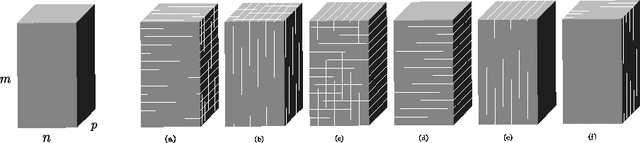
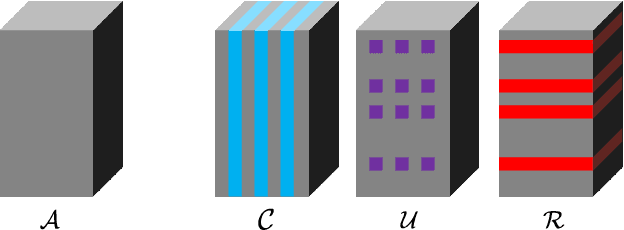
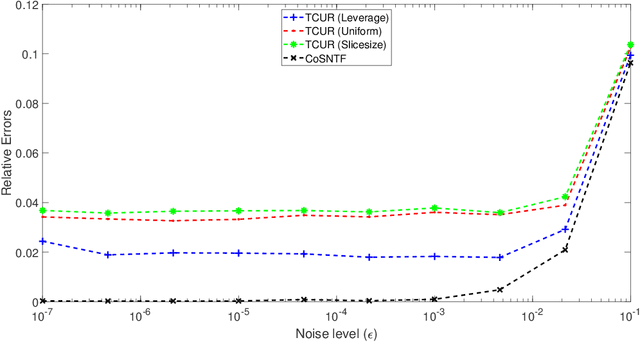
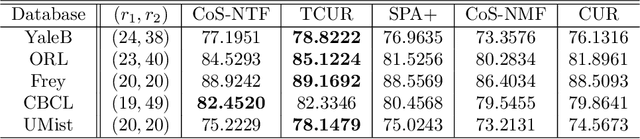
Nonnegative Matrix Factorization (NMF) is an important unsupervised learning method to extract meaningful features from data. To address the NMF problem within a polynomial time framework, researchers have introduced a separability assumption, which has recently evolved into the concept of coseparability. This advancement offers a more efficient core representation for the original data. However, in the real world, the data is more natural to be represented as a multi-dimensional array, such as images or videos. The NMF's application to high-dimensional data involves vectorization, which risks losing essential multi-dimensional correlations. To retain these inherent correlations in the data, we turn to tensors (multidimensional arrays) and leverage the tensor t-product. This approach extends the coseparable NMF to the tensor setting, creating what we term coseparable Nonnegative Tensor Factorization (NTF). In this work, we provide an alternating index selection method to select the coseparable core. Furthermore, we validate the t-CUR sampling theory and integrate it with the tensor Discrete Empirical Interpolation Method (t-DEIM) to introduce an alternative, randomized index selection process. These methods have been tested on both synthetic and facial analysis datasets. The results demonstrate the efficiency of coseparable NTF when compared to coseparable NMF.
On the Robustness of Cross-Concentrated Sampling for Matrix Completion
Jan 28, 2024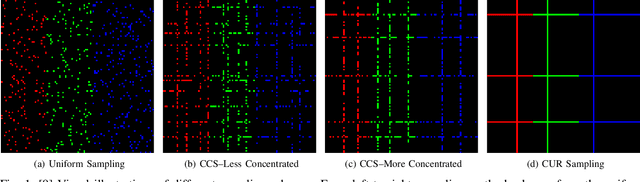

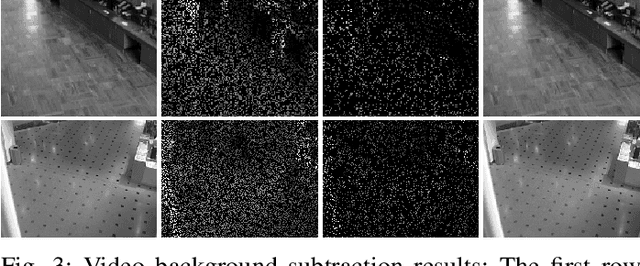
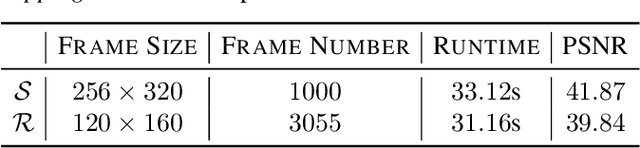
Matrix completion is one of the crucial tools in modern data science research. Recently, a novel sampling model for matrix completion coined cross-concentrated sampling (CCS) has caught much attention. However, the robustness of the CCS model against sparse outliers remains unclear in the existing studies. In this paper, we aim to answer this question by exploring a novel Robust CCS Completion problem. A highly efficient non-convex iterative algorithm, dubbed Robust CUR Completion (RCURC), is proposed. The empirical performance of the proposed algorithm, in terms of both efficiency and robustness, is verified in synthetic and real datasets.