 Add to Chrome
 Add to Firefox
 Add to Edge
DGA$_2$D: Directed Graph-Guided Automated Algorithm Design with Large Language Models
Aug 01, 2026
The rapid development of Large Language Models (LLMs) has opened new avenues for Automated Heuristic Design (AHD) for solving NP-hard combinatorial optimization problems (COPs). However, existing LLM-driven AHD methods are largely confined to rigid solver templates, relegating the search process to isolated module tuning. Transitioning to fully autonomous, system-level algorithm design is essential but fraught with low reliability of generated operators, extremely large search spaces, and ineffective credit assignment. To overcome these drawbacks, this paper proposes a Directed Graph-Guided Automated Algorithm Design framework, termed DGA$_2$D. It structures the open-ended program space as a directed graph, where each node represents a functional operator that can be instantiated using one of multiple candidate code implementations, while directed walks constitute complete algorithmic pipelines. A first-order path-dependent credit assignment mechanism is introduced to evaluate code variations strictly based on their topological context. Extensive experiments across 12 distinct COPs, ranging from complex scheduling to routing, demonstrate the consistent empirical advantages of DGA$_2$D. It reduces the average normalized gap by up to 10.96 percentage points compared to state-of-the-art LLM baselines.

An empirical learning-based validation procedure for simulation workflow
Sep 11, 2018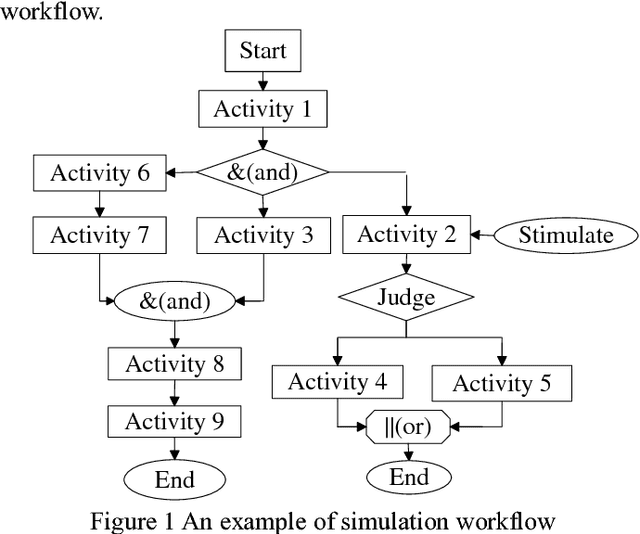
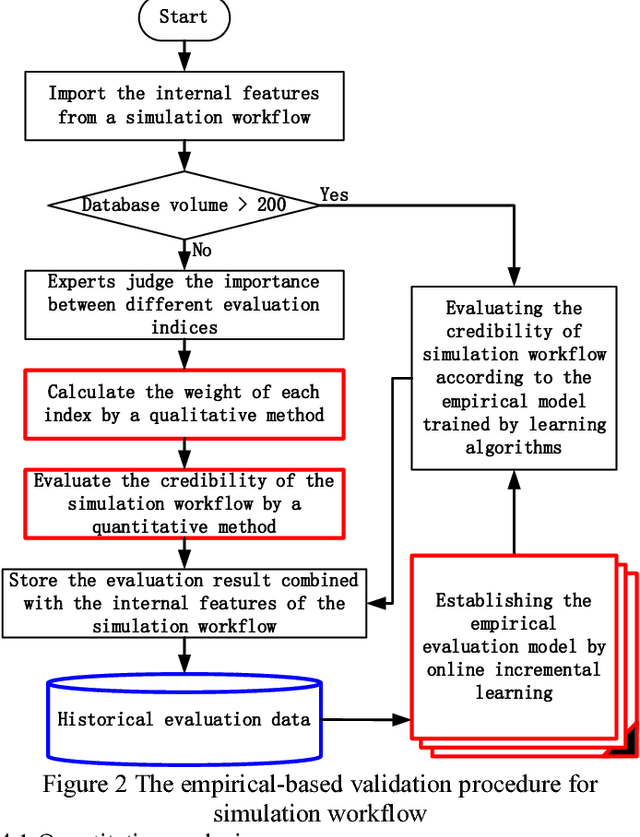
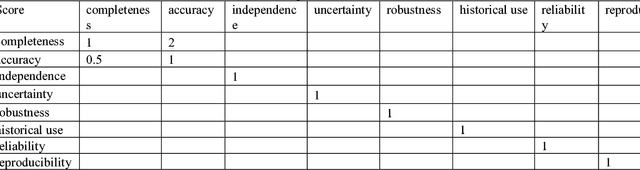
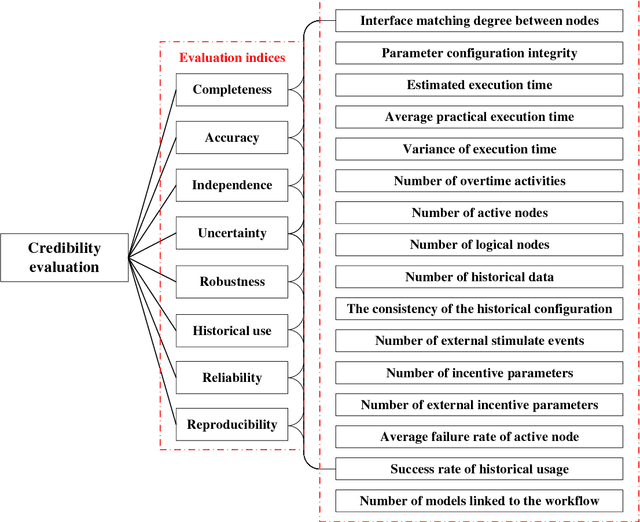
Simulation workflow is a top-level model for the design and control of simulation process. It connects multiple simulation components with time and interaction restrictions to form a complete simulation system. Before the construction and evaluation of the component models, the validation of upper-layer simulation workflow is of the most importance in a simulation system. However, the methods especially for validating simulation workflow is very limit. Many of the existing validation techniques are domain-dependent with cumbersome questionnaire design and expert scoring. Therefore, this paper present an empirical learning-based validation procedure to implement a semi-automated evaluation for simulation workflow. First, representative features of general simulation workflow and their relations with validation indices are proposed. The calculation process of workflow credibility based on Analytic Hierarchy Process (AHP) is then introduced. In order to make full use of the historical data and implement more efficient validation, four learning algorithms, including back propagation neural network (BPNN), extreme learning machine (ELM), evolving new-neuron (eNFN) and fast incremental gaussian mixture model (FIGMN), are introduced for constructing the empirical relation between the workflow credibility and its features. A case study on a landing-process simulation workflow is established to test the feasibility of the proposed procedure. The experimental results also provide some useful overview of the state-of-the-art learning algorithms on the credibility evaluation of simulation models.