 Add to Chrome
 Add to Firefox
 Add to Edge
A Policy-Driven Runtime Layer for Agentic LLM Serving
May 26, 2026
Multi-agent LLM systems have become the dominant production workload, but the serving stack was not built for them. The agent framework above knows agent identities, role, schemas, and dispatch structure but never sees an engine-level event; the serving engine below sees every event but knows nothing about agents. A surprising number of cross-cutting policies depend on both: prefix caching, batch shaping, speculative execution, fairness, tool-result memoization, safety enforcement, and more. Each lives in the seam between the two layers and is currently solved by a one-off patch into one neighbor or the other. We argue this seam is best addressed by an architectural change rather than point fixes: insert a third tier, an agent runtime layer, between the framework and the engine, exposing four primitives (observe, score, predict, act) into which any agent-aware policy plugs, with agent identity as the shared coordinate. We map nine concrete policies onto the layer and validate the abstraction in depth on the one with the largest immediate serving-cost lever: KV caching across sessions, instantiated as CacheSage, which learns the per-workload agent transition matrix online and uses it for survival-based eviction and between-step prefetch. Preliminary results on five real multi-agent workloads show +13 to +37 pp cache hit-rate lift, 12% to 29% lower mean TTFT, and 6% to 14% higher throughput over an unmodified serving stack.

StraightLine: An End-to-End Resource-Aware Scheduler for Machine Learning Application Requests
Jul 25, 2024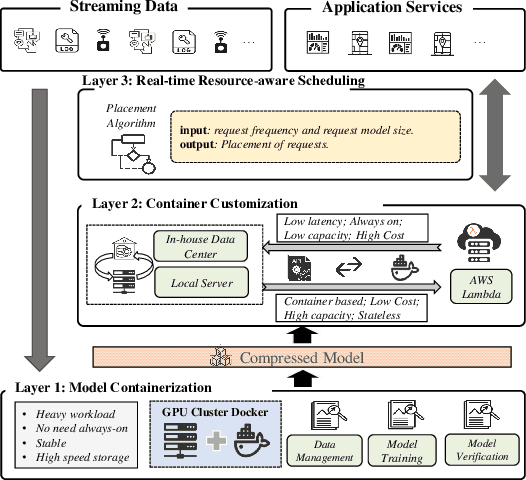
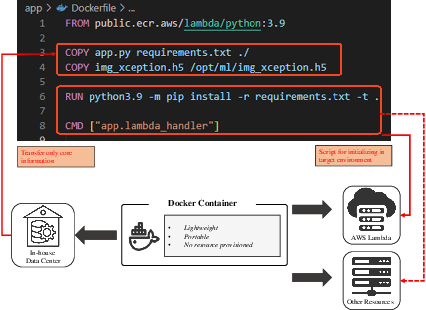
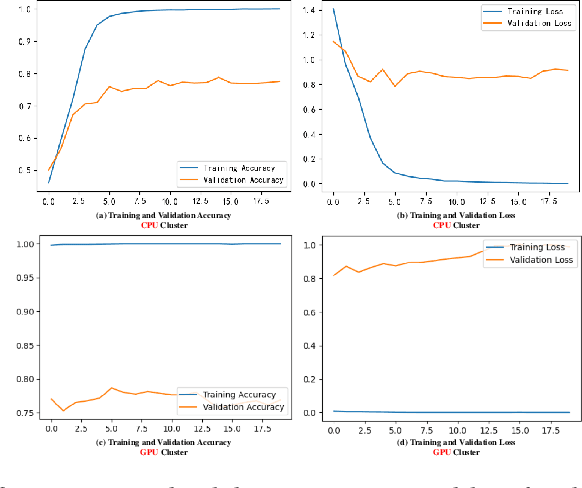
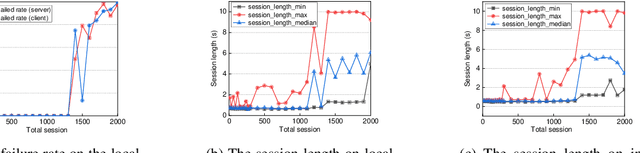
The life cycle of machine learning (ML) applications consists of two stages: model development and model deployment. However, traditional ML systems (e.g., training-specific or inference-specific systems) focus on one particular stage or phase of the life cycle of ML applications. These systems often aim at optimizing model training or accelerating model inference, and they frequently assume homogeneous infrastructure, which may not always reflect real-world scenarios that include cloud data centers, local servers, containers, and serverless platforms. We present StraightLine, an end-to-end resource-aware scheduler that schedules the optimal resources (e.g., container, virtual machine, or serverless) for different ML application requests in a hybrid infrastructure. The key innovation is an empirical dynamic placing algorithm that intelligently places requests based on their unique characteristics (e.g., request frequency, input data size, and data distribution). In contrast to existing ML systems, StraightLine offers end-to-end resource-aware placement, thereby it can significantly reduce response time and failure rate for model deployment when facing different computing resources in the hybrid infrastructure.
OrcoDCS: An IoT-Edge Orchestrated Online Deep Compressed Sensing Framework
Aug 05, 2023Compressed data aggregation (CDA) over wireless sensor networks (WSNs) is task-specific and subject to environmental changes. However, the existing compressed data aggregation (CDA) frameworks (e.g., compressed sensing-based data aggregation, deep learning(DL)-based data aggregation) do not possess the flexibility and adaptivity required to handle distinct sensing tasks and environmental changes. Additionally, they do not consider the performance of follow-up IoT data-driven deep learning (DL)-based applications. To address these shortcomings, we propose OrcoDCS, an IoT-Edge orchestrated online deep compressed sensing framework that offers high flexibility and adaptability to distinct IoT device groups and their sensing tasks, as well as high performance for follow-up applications. The novelty of our work is the design and deployment of IoT-Edge orchestrated online training framework over WSNs by leveraging an specially-designed asymmetric autoencoder, which can largely reduce the encoding overhead and improve the reconstruction performance and robustness. We show analytically and empirically that OrcoDCS outperforms the state-of-the-art DCDA on training time, significantly improves flexibility and adaptability when distinct reconstruction tasks are given, and achieves higher performance for follow-up applications.