 Add to Chrome
 Add to Firefox
 Add to Edge
Exploring Robust Multi-Agent Workflows for Environmental Data Management
Apr 02, 2026
Embedding LLM-driven agents into environmental FAIR data management is compelling - they can externalize operational knowledge and scale curation across heterogeneous data and evolving conventions. However, replacing deterministic components with probabilistic workflows changes the failure mode: LLM pipelines may generate plausible but incorrect outputs that pass superficial checks and propagate into irreversible actions such as DOI minting and public release. We introduce EnviSmart, a production data management system deployed on campus-wide storage infrastructure for environmental research. EnviSmart treats reliability as an architectural property through two mechanisms: a three-track knowledge architecture that externalizes behaviors (governance constraints), domain knowledge (retrievable context), and skills (tool-using procedures) as persistent, interlocking artifacts; and a role-separated multi-agent design where deterministic validators and audited handoffs restore fail-stop semantics at trust boundaries before irreversible steps. We compare two production deployments. The University's GIS Center Ecological Archive (849 curated datasets) serves as a single-agent baseline. SF2Bench, a compound flooding benchmark comprising 2,452 monitoring stations and 8,557 published files spanning 39 years, validates the multi-agent workflow. The multi-agent approach improved both efficiency - completed by a single operator in two days with repeated artifact reuse across deployments - and reliability: audited handoffs detected and blocked a coordinate transformation error affecting all 2,452 stations before publication. A representative incident (ISS-004) demonstrated boundary-based containment with 10-minute detection latency, zero user exposure, and 80-minute resolution. This paper has been accepted at PEARC 2026.

StraightLine: An End-to-End Resource-Aware Scheduler for Machine Learning Application Requests
Jul 25, 2024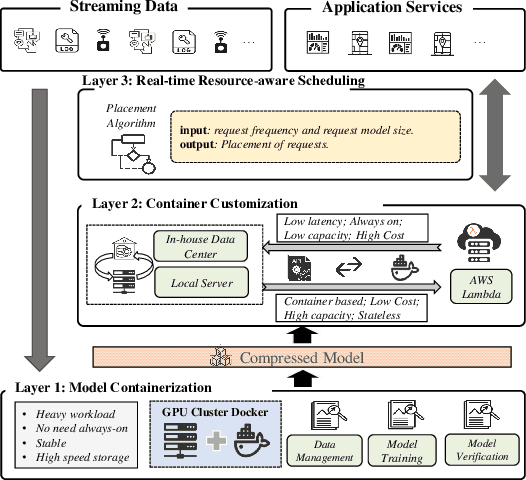
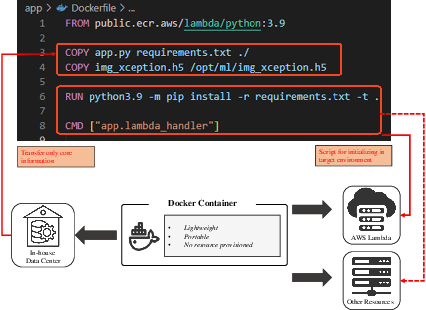
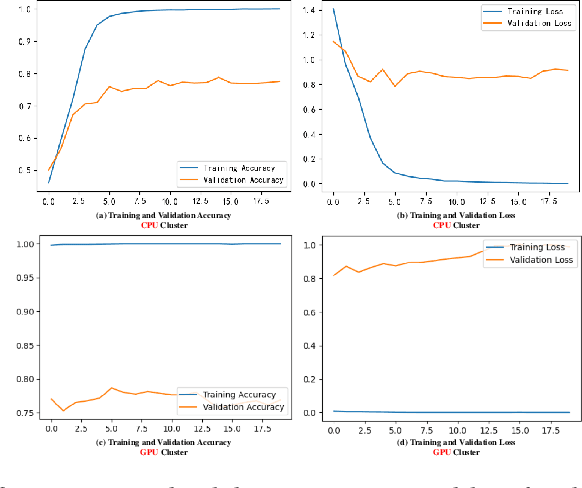
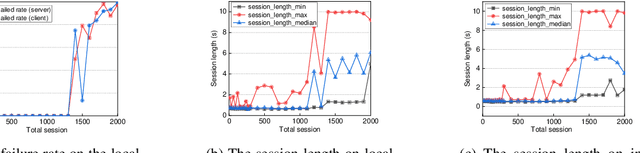
The life cycle of machine learning (ML) applications consists of two stages: model development and model deployment. However, traditional ML systems (e.g., training-specific or inference-specific systems) focus on one particular stage or phase of the life cycle of ML applications. These systems often aim at optimizing model training or accelerating model inference, and they frequently assume homogeneous infrastructure, which may not always reflect real-world scenarios that include cloud data centers, local servers, containers, and serverless platforms. We present StraightLine, an end-to-end resource-aware scheduler that schedules the optimal resources (e.g., container, virtual machine, or serverless) for different ML application requests in a hybrid infrastructure. The key innovation is an empirical dynamic placing algorithm that intelligently places requests based on their unique characteristics (e.g., request frequency, input data size, and data distribution). In contrast to existing ML systems, StraightLine offers end-to-end resource-aware placement, thereby it can significantly reduce response time and failure rate for model deployment when facing different computing resources in the hybrid infrastructure.
ChatGPT as a mapping assistant: A novel method to enrich maps with generative AI and content derived from street-level photographs
Jun 05, 2023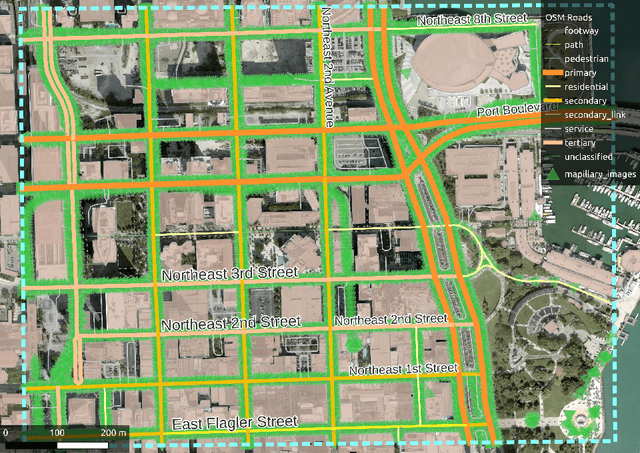

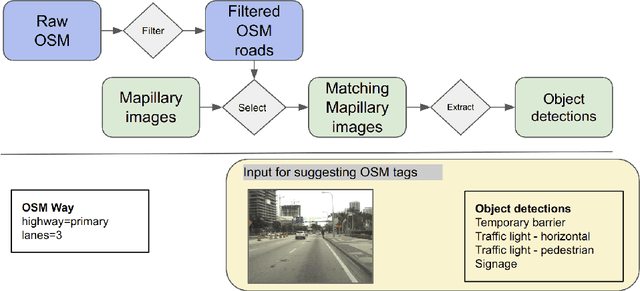
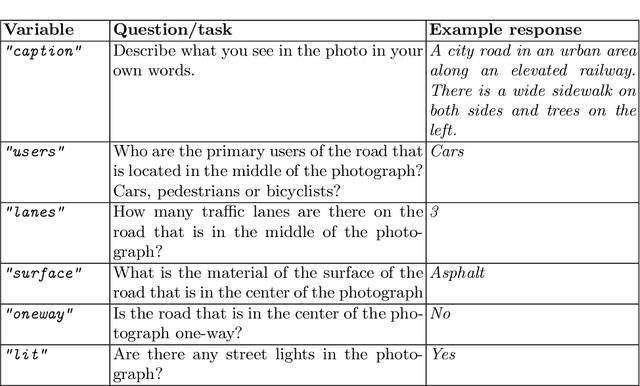
This paper explores the concept of leveraging generative AI as a mapping assistant for enhancing the efficiency of collaborative mapping. We present results of an experiment that combines multiple sources of volunteered geographic information (VGI) and large language models (LLMs). Three analysts described the content of crowdsourced Mapillary street-level photographs taken along roads in a small test area in Miami, Florida. GPT-3.5-turbo was instructed to suggest the most appropriate tagging for each road in OpenStreetMap (OSM). The study also explores the utilization of BLIP-2, a state-of-the-art multimodal pre-training method as an artificial analyst of street-level photographs in addition to human analysts. Results demonstrate two ways to effectively increase the accuracy of mapping suggestions without modifying the underlying AI models: by (1) providing a more detailed description of source photographs, and (2) combining prompt engineering with additional context (e.g. location and objects detected along a road). The first approach increases the suggestion accuracy by up to 29%, and the second one by up to 20%.