 Add to Chrome
 Add to Firefox
 Add to Edge
Debiasing Diffusion Priors via 3D Attention for Consistent Gaussian Splatting
Dec 16, 2025
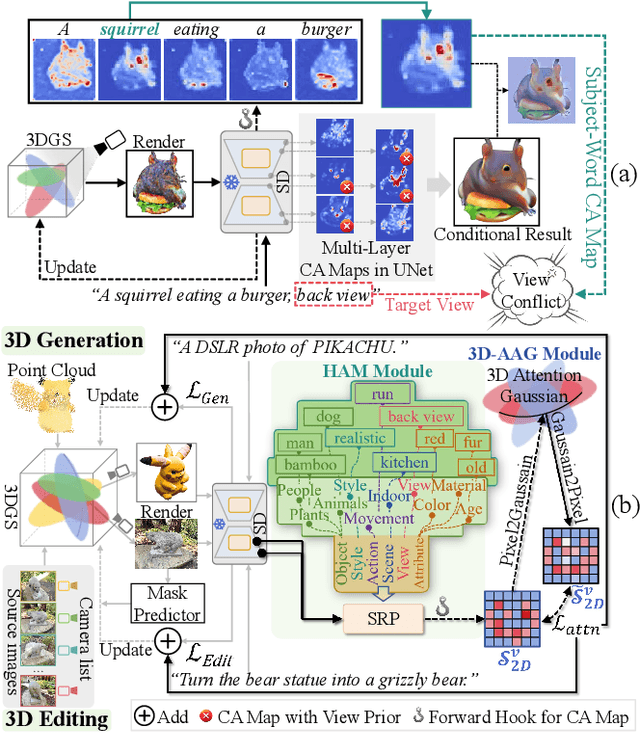
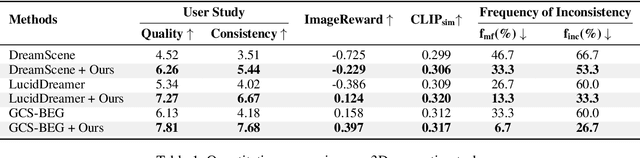
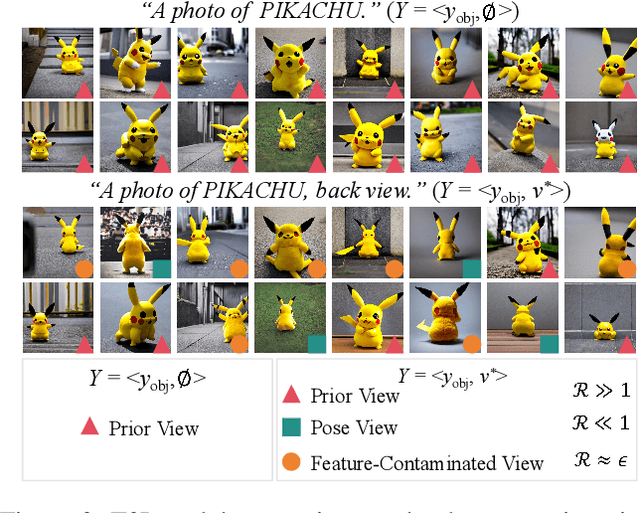
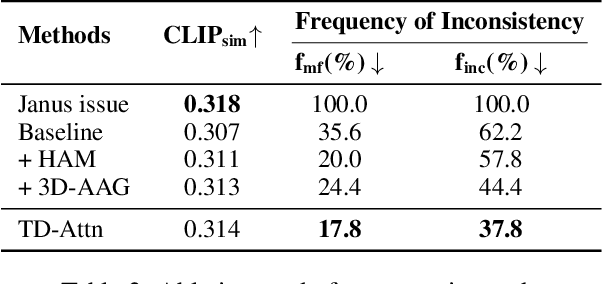
Versatile 3D tasks (e.g., generation or editing) that distill from Text-to-Image (T2I) diffusion models have attracted significant research interest for not relying on extensive 3D training data. However, T2I models exhibit limitations resulting from prior view bias, which produces conflicting appearances between different views of an object. This bias causes subject-words to preferentially activate prior view features during cross-attention (CA) computation, regardless of the target view condition. To overcome this limitation, we conduct a comprehensive mathematical analysis to reveal the root cause of the prior view bias in T2I models. Moreover, we find different UNet layers show different effects of prior view in CA. Therefore, we propose a novel framework, TD-Attn, which addresses multi-view inconsistency via two key components: (1) the 3D-Aware Attention Guidance Module (3D-AAG) constructs a view-consistent 3D attention Gaussian for subject-words to enforce spatial consistency across attention-focused regions, thereby compensating for the limited spatial information in 2D individual view CA maps; (2) the Hierarchical Attention Modulation Module (HAM) utilizes a Semantic Guidance Tree (SGT) to direct the Semantic Response Profiler (SRP) in localizing and modulating CA layers that are highly responsive to view conditions, where the enhanced CA maps further support the construction of more consistent 3D attention Gaussians. Notably, HAM facilitates semantic-specific interventions, enabling controllable and precise 3D editing. Extensive experiments firmly establish that TD-Attn has the potential to serve as a universal plugin, significantly enhancing multi-view consistency across 3D tasks.

ReaSon: Reinforced Causal Search with Information Bottleneck for Video Understanding
Nov 16, 2025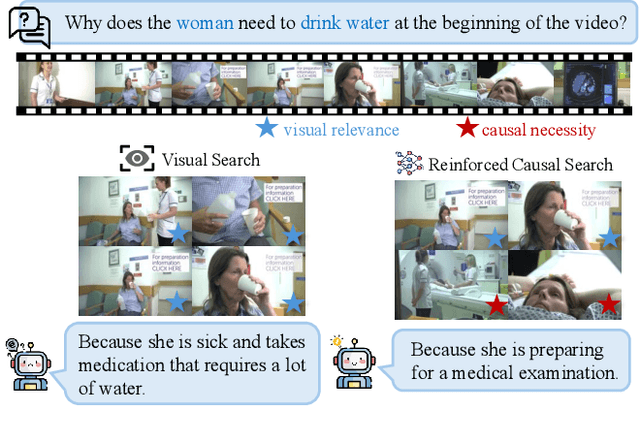
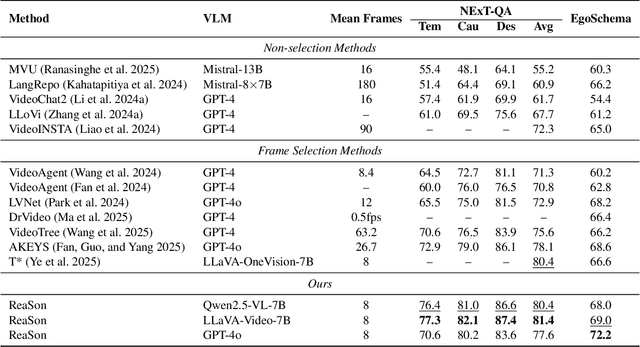
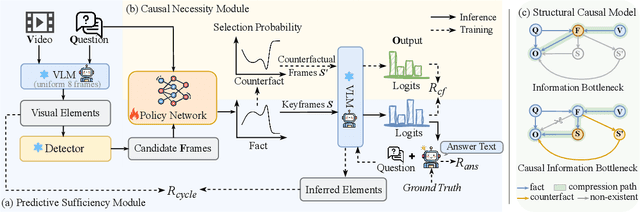
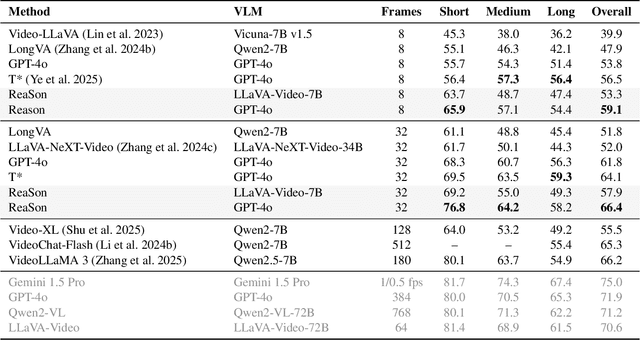
Keyframe selection has become essential for video understanding with vision-language models (VLMs) due to limited input tokens and the temporal sparsity of relevant information across video frames. Video understanding often relies on effective keyframes that are not only informative but also causally decisive. To this end, we propose Reinforced Causal Search with Information Bottleneck (ReaSon), a framework that formulates keyframe selection as an optimization problem with the help of a novel Causal Information Bottleneck (CIB), which explicitly defines keyframes as those satisfying both predictive sufficiency and causal necessity. Specifically, ReaSon employs a learnable policy network to select keyframes from a visually relevant pool of candidate frames to capture predictive sufficiency, and then assesses causal necessity via counterfactual interventions. Finally, a composite reward aligned with the CIB principle is designed to guide the selection policy through reinforcement learning. Extensive experiments on NExT-QA, EgoSchema, and Video-MME demonstrate that ReaSon consistently outperforms existing state-of-the-art methods under limited-frame settings, validating its effectiveness and generalization ability.
ConsDreamer: Advancing Multi-View Consistency for Zero-Shot Text-to-3D Generation
Apr 03, 2025Recent advances in zero-shot text-to-3D generation have revolutionized 3D content creation by enabling direct synthesis from textual descriptions. While state-of-the-art methods leverage 3D Gaussian Splatting with score distillation to enhance multi-view rendering through pre-trained text-to-image (T2I) models, they suffer from inherent view biases in T2I priors. These biases lead to inconsistent 3D generation, particularly manifesting as the multi-face Janus problem, where objects exhibit conflicting features across views. To address this fundamental challenge, we propose ConsDreamer, a novel framework that mitigates view bias by refining both the conditional and unconditional terms in the score distillation process: (1) a View Disentanglement Module (VDM) that eliminates viewpoint biases in conditional prompts by decoupling irrelevant view components and injecting precise camera parameters; and (2) a similarity-based partial order loss that enforces geometric consistency in the unconditional term by aligning cosine similarities with azimuth relationships. Extensive experiments demonstrate that ConsDreamer effectively mitigates the multi-face Janus problem in text-to-3D generation, outperforming existing methods in both visual quality and consistency.