 Add to Chrome
 Add to Firefox
 Add to Edge
A Token/KV-Cache Communication Media Selection and Resource Allocation Strategy for Multi-Agent Collaboration
May 25, 2026
The convergence of large language models (LLMs) with 6G networks is fostering a paradigm of autonomous multi-agent cooperation, which in turn is expected to substantially increase east-west traffic. Although latent-space interaction mechanisms can enable more efficient collaboration than symbolic natural-language (NL) exchanges, prior work often abstracts away the associated communication overhead under practical wireless constraints. In embodied multi-agent settings, heterogeneous interaction media incur disparate inference and transmission costs, thereby inducing an inherent end-to-end (E2E) latency trade-off. To address this, we propose a joint design that integrates communication-media selection with wireless resource allocation. Through analytical characterization and simulation-based evaluation, we show that neither token-based transmission nor key-value (KV) cache-based transmission is uniformly optimal across operating regimes, as performance depends critically on system parameters such as available computational resources and channel conditions. Accordingly, we formulate a joint optimization problem aimed at minimizing the E2E latency of multi-agent collaboration and develop a low-complexity joint media selection and resource allocation (JMSRA) algorithm. Numerical results further confirm that, by adaptively coordinating the interaction media and bandwidth allocation over heterogeneous links, the proposed scheme achieves markedly reduced E2E latency relative to conventional NL-only and KV-cache-only baselines, enabling efficient and robust multi-agent collaboration in future wireless networks.

6G Communication Networks Enabling Embodied Agents: Architecture and Prototype
May 22, 2026Embodied agents, which couple intelligent decision-making with physical actuation in the real world, impose far more stringent and heterogeneous communication requirements than purely software-based agents. While 6G promises sub-millisecond latency, ultra-high reliability, native intelligence, and integrated sensing, systematic studies on how to exploit these capabilities for embodied agent communication remain limited. This article investigates 6G-enabled communication systems for embodied agents from both conceptual and engineering perspectives. First, we review the concept, embodiment value of embodied agents, and clarify their distinctions from disembodied agents. Then, we analyse the symbiotic relationship between embodied agents and 6G networks. We highlight how key 6G enablers can support the stringent requirements of human-robot interaction. Furthermore, we demonstrate the proactive role of embodied agents in bolstering communication networks through coverage extension, environmental sensing, and physical world understanding. Building on these insights, we propose a hierarchical communication architecture for human-robot remote interaction, comprising a human-intent perception layer, an open radio access network (O-RAN)-based transport layer, an intelligent intermediary layer, and an embodiment layer. To validate its feasibility, we implement an end-to-end prototype that integrates a haptic device, an industrial robotic arm, an intermediary platform, and a 5G O-RAN testbed. Experimental results demonstrate millisecond-level latency and stable closed-loop operation, confirming the practicality of the proposed architecture and providing a reference for future 6G-embodied agent research and industrial deployments.
DISCO Might Not Be Funky: Random Intelligent Reflective Surface Configurations That Attack
Oct 01, 2023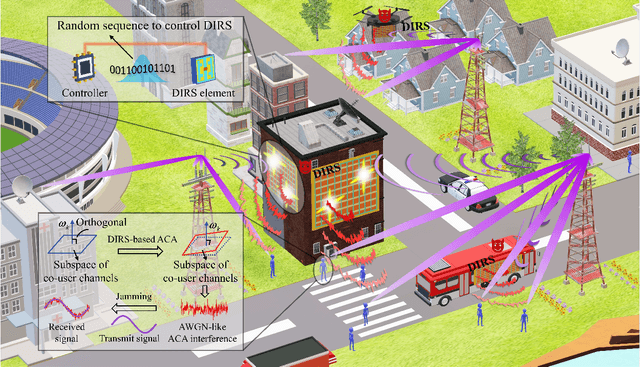
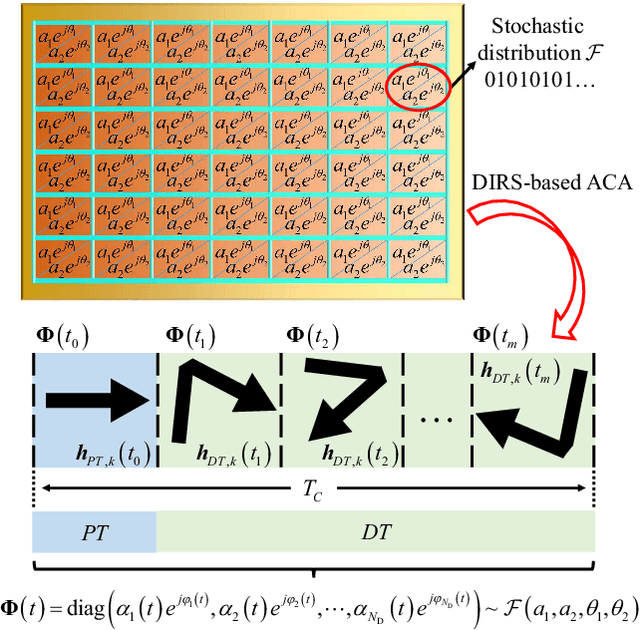
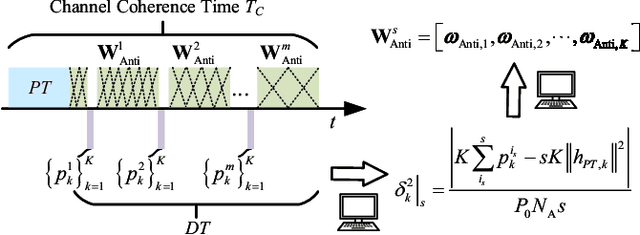
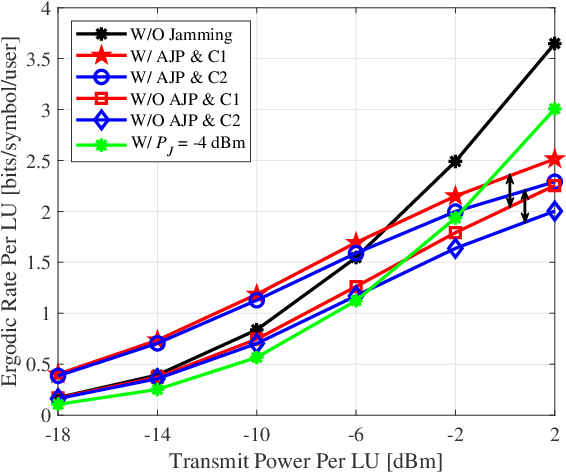
Emerging intelligent reflective surfaces (IRSs) significantly improve system performance, but also pose a signifcant risk for physical layer security (PLS). Unlike the extensive research on legitimate IRS-enhanced communications, in this article we present an adversarial IRS-based fully-passive jammer (FPJ). We describe typical application scenarios for Disco IRS (DIRS)-based FPJ, where an illegitimate IRS with random, time-varying reflection properties acts like a "disco ball" to randomly change the propagation environment. We introduce the principles of DIRS-based FPJ and overview existing investigations of the technology, including a design example employing one-bit phase shifters. The DIRS-based FPJ can be implemented without either jamming power or channel state information (CSI) for the legitimate users (LUs). It does not suffer from the energy constraints of traditional active jammers, nor does it require any knowledge of the LU channels. In addition to the proposed jamming attack, we also propose an anti-jamming strategy that requires only statistical rather than instantaneous CSI. Furthermore, we present a data frame structure that enables the legitimate access point (AP) to estimate the statistical CSI in the presence of the DIRS jamming. Typical cases are discussed to show the impact of the DIRS-based FPJ and the feasibility of the anti-jamming precoder. Moreover, we outline future research directions and challenges for the DIRS-based FPJ and its anti-jamming precoding to stimulate this line of research and pave the way for practical applications.
Anti-Jamming Precoding Against Disco Intelligent Reflecting Surfaces Based Fully-Passive Jamming Attacks
Aug 30, 2023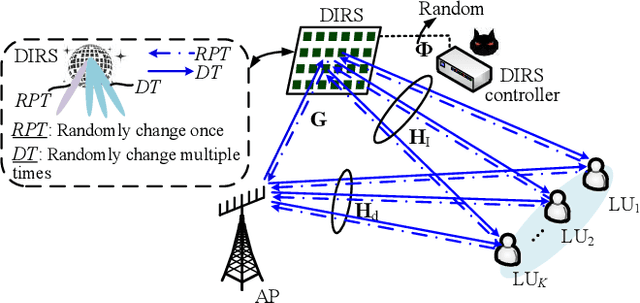
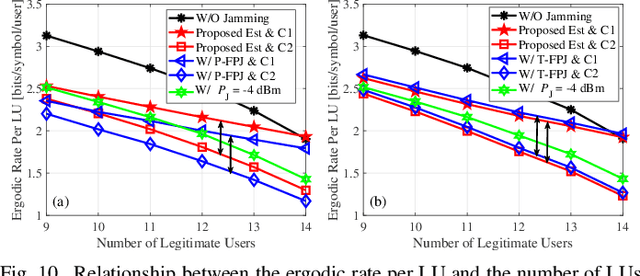
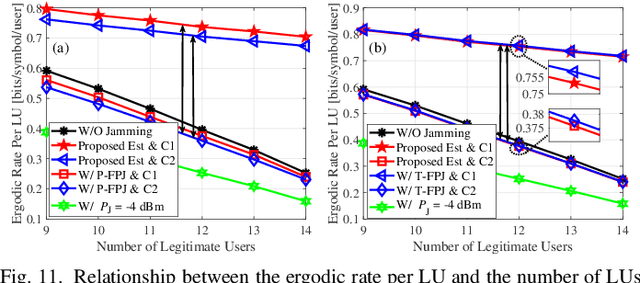
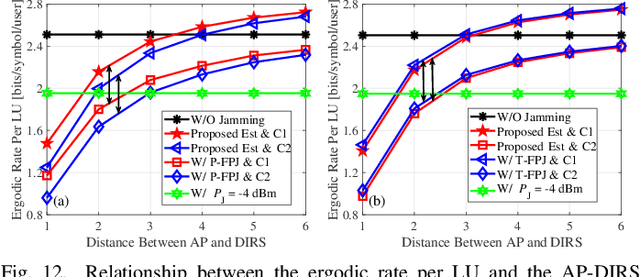
Emerging intelligent reflecting surfaces (IRSs) significantly improve system performance, but also pose a huge risk for physical layer security. Existing works have illustrated that a disco IRS (DIRS), i.e., an illegitimate IRS with random time-varying reflection properties (like a "disco ball"), can be employed by an attacker to actively age the channels of legitimate users (LUs). Such active channel aging (ACA) generated by the DIRS can be employed to jam multi-user multiple-input single-output (MU-MISO) systems without relying on either jamming power or LU channel state information (CSI). To address the significant threats posed by DIRS-based fully-passive jammers (FPJs), an anti-jamming precoder is proposed that requires only the statistical characteristics of the DIRS-based ACA channels instead of their CSI. The statistical characteristics of DIRS-jammed channels are first derived, and then the anti-jamming precoder is derived based on the statistical characteristics. Furthermore, we prove that the anti-jamming precoder can achieve the maximum signal-to-jamming-plus-noise ratio (SJNR). To acquire the ACA statistics without changing the system architecture or cooperating with the illegitimate DIRS, we design a data frame structure that the legitimate access point (AP) can use to estimate the statistical characteristics. During the designed data frame, the LUs only need to feed back their received power to the legitimate AP when they detect jamming attacks. Numerical results are also presented to evaluate the effectiveness of the proposed anti-jamming precoder against the DIRS-based FPJs and the feasibility of the designed data frame used by the legitimate AP to estimate the statistical characteristics.