 Add to Chrome
 Add to Firefox
 Add to Edge
A Systematic Evaluation of Imbalance Handling Methods in Biomedical Binary Classification
May 13, 2026
Objective: The primary goal of this study was to systematically examine the impact of commonly used imbalance handling methods (IHMs) on predictive performance in biomedical binary classification, considering the interplay between model complexity and diverse data modalities. Material and Methods: We evaluated five representative IHMs: random undersampling (RUS), random oversampling (ROS), SMOTE, re-weighting (RW), and direct F1-score optimization (DMO), against a raw training (RAW) baseline. The evaluation encompassed three public biomedical datasets: MIMIC-III (tabular), ADE-Corpus-V2 (text), and MURA (image), spanning three common biomedical data modalities. To assess varying model complexity, we employed a range of architectures, from classical logistic regression and random forest to deep neural networks, including multilayer perceptron (MLP), BiLSTM, BERT, DenseNet, and DINOv2. Results: For simpler models such as logistic regression on tabular data, IHMs yielded no significant advantage over the RAW baseline, aligning with prior findings. However, clear benefits were observed for more complex models and unstructured data: (a) ROS and RW consistently enhanced the performance of powerful models; (b) direct F1-score optimization demonstrated utility primarily for unstructured text and image data; and (c) RUS and SMOTE consistently degraded performance and are therefore not recommended. Conclusion: The effectiveness of IHMs depends on both model complexity and data modality. Performance gains are most pronounced when leveraging appropriate IHMs, such as ROS, RW, and DMO, on high-complexity models.

A Robust Probability-based Joint Registration Method of Multiple Point Clouds Considering Local Consistency
Sep 15, 2024
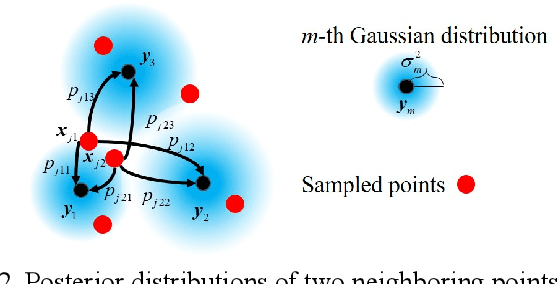
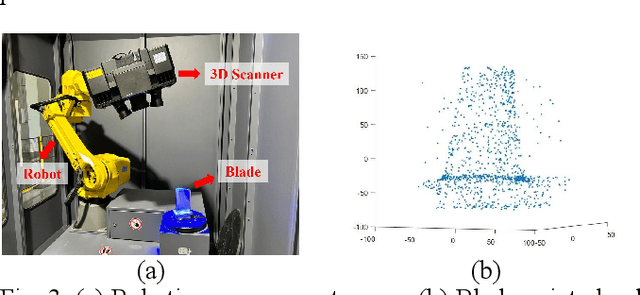
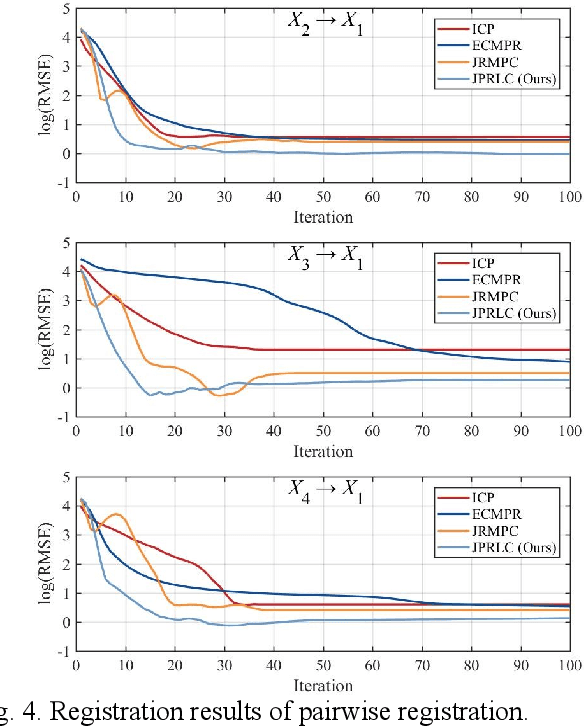
In robotic inspection, joint registration of multiple point clouds is an essential technique for estimating the transformation relationships between measured parts, such as multiple blades in a propeller. However, the presence of noise and outliers in the data can significantly impair the registration performance by affecting the correctness of correspondences. To address this issue, we incorporate local consistency property into the probability-based joint registration method. Specifically, each measured point set is treated as a sample from an unknown Gaussian Mixture Model (GMM), and the registration problem is framed as estimating the probability model. By incorporating local consistency into the optimization process, we enhance the robustness and accuracy of the posterior distributions, which represent the one-to-all correspondences that directly determine the registration results. Effective closed-form solution for transformation and probability parameters are derived with Expectation-Maximization (EM) algorithm. Extensive experiments demonstrate that our method outperforms the existing methods, achieving high accuracy and robustness with the existence of noise and outliers. The code will be available at https://github.com/sulingjie/JPRLC_registration.
Robust Point Cloud Registration in Robotic Inspection with Locally Consistent Gaussian Mixture Model
Jul 24, 2024In robotic inspection of aviation parts, achieving accurate pairwise point cloud registration between scanned and model data is essential. However, noise and outliers generated in robotic scanned data can compromise registration accuracy. To mitigate this challenge, this article proposes a probability-based registration method utilizing Gaussian Mixture Model (GMM) with local consistency constraint. This method converts the registration problem into a model fitting one, constraining the similarity of posterior distributions between neighboring points to enhance correspondence robustness. We employ the Expectation Maximization algorithm iteratively to find optimal rotation matrix and translation vector while obtaining GMM parameters. Both E-step and M-step have closed-form solutions. Simulation and actual experiments confirm the method's effectiveness, reducing root mean square error by 20% despite the presence of noise and outliers. The proposed method excels in robustness and accuracy compared to existing methods.